

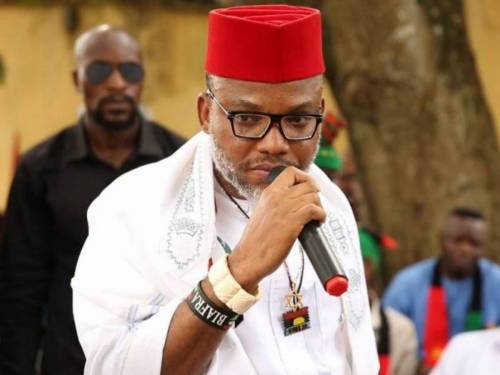
The detained leader of the proscribed Indigenous People of Biafra (IPOB), Nnamdi Kanu, has renewed his challenge to the authority of Nigerian courts to try him, declaring that his prosecution is unconstitutional and politically orchestrated.
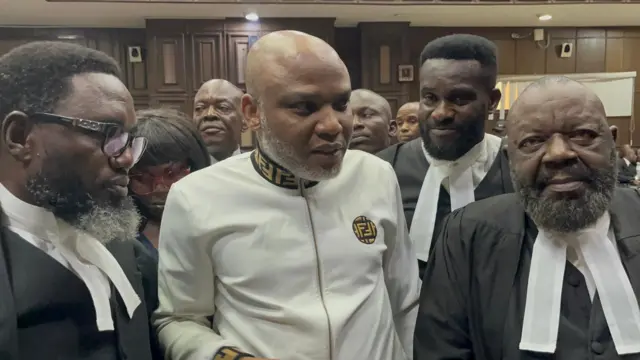
Speaking during a brief interaction with journalists at the Federal High Court in Abuja, Kanu accused the judiciary of “selective justice,” alleging that parts of the Supreme Court’s 2023 ruling favourable to him are being ignored.
“Nigerian court has no jurisdiction to try me,” he said. “If the judgment should be implemented, it must be implemented wholly — not selectively.”
READ ALSO: Live Bullets Released on #FreeNnamdiKanuNow Protesters in Abuja
His renewed declaration has revived one of the most polarizing legal battles in Nigeria’s modern history, a case that pits constitutional process against national security, and public protest against judicial restraint.
Jurisdiction and the Heart of the Legal Dispute
At the nucleus of Kanu’s argument is a question of jurisdiction and legality. His lawyers insist the terrorism charges brought against him are legally defective, having been filed under the Terrorism Prevention (Amendment) Act 2013, which was repealed and replaced by the Terrorism Prevention and Prohibition Act 2022.
Barrister Christopher Chidera, a constitutional lawyer, described the continued prosecution under the repealed law as “legally untenable,” warning that “you cannot prosecute a man under a law that no longer exists.”
He further contends that the venue of the trial, which is Abuja, violates Section 45 of the Federal High Court Act, which requires offences to be tried in the jurisdiction where they allegedly occurred.
“The prosecution first alleged that the acts took place in London,” Chidera said. “If so, the matter falls outside Nigerian territory and the charges collapse automatically. You cannot have jurisdiction without territorial nexus.”
Extraordinary Rendition and Due Process
The question of how Kanu was brought back to Nigeria in 2021 continues to shadow the case. His defense maintains that his transfer from Kenya was an act of extraordinary rendition, which, they argue, strips the Nigerian courts of any power to try him.
READ ALSO: Inside Anambra’s Million-naira Endorsement Wave for Soludo’s Re-Election
This view once found judicial backing when the Court of Appeal ruled in 2022 that Kanu’s abduction breached both Nigerian and international law, effectively nullifying the trial. However, the Supreme Court later overturned that decision, allowing proceedings to resume.
Despite that reversal, UK-based human rights lawyer, practicing in relation to Nigerian legal matters, Jude Njoku, maintained that the principle of due process remains unsettled. “The Supreme Court’s reasoning appears per incuriam — delivered without proper regard to precedent,” the lawyer argued. “When a court acts without jurisdiction, every subsequent proceeding becomes void.”
Njoku’s views suggest that, beyond the specific claims made by Kanu himself, there are recognized legal and policy issues relating to jurisdiction, statutory validity, location of trial, and fairness of the process.
Government’s Counter-Position: Lawful Trial and National Security
The Federal Government, however, firmly rejects the defense’s arguments, insisting that the prosecution is both lawful and necessary in the interest of national security.
Presidential media aide, Bayo Onanuga, said the government had “fully complied with due process,” urging Kanu’s lawyers to “focus on their defense in court rather than stage-managed protests in the streets.”
He accused activists of seeking to “blackmail the judiciary” through orchestrated demonstrations — a veiled reference to the nationwide #FreeNnamdiKanuNow protests organized by human rights activist and #RevolutionNow convener, Omoyele Sowore.
READ ALSO: Alleged Terrorism: NMA Panel Report Stalls Nnamdi Kanu’s Trial
Government sources maintain that Kanu was “lawfully returned” to Nigeria and that his trial must proceed “in the overriding interest of justice and national cohesion.”
According to the Federal Ministry of Justice, the state has presented sufficient evidence to sustain the charges, which include incitement, unlawful broadcasts and terrorism-related offences.
“The rule of law does not mean impunity for those who threaten the unity of the nation,” a senior ministry official said. “The courts must not be held hostage by technicalities.”
Judiciary’s Balancing Act
The judiciary now sits uneasily at the center of a volatile legal and political storm. Having reinstated the trial, the Supreme Court’s position signals a determination not to allow procedural objections to derail cases touching on terrorism or national security.
But critics say this approach risks weakening public trust in the impartiality of the courts. The trial, already having four different judges preside over different phases, reflects both the sensitivity and complexity of the proceedings.
Street Protests and Political Overtones
Beyond the courtroom, the case has ignited fierce public reactions. The #FreeNnamdiKanuNow protests, spearheaded by Omoyele Sowore, have spread across Abuja, Enugu, and Onitsha, drawing large crowds and heightened security responses.
Security forces deployed tear gas and live bullet rounds to disperse demonstrators outside the Federal Ministry of Women Affairs in Abuja, underscoring the political tension surrounding the trial.
READ ALSO: Amnesty International Condemns Crackdown on Protesters Demanding Release of Nnamdi Kanu
While supporters see the protest as a legitimate call for justice, the presidency regards it as “a calculated attempt to intimidate the judiciary.”
Human rights lawyer Inibehe Effiong, who joined the protest, dismissed claims of impropriety, saying: “There is nothing unethical about peaceful advocacy. Lawyers are not voiceless observers; they are defenders of justice both inside and outside the courtroom.”
The Analytical Divide: Law, Power and Precedent
Many commentators, like Lakan Olayiwola, Allwell Uwazurike, among others, opine that Kanu’s case has become a litmus test for Nigeria’s constitutional order. One that exposes the uneasy balance between the rule of law and state power.
Those siding with the defense argue that failure to address jurisdictional defects, extraordinary rendition, and procedural irregularities will set a dangerous precedent, by effectively legitimizing illegality when committed by the state.
Conversely, government advocates argue that national security concerns and judicial authority must prevail, lest the state appear impotent in the face of secessionist threats.
READ ALSO: Police Arrest Nnamdi Kanu’s Lawyer, Aloy Ejimakor, During Abuja Protest
“The danger,” said policy analyst Dr. Obiora Nnaji, “is that the judiciary may be bending to national security logic, which often expands executive power at the expense of the rule of law.”
What Lies Ahead
The coming months are likely to determine both the future of the trial and the credibility of Nigeria’s justice system.
There are anticipations that Kanu’s team may file fresh interlocutory appeals on jurisdiction and statute validity. The government, meanwhile, is expected to press for an accelerated hearing to bring the long-running case to a conclusion.
Beyond the verdict, however, the deeper question remains: Can the Nigerian judiciary deliver justice in a politically charged case without appearing either defiant or compliant?
