

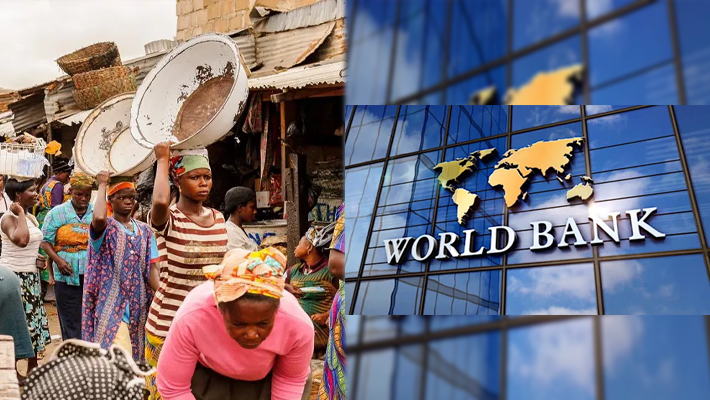
The World Bank has raised concerns over the inefficiency and poor targeting of Nigeria’s social safety net programmes, revealing that less than half of total benefits actually reach poor households despite the majority of beneficiaries being from low-income backgrounds.
In its latest report titled “The State of Social Safety Nets in Nigeria,” the global financial institution disclosed that while 56 per cent of beneficiaries of government social protection initiatives are poor, only 44 per cent of the total benefits go to those who truly need them.
According to the Bank, this disparity highlights deep structural flaws in the country’s welfare system, suggesting that Nigeria’s current social protection framework—though extensive on paper—fails to effectively reach or sustain its most vulnerable citizens.
READ ALSO: 139 Million Nigerians Still Poor Despite Economic Reforms-World Bank
“While 56 per cent of the beneficiaries are poor, only 44 per cent of the total safety net benefits go to the poor. For each programme category, the share of benefits going to the poor is lower than the share of beneficiaries that are poor,” the World Bank stated.
Programme Inefficiencies Rooted in Benefit Distribution
The report attributed these inefficiencies largely to the way benefits are allocated. In most cases, support is distributed at the household level rather than on an individual basis—an approach that disadvantages poorer families, which tend to be larger.
“This inefficiency arises because benefit levels for most programmes, including the NASSP cash transfer programme, are determined at the household level, but poor people tend to live in larger households,” the report explained. “Even for well-targeted programmes, the same benefit amount is divided over a larger number of people living in poorer households.”
School Feeding Scheme Offers a Partial Solution
The World Bank highlighted the National Home-Grown School Feeding Programme (NHGSFP) as an example of an initiative that targets individuals directly, thereby minimizing inefficiency. However, it noted that the programme’s limited coverage—focusing only on pupils in grades 1 to 3—restricts its overall impact.
READ ALSO: U.S. Retirees to Get 2.8% Social Security Increase in 2026
“Programmes such as the NHGSFP, which target individuals and not households, should be less affected by these issues. But NHGSFP only benefits children in grades 1 to 3 and does not yet have full coverage, which limits the number of children per household that can benefit from the programme,” the Bank added.
Calls for Reform and Data-Driven Coordination
Analysts have urged the Nigerian government to embark on comprehensive reforms of its social protection architecture. Recommended measures include integrating real-time data systems, improving household targeting mechanisms, and enhancing coordination between federal and state agencies.
In a related development, the International Monetary Fund (IMF) in June also expressed concern over Nigeria’s inadequate social safety nets, warning that the country lacks the necessary systems to cushion vulnerable citizens from the adverse impacts of ongoing economic reforms, including fuel subsidy removal and currency adjustments.
The Bigger Picture
Nigeria’s social protection programmes—ranging from cash transfers to food support schemes- were designed to alleviate poverty and cushion vulnerable households against economic shocks. However, the World Bank’s latest findings underscore a growing gap between policy intentions and outcomes.
READ ALSO: NSIPA Disburses ₦22.48bn to Katsina Beneficiaries, ₦344bn Nationwide Under Renewed Hope Programme
As inflation continues to erode purchasing power and poverty levels rise, experts warn that unless reforms are urgently implemented, millions of Nigerians could remain excluded from the government’s social assistance efforts.
