

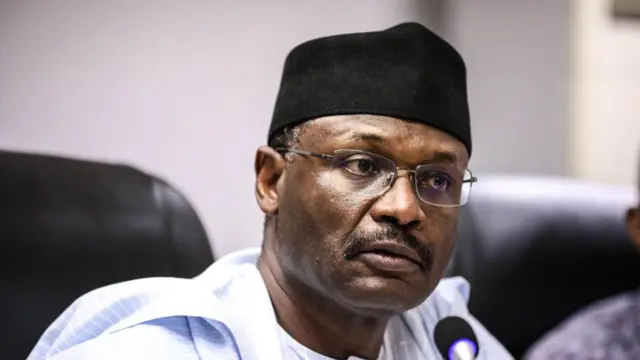
Following Professor Mahmood Yakubu’s formal exit as Chairman of the Independent National Electoral Commission (INEC), a fierce debate has erupted over who will take charge of the electoral body ahead of the 2027 general elections.
Yakubu, the 13th INEC boss, was appointed in 2015 and reappointed in 2020, making 10 years of service, the longest-serving INEC chairman in Nigeria’s history.
On Tuesday, October 7, he handed over to May Agbamuche-Mbu, a legal practitioner and National Commissioner, who now serves as Acting INEC Chairman.
President Bola Tinubu accepted Yakubu’s departure and is expected to name his successor after the Council of State meeting in Abuja on Thursday, where the list of nominees for the nation’s top electoral position will be presented.
In recognition of his service, the President conferred on Yakubu the national honour of Commander of the Order of the Niger (CON).
Regional Balance Sparks Heated Debate
The question of zoning has become central in the race for the next INEC chairman. Concerns have mounted over what many describe as a growing pattern of appointments favouring the South West, where President Tinubu hails from.
Political observers say appointing another Southerner could heighten tensions, as successive INEC chairmen have predominantly come from the North.
While the law places no restriction on the president’s choice, the unwritten convention of regional balance remains politically sensitive.
The Top Contenders
Prof. Joash Ojo Amupitan (SAN)
There are speculations that Prof. Amupitan might be the next INEC chair, as SaharaReporters learnt that to formalise the appointment, the president has scheduled a meeting of the Council of State for this Thursday.
A legal scholar from Kogi State, Professor Amupitan is widely considered one of the favourites. He is a professor of law and deputy vice-chancellor (administration) at the University of Jos, where he has lectured for more than three decades. He became a Senior Advocate of Nigeria (SAN) in 2014 and is currently Pro-Chancellor of Joseph Ayo Babalola University.
May Agbamuche-Mbu
After assuming leadership of INEC as Acting Chairman, May Agbamuche-Mbu has sparked growing speculation about her possible confirmation, as calls intensify for a female to head the electoral body.
May Agbamuche-Mbu is a seasoned legal practitioner and national commissioner at INEC.
Born in Kano to Delta parents, she holds law degrees from the University of Ife and the University of London and is qualified to practise in both Nigeria and the UK. With over 30 years of experience, she has contributed to major electoral reforms, public policy, and legal development in Nigeria.
Justice Abdullahi Mohammed Liman
A serving Justice of the Court of Appeal from Nasarawa State, Justice Liman has been linked to several politically charged cases, including rulings involving former Kano Governor Abdullahi Ganduje and the Kano Emirate tussle. Born in 1959, he began practising law in 1984 and became a judge at 42.
His name has surfaced repeatedly in political discussions, though his judicial background has attracted mixed reactions.
Prof. Lai Olurode
A retired academic and former INEC National Commissioner, Olurode is a respected sociologist from Osun State. A first-class graduate of sociology from the University of Lagos, he later earned a PhD from the University of Sussex, UK, and an LL.B from UNILAG. He served as National Commissioner overseeing Oyo, Ogun and Ekiti States.
Known for his expertise in political sociology, governance and inequality, Olurode’s name resonates among advocates for experience-driven leadership.
Sam Olumekun
The current INEC National Commissioner for Information and Voter Education, Olumekun, has extensive administrative experience. From Ondo State, he has served as Resident Electoral Commissioner (REC) in Edo and Lagos States and previously held top roles in the Ondo State civil service.
Kenneth Ukeagu
A former Director of Procurement at INEC, Ukeagu, from Abia State, is regarded as the Commission’s insider candidate. With over 30 years of service, he was appointed a national commissioner by former President Muhammadu Buhari, marking a rare instance of an internal staff member being elevated to the Commission’s board.
Prof. Bashiru Olamilekan
Although earlier speculation about his appointment turned out false, Olamilekan remains a name under consideration. His academic and administrative background makes him a potential technocratic choice.
Political and Opposition Reactions
The selection process has already attracted criticism from opposition figures. NNPP chieftain Alhaji Buba Galadima warned that appointing a “controversial” figure could provoke unrest.
Similarly, Rauf Aregbesola, National Secretary of the African Democratic Congress (ADC), said the current system of appointing the INEC chairman and commissioners “lacks transparency and public trust”.
“He Promised So Much, Delivered So Little”
Legal practitioner and rights advocate Frank Tietie criticised Yakubu’s tenure, describing it as “a huge disappointment” despite the Commission’s financial independence.
“He promised so much and delivered so little. Nigerians did him well, but the legacy he leaves behind is one of disappointment,” Tietie said in an interview on Arise Television and monitored by Pinnacle Daily.
RELATED STORIES:
- Profile: Things to Know About New INEC Acting Chairman, May Agbamuche-Mbu
- Yakubu Hands Over INEC Leadership to Agbamuche-Mbu as Acting Chairman
- Fix INEC Before 2027, Soludo, Dauda, Aregbesola, Chidoka Tell FG
- INEC Reports 6.2m Voter Registrations, Majorly Youths, Students
He noted that the failure of the electronic transmission of results during the 2023 general elections “eroded public confidence” and urged the president to appoint a woman to head the commission, arguing that “female administrators often show greater integrity.”
“He Who Pays the Piper Dictates the Tune”
Professor Abubakar Umar Kari, a political sociologist at the University of Abuja, has called for an end to presidential control over appointments into the Independent National Electoral Commission (INEC), saying it undermines electoral integrity.
In an interview with Pinnacle Daily, Prof. Kari warned that allowing the president to appoint the INEC Chairman, National Commissioners, and Resident Electoral Commissioners “is very dangerous for democracy”.
“He who pays the piper dictates the tune. The executive should not appoint INEC officials. A neutral body, possibly involving the Chief Justice and other stakeholders, should handle this,” he said.
He accused the Senate of clearing nominees who are often card-carrying members of ruling parties despite evidence presented during screening.
Prof. Kari insisted that only a non-partisan, independent body should oversee such appointments to restore public confidence in Nigeria’s elections.
What History Reveals
A review of past appointments shows that successive governments have largely respected regional diversity in choosing INEC chairmen. Tafawa Balewa’s administration had Eyo Ita Esua (South-South); Shehu Shagari appointed Michael Ani (South-East) and Victor Ovie-Whisky (South-South); Olusegun Obasanjo named Ephraim Akpata and Abel Guobadia (both South-South) and Maurice Iwu (South-East).
Goodluck Jonathan appointed Attahiru Jega (North-West), while Muhammadu Buhari appointed Mahmood Yakubu (North-East).
As the Council of State meets this week, all eyes are on President Tinubu’s next move. The appointment will not only shape INEC’s internal direction but also determine public trust in Nigeria’s democratic process.

Rafiyat Sadiq is a political, justice, and human rights reporter with Pinnacle Daily, known for fearless reporting and impactful storytelling. At Pinnacle Daily, she brings clarity and depth to issues shaping governance, democracy, and the protection of citizens’ rights.