Nigeria has used the 81st United Nations General Assembly (UNGA) in New York to push for major changes to global institutions, greater access to development finance and stronger representation for Africa in international decision-making. Vice-President Kashim Shettima, representing President Bola Tinubu, delivered Nigeria’s national statement on Thursday, calling for reforms spanning the UN Security Council, …
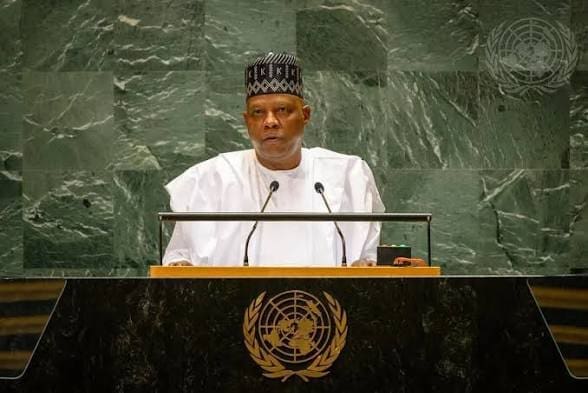
Nigeria has used the 81st United Nations General Assembly (UNGA) in New York to push for major changes to global institutions, greater access to development finance and stronger representation for Africa in international decision-making.
Vice-President Kashim Shettima, representing President Bola Tinubu, delivered Nigeria’s national statement on Thursday, calling for reforms spanning the UN Security Council, climate finance, artificial intelligence, debt, trade, security and international peace efforts.
The demands came as African leaders at the assembly continued to raise concerns over the continent’s debt burden, access to critical resources, international law and the need to reform global institutions.
Pinnacle Daily had earlier reported that the 81st UN General Assembly is being held under the theme, ‘Restoring trust, managing transformation: A United Nations that delivers for all.’
The high-level general debate runs from September 22 to September 28, 2026.
Here are the eight major demands and positions Nigeria presented at the assembly.
1. Two permanent UN Security Council seats for Africa
Nigeria called for the restructuring of the UN Security Council to reflect the current distribution of global power, rather than the structure established in 1945.
Nigeria demanded at least two permanent seats for Africa, with the full rights and responsibilities of permanent membership, including veto power, as long as the veto exists. It also called for five non-permanent African seats in total.
“The reform of this institution must begin with the reconstitution of the Security Council, for the world of 2026 cannot remain captive to the distribution of power in 1945,” Shettima said.
“Africa cannot continue to fill the council’s agenda while remaining absent from its permanent membership.”
The demand is consistent with Nigeria’s longstanding position under the Ezulwini Consensus, the common African position on UN Security Council reform. UN records also show Nigeria has continued to support at least two permanent African seats with full privileges, including the veto.
2. Reform of the international financial system
Nigeria called for changes to the international financial architecture to give developing countries wider access to affordable financing and debt arrangements that take their development needs into account.
The country also backed wider use of concessional financing, offered on more favourable terms than normal commercial borrowing, as well as private capital, blended finance, and partnerships between developing countries.
READ ALSO:
- Reform Gains Must Translate Into Jobs, Welfare, Accountability, CPPE, Alliance Urge
- UNGA 81: Shettima, African Leaders Demand Debt Relief, Reforms
- Sahara Group Seeks Global Capital for Africa’s Growth
- How $120m TEF Funding Created 1.5m Jobs Across Africa
- Nigeria’s Economic Growth to Rebound in Q4 as Inflation, Fiscal Risks Persist
“One of the greatest obstacles to sustainable development is inadequate financing,” Shettima said.
“Many developing countries devote substantial resources to debt servicing at the expense of education, healthcare, and infrastructure.”
Nigeria therefore called for debt sustainability frameworks that recognise developmental needs and greater access to financing for sustainable development, climate adaptation and resilient infrastructure.
3. More predictable climate finance for developing countries
Nigeria rejected what it described as a choice between economic development and climate action, arguing that developing countries need to industrialise, reduce poverty and expand access to energy while cutting emissions.
Shettima said developing countries should receive technology transfers, capacity building and climate finance to support that transition.
Nigeria said it remains committed to the Paris Agreement and its goal of reaching net-zero emissions by 2060 while expanding access to affordable and reliable energy.
Its approach includes renewable energy, clean cooking and gas as a transitional fuel, alongside climate-smart agriculture and nature-based solutions.
Nigeria also called for climate finance to be based on equity and shared responsibility rather than charity, with international commitments translated into funding that is accessible, predictable and adequate.
4. Global cooperation on artificial intelligence
Nigeria called for international cooperation to ensure artificial intelligence is used to improve lives rather than deepen global risks.
Shettima said Nigeria was investing in digital public infrastructure, broadband connectivity, innovation systems, research institutions and technology entrepreneurship.
“We can deploy artificial intelligence to wage war or use it to transform healthcare, agriculture, governance, and economic productivity,” he said.
Nigeria invited international partners to work with its young people to use AI for development and economic productivity.
The issue comes as AI governance has become a major subject at the 81st General Assembly, with the UN also highlighting the rapid development of the technology as one of the challenges facing the international system.
5. Greater use of AfCFTA to drive African industrialisation
Nigeria called for stronger implementation of the African Continental Free Trade Area, or AfCFTA, the continental framework designed to increase trade among African countries.
Shettima said the agreement could strengthen regional supply chains, increase trade within Africa, promote industrialisation and attract investment.
Nigeria also called for Africa to move beyond exporting largely unprocessed raw materials and instead expand manufacturing, technological innovation and knowledge-based industries.
“Our abundant natural resources must become engines of shared prosperity rather than sources of perpetual dependency,” he said.
6. Stronger international cooperation against terrorism and organised crime
Nigeria called for greater cooperation against terrorism, organised crime, cyber attacks and illicit finance, which refers to money linked to illegal activities or moved through unlawful channels.
Drawing on Nigeria’s experience fighting Boko Haram, ISWAP and other armed groups, Shettima said military action alone was insufficient to achieve lasting security.
He called for greater intelligence sharing, stronger institutions, disruption of terrorist financing and tighter action against the movement of illegal weapons across borders.
Nigeria also urged stronger regional cooperation to address insecurity in the Sahel, where instability in one country can affect neighbouring states through displacement, cross-border crime and disruption of regional integration.
7. Urgent diplomacy and protection of civilians in conflicts
Nigeria called for peaceful settlements to conflicts, including the war in Sudan, and urged all parties to comply with international humanitarian and human rights law.
Shettima said civilians must be protected and humanitarian assistance allowed to reach people affected by conflict.
“Negotiated settlements must respect sovereignty and territorial integrity,” he said.
He also argued that military victories alone cannot guarantee lasting peace, calling instead for dialogue, reconciliation and inclusive political processes.
Nigeria urged the UN to devote greater resources to peacebuilding, mediation and institution building, with greater emphasis on preventing conflicts before they escalate.
8. Stronger representation for developing countries in global decisions
Beyond the Security Council, Nigeria called for a broader transformation of international institutions so that developing countries have a stronger voice in decisions affecting the global economy, security and development.
Shettima argued that developing countries should be treated as indispensable partners in finding global solutions rather than primarily as recipients of assistance.
“A reformed, inclusive, and effective United Nations is indispensable to the peaceful, just, and sustainable world that future generations deserve,” he said.
Nigeria’s position reflects the wider African push for reforms to global institutions, including changes to international financing arrangements and decision-making structures.
The country has previously argued that UN institutions must reflect current global realities rather than the balance of power that existed when the organisation was established.

Alex is a business journalist cum data enthusiast with the Pinnacle Daily. He can be reached via ealex@thepinnacleng.com, @ehime_alex on X