

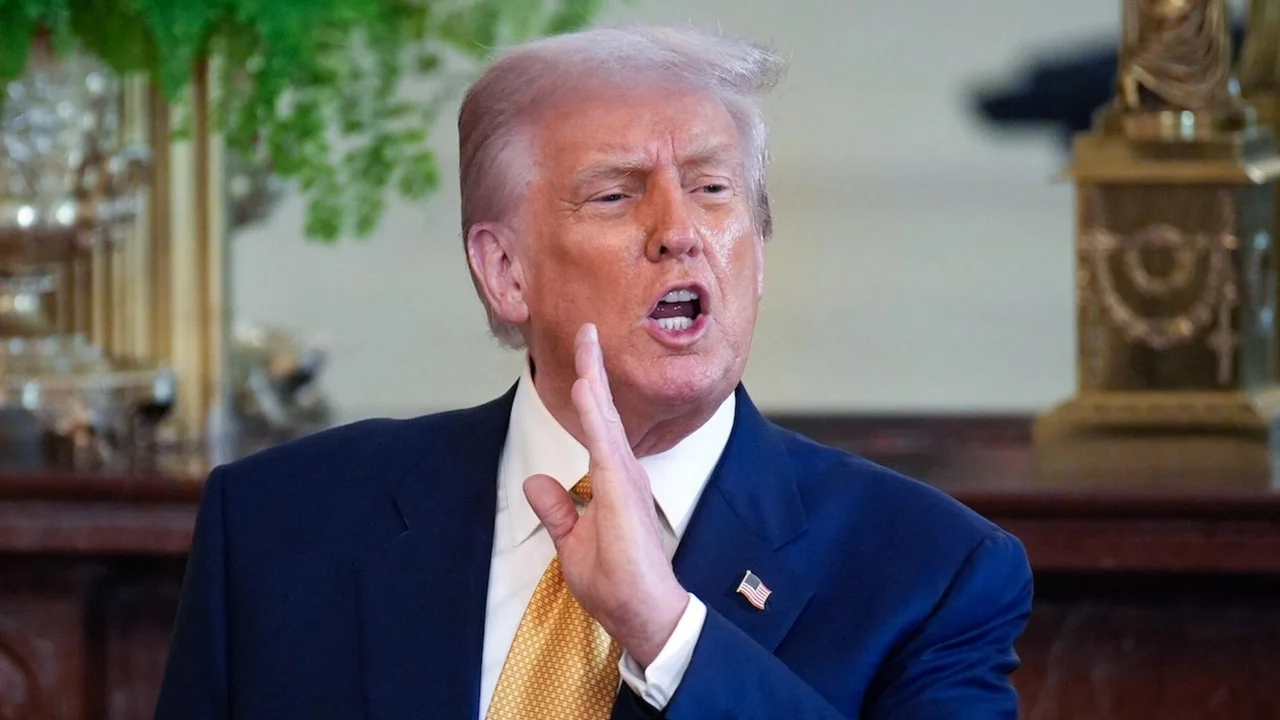
President Donald Trump has reduced the number of refugees to be admitted into the United States to 7,500 for the 2026 fiscal year which is the lowest cap in U.S. history, while giving priority to white South Africans, particularly Afrikaners, under a new Executive Order.
The drastic reduction, announced on Thursday via the Federal Register, represents a drop of more than 117,000 from the 125,000 refugee admissions target set under former President Joe Biden.
According to the determination, refugee admissions are “justified by humanitarian concerns or are otherwise in the national interest” and “shall primarily be allocated among Afrikaners from South Africa pursuant to Executive Order 14204.”
Executive Order 14204: Focus on White South African Refugees
Executive Order 14204, signed in February 2025, accuses the South African government of “unjust racial discrimination” against minority Afrikaners, citing farm attacks and land expropriation without compensation.
READ ALSO: Trump, South Korea Seal $350bn Trade, Investment Deal during Asia Tour
The order instructs U.S. agencies to prioritize Afrikaners as refugees “escaping government-sponsored race-based discrimination.” Though South Africa’s government vehemently denies this claim.
President Trump described the move as a “moral obligation” to protect persecuted minorities. In February, he also suspended aid to South Africa, citing alleged violence against white farmers.
Diplomatic Tensions Between Washington and Pretoria
The decision has sparked a sharp diplomatic fallout.
South Africa’s foreign ministry condemned the move as “politically motivated and based on misinformation.” saying it sought to “undermine South Africa’s democracy and social cohesion.”
Relations deteriorated further in March when Washington expelled South Africa’s ambassador, Ebrahim Rasool.
In a subsequent Oval Office meeting in May, President Trump reportedly confronted South African President Cyril Ramaphosa over alleged attacks on white farmers, claims that Pretoria insists are exaggerated and racially divisive.
Record Low Refugee Cap Draws Global Criticism
Humanitarian organisations and migration experts have criticised the record-low cap as a departure from the United States’ traditional humanitarian commitments.
“This policy undermines America’s credibility as a global protector of displaced people,” said Becca Heller, executive director of the International Refugee Assistance Project (IRAP). “It effectively prioritizes one ethnic group while thousands of families fleeing war and persecution are shut out.”
READ ALSO: U.S. Eases Tariffs as China Pledges Crackdown on Fentanyl, Rare Earths Exports
Analysts note that the 7,500-person ceiling redefines refugee admissions as a tool of foreign policy rather than a humanitarian obligation — a trend seen throughout Trump’s second term.
A Major Shift in U.S. Humanitarian Policy
Experts argue that the Trump’s administration is reorienting refugee resettlement around “national interest” rather than humanitarian need.
“By reserving such a small quota and assigning most of it to one group, the U.S. is signaling that refugee policy is now a political instrument,” said Dr Eleanor Hayes, a political analyst at Georgetown University. “It’s a profound shift away from the bipartisan consensus that has guided refugee policy for decades.”
Under the Biden administration, the U.S. resettled refugees from countries such as Syria, Afghanistan, Sudan, and Myanmar. Many of those applicants are now expected to face long delays or rejection under the new system.
Legal and Political Challenges Loom
The move is expected to face legal scrutiny and congressional pushback.
Under the Refugee Act of 1980, the president must consult with Congress before determining annual refugee limits — a step that critics say was bypassed.
Democratic lawmakers have already described the policy as “racially selective” and “a breach of international humanitarian norms.” Advocacy groups are reportedly preparing to challenge the policy in U.S. federal courts.
Impact on Global Refugee Flows
International observers warn that the policy could have wider global repercussions, as fewer refugees from conflict zones will now have access to U.S. resettlement programmes.
Countries such as Jordan, Kenya, and Bangladesh, which host millions of displaced people, are likely to feel the strain as fewer refugees are resettled abroad.
READ ALSO: Soyinka Breaks Silence on U.S. Visa Revocation
“This sends a troubling signal,” said a United Nations refugee agency official. “It tells host countries that the United States no longer intends to share the burden.”
Domestic Reactions and Political Implications
The policy has divided U.S. opinion.
Conservative groups and Trump’s political allies have praised the move as a “pro-Western humanitarian policy,” while opponents view it as racially exclusionary and inconsistent with American values.
Far-right commentators have hailed the decision as evidence that the U.S. is “protecting Western civilization,” while civil rights groups warn it emboldens extremist narratives at home and abroad.
Trump’s decision to slash refugee admissions and prioritize white South Africans marks a historic shift in U.S. immigration and humanitarian policy.
By combining a record-low refugee ceiling with an explicitly racialized preference, the administration has redefined the country’s approach to asylum, one that analysts say will test both America’s moral standing and its diplomatic credibility on the world stage.
