

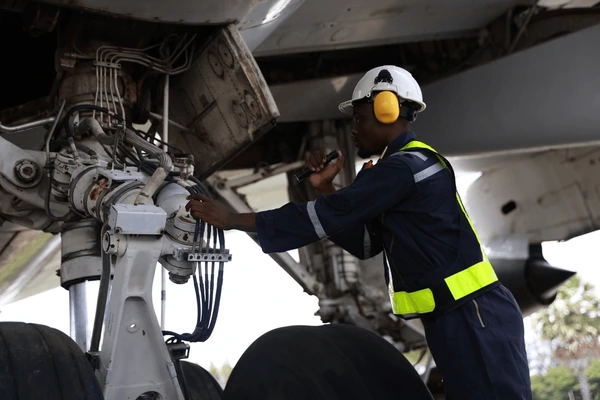
Nigerian airlines have spent an estimated US$5 billion (N7.5 trillion at N1500 per $) on aircraft maintenance abroad over the past five years, as they continue to ferry their fleets to other countries for major maintenance, particularly the extensive “C-checks”.
The absence of a fully equipped domestic Maintenance, Repair and Overhaul (MRO) facility capable of handling category C-checks remains a critical barrier to local industry growth.
Maintenance Costs and Flights to Foreign MROs
Industry investigations show that domestic carriers in Nigeria are compelled to send aircraft to facilities in Ethiopia, Italy, Morocco, Egypt, the United Arab Emirates and South Africa for heavy maintenance.
These C-checks, which involve stripping major systems such as engines, avionics and landing gear, typically occur every 12 to 18 months and cost between US$4 million and US$6 million per aircraft, excluding ferrying and related expenses.
READ ALSO: Dangote Refinery Backs 15% Fuel Import Tax, Pushes Against Substandard Products
A former rector of the Nigeria College of Aviation Technology (NCAT), Capt. Samuel Caulcrick, estimates Nigerian carriers spend around US$1 billion annually on overseas maintenance.
Earlier data confirms significant capital flight. In 2021, the Federal Airports Authority of Nigeria (FAAN) revealed the country lost over US$2.5 billion to foreign MROs.
Domestic Capacity – Present-Day Gaps
While Nigeria does host a few MRO outfits, their scope is limited. For example, local firms can typically do line maintenance or lighter checks—but not full C-checks on larger aircraft. A cited article observed, “Existing hangars in Nigeria do not have capacity and cannot attend to many aircraft at the same time.”
According to Capt. Mohammed Gbadamasi (former Chief Pilot of the defunct ADC Airline), one major constraint is manpower: “Some airlines had the capacity for C-Checks on their aircraft, but they lacked the manpower capacity to effectively carry out the maintenance.”
He added that the old national carrier’s hangar and the air force hangar, in collaboration with local operator Aero Contractors, could be pooled to create a robust MRO facility. Without such co-operation, “the only solution is to have a well-equipped hangar in the country that can effectively carry out maintenance on all aircraft up to category C-check.”
Economic and Regulatory Consequences
The reliance on overseas MROs has a number of knock-on effects:
-
Heavy outflow of foreign exchange, placing additional strain on the naira and reserves.
-
Increased costs for airlines, which must shoulder not only the maintenance bill but also ferry costs, downtime and revenue losses. (Some reports estimate that downtime while waiting for overseas MRO slots can run into days, translating into lost revenue.)
-
Constraints on fleet growth: The local carriers’ operational viability is hampered if maintenance planning is reactive and expensive.
-
Reduced competitiveness regionally: Analysts argue Nigeria could have leveraged its labour cost advantage by developing an MRO hub but has so far not fully done so.
Capt. Caulcrick urged the Nigeria Civil Aviation Authority (NCAA) to introduce policy reforms, such as making it a condition of an airline’s Air Operator Certificate (AOC) renewal to identify a local MRO partner to compel greater utilisation of domestic maintenance facilities.
Investment and Future Outlook
There are signs that change could be on the horizon. For example, the domestic carrier Air Peace has announced plans to construct a state-of-the-art MRO facility at the Murtala Muhammed International Airport in Lagos, covering some 32 000 m², including a hangar, warehouse and workshops. The project aims to service Nigerian and other African airlines alike.
READ ALSO: of Particular Concern: Understanding Kukah’s Call for Dialogue Over Punishment
Industry observers suggest that if Nigeria builds a world-class MRO facility and develops local manpower, substantial savings could be realised; estimates range from hundreds of millions of dollars per annum in diverted maintenance spend.
Challenges Remain
Despite the potential, major hurdles remain:
-
The cost of establishing full-scale heavy maintenance hangars is high and requires government commitment.
-
Certification hurdles: Local MROs often lack accreditation from international regulators (e.g., EASA, FAA), which limits their ability to attract foreign customers or service leased aircraft.
-
Foreign exchange and spare-parts importation: Even local labour cost advantages are offset by the fact that many parts and tooling must be imported in foreign currency, so a weak naira undermines cost benefits.
-
Skilled manpower: There remains a shortage of trained engineers and technicians, combined with the risk of brain drain to better-paid markets abroad.
READ ALSO: Trump Threatens Military Action, Aid Stoppage to Nigeria over Treatment of Christians
With Nigerian airlines reportedly spending US$1 billion or more each year on overseas aircraft maintenance and a cumulative outflow over five years estimated at US$5 billion, the argument for investing in local heavy-maintenance capacity is compelling.
Building a modern MRO facility, complemented by policy reform, certification upgrades and manpower development, would not only keep billions of dollars within the economy but also position Nigeria as a regional aviation maintenance hub. Without swift action, however, the country risks continuing the same costly pattern and weakening the competitiveness of its aviation sector.
