

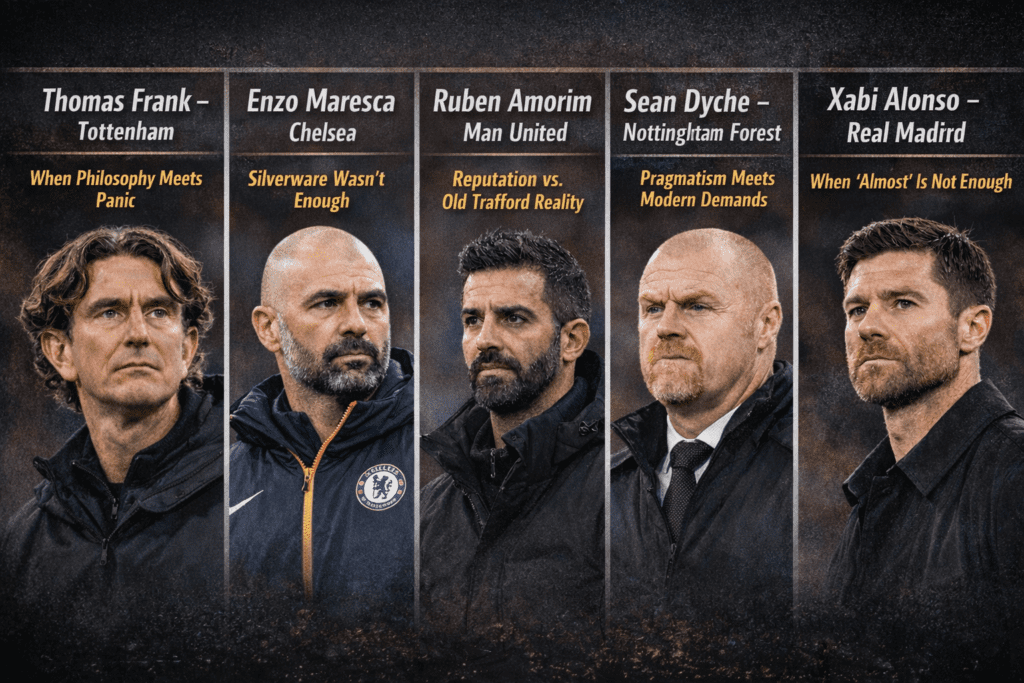
The 2026 football calendar is barely underway, yet the managerial carousel is already spinning at full speed. Across Europe’s elite leagues, impatience has become the dominant currency.
Reputation offers no shield. Silverware provides no immunity. Even long-term “projects” now operate on short-term tolerance.
In just weeks, five high-profile managers have lost their jobs, each exit telling a deeper story about modern football’s unforgiving culture, shifting boardroom priorities, and the shrinking lifespan of managerial trust.
Here is an in-depth look at the five managerial casualties of 2026 and what their dismissals truly signal.
Thomas Frank – Tottenham Hotspur
When Philosophy Meets Panic
Thomas Frank arrived at Tottenham with a reputation for structure, intelligence, and progressive football. His Brentford tenure had painted him as one of England’s most tactically astute minds.
But at Spurs, theory collided with reality.
A turbulent run left Tottenham just five points above the relegation zone — a statistic that rattled a fanbase accustomed to European ambitions. Performances lacked cohesion. Defensive frailties persisted. Confidence drained quickly.
The board acted before the crisis turned catastrophic.
Frank’s dismissal highlights a brutal truth: clubs chasing Champions League dreams have no appetite for transitional seasons. Attractive football matters, but survival and momentum matter more.
Enzo Maresca – Chelsea
Silverware Wasn’t Enough
Few managerial sackings in recent memory have been as paradoxical as Enzo Maresca’s.
The Italian lifted both the Europa Conference League and the FIFA Club World Cup with Chelsea. On paper, that reads like success.
Yet domestic inconsistency proved fatal.
One win in seven league matches triggered alarm bells. Behind the scenes, reports suggested tension between Maresca and the club hierarchy over transfers and squad direction.
Chelsea’s decision reflects a modern reality: trophies buy goodwill, but league stability secures jobs. In a club still rebuilding its identity, patience remains scarce.
Ruben Amorim – Manchester United
Reputation vs. Old Trafford Reality
Ruben Amorim arrived at Manchester United with enormous credibility. His success in Portugal had marked him as one of Europe’s brightest tactical innovators.
But Old Trafford has devoured bigger reputations.
READ ALSO:
- NIS Upgrades Passport Tracking System to Curb Delays
- FG Issues 3.5m Passports in 2 Years, Saves ₦1Bn from Reforms
- Football, Flights, Free E-Visas, How To Turn AFCON 2025 into a Passport Booster
- SWAN Urges Super Eagles to Stay Calm, Focused Ahead of AFCON Quarter-finals
United sat sixth in the Premier League when the axe fell. In isolation, that position was not disastrous. However, inconsistent performances in major fixtures and internal disputes with the recruitment department eroded confidence.
Sources cited friction over transfer strategy and squad alignment, a familiar narrative at United.
Amorim’s dismissal underlines a pattern: managerial authority at elite clubs now extends only as far as alignment with the boardroom. Tactical vision alone is insufficient.
Sean Dyche – Nottingham Forest
Pragmatism Meets Modern Demands
Sean Dyche was appointed to bring structure, discipline, and survival expertise to Nottingham Forest.
Instead, Forest drifted into danger.
A prolonged winless run left the club staring at relegation anxiety. While Dyche’s defensive blueprint offered organisation, Forest struggled to generate attacking momentum. In today’s Premier League, survival requires adaptability as much as resilience.
The club opted for change before the relegation battle intensified.
Dyche’s exit illustrates a shift in expectations. Even teams fighting at the bottom now demand evolution, not just stability.
Xabi Alonso – Real Madrid
When ‘Almost’ Is Not Enough
The most shocking dismissal of 2026 came in Madrid.
Xabi Alonso, admired for his tactical intelligence and composure, appeared to be building something promising. Real Madrid sat second in La Liga and remained competitive in Europe.
But “competitive” does not define success at the Santiago Bernabéu.
Inconsistency in key European fixtures raised doubts. The club responded swiftly, promoting reserve team coach Álvaro Arbeloa.
Alonso’s departure reinforces a Madrid principle: proximity to excellence is not excellence. At Europe’s most demanding institutions, margins are microscopic.
What connects these five sackings?
- Immediate Results Trump’s Long-Term Vision
Clubs speak of projects but operate on urgency. - Boardroom Alignment Is Crucial
Internal disputes now end careers as quickly as poor form. - Fan Pressure Accelerates Decisions
Social media amplifies unrest and shortens tolerance cycles. - Elite Football Has No Safe Zones
Even trophies (Maresca) and second-place finishes (Alonso) offer no guarantees.
In 2026, managerial security lasts weeks, not seasons.
History suggests the carousel is far from stopping. Europe’s top leagues are more competitive than ever. Financial stakes are enormous. Qualification for continental competitions can determine budgets and future planning. For managers, the margin between progress and dismissal grows thinner each month. Five have already fallen. And the year has only just begun.

Esther Ososanya is an investigative journalist with Pinnacle Daily, reporting across health, business, environment, metro, Fct and crime. Known for her bold, empathetic storytelling, she uncovers hidden truths, challenges broken systems, and gives voice to overlooked Nigerians. Her work drives national conversations and demands accountability one powerful story at a time.