

The 2025 financial year has revealed a clear shift in where growth is coming from for two of Nigeria’s most valuable banks — Zenith Bank Group and Guaranty Trust Holding Company (GTCO).
A review of their 2025 audited financial results revealed that while home operations in Nigeria and some developed markets like the United Kingdom (UK) showed mixed or even declining results, their subsidiaries across Africa delivered strong and, in some cases, explosive profit growth.
Across both groups, a common pattern emerges as their subsidiaries in West Africa, particularly Ghana, Sierra Leone, and The Gambia, have become the main engines of expansion.
These markets, once seen as smaller contributors, are now driving earnings momentum and reshaping the geographic balance of profits.
In this report, Pinnacle Daily examines how both banks’ subsidiaries performed, what drove their growth, and what it means for their overall financial position.
Zenith Bank Subsidiaries Lead with Explosive Growth Across Africa
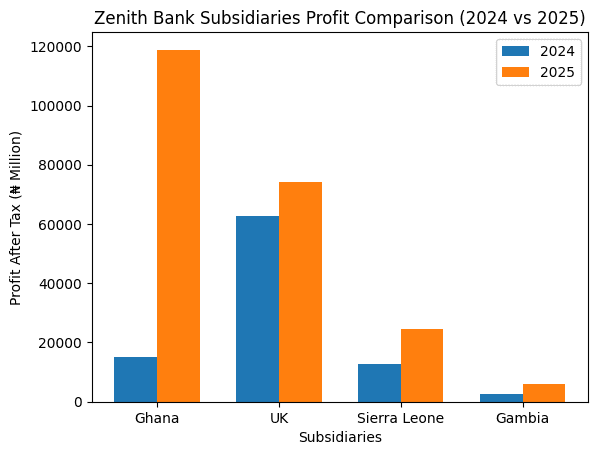
Zenith Bank’s international subsidiaries delivered strong results in 2025, with all four major foreign units—Ghana, the United Kingdom, Sierra Leone, and The Gambia—recording higher profits compared to 2024.
The standout performer was Zenith Bank Ghana, which posted an extraordinary surge in profit. Profit after tax rose sharply from ₦15.19 billion in 2024 to ₦118.84 billion in 2025, representing a growth of about 682 per cent.
This was not just incremental growth; it was a major leap driven by a combination of higher income, improving economic conditions, and better tax outcomes.
The Ghana operation benefited from a near doubling of its operating income, which climbed from ₦247.04 billion to ₦483.55 billion.
This increase was supported by strategic lending activities, including participation in key financing programmes such as a ₦12.6 billion facility from the Development Bank of Ghana and agricultural funding schemes.
These initiatives expanded lending opportunities and boosted revenue for the Zenith Bank Ghana subsidiary.
Another important factor was the stabilisation of Ghana’s economy. During the year, the country exited its hyperinflationary phase, allowing the bank to stop applying hyperinflation accounting adjustments from November 2025.
This reduced financial distortions and improved reported earnings, even as net monetary losses also declined significantly, falling by about 48 per cent.
Tax efficiency further strengthened the bottom line for the Ghana subsidiary. In 2024, a large portion of profits was consumed by taxes, but in 2025, the effective tax rate dropped significantly, allowing more earnings to flow through to final profit.
Beyond Ghana, other African subsidiaries also posted impressive gains.
Zenith Bank Sierra Leone nearly doubled its profit, rising from ₦12.70 billion to ₦24.64 billion. This growth reflects a recovery from prior inflation-related pressures and improved operating conditions.
READ ALSO:
- Five Key Issues That Shaped Zenith Bank Performance in 2025
- How Growing Xenophobic Wave Targets Nigerians Across Africa
- Nigeria Is Working Its Healers to Death- Resident Doctors
- Energy, Industrial Stocks Spark ₦17.6trn Gain in February
- Nigeria’s Reserves Drop $1.18bn in One Month Amid CPI, Oil Risks
- Dangote Targets Historic Pan-African IPO for Mega Refinery
Zenith Bank Gambia also delivered a strong performance, with profit increasing from ₦2.76 billion to ₦5.88 billion, a growth of over 100 per cent. The subsidiary continued to expand its corporate and retail banking activities within its market.
Zenith Bank UK, while not growing as dramatically as its African counterparts, still recorded steady progress. Profit rose from ₦62.74 billion to ₦74.10 billion, an increase of about 18 per cent.
The UK operation, which focuses on wholesale and investment banking and has branches in the UAE and France, remained a stable contributor to the group’s earnings.
Mixed Fortunes in Zenith’s Nigerian and Non-Banking Units
While Zenith Bank’s foreign subsidiaries delivered strong growth, its Nigerian parent entity, Zenith Bank Plc, experienced a decline in profitability.
It reported a profit after tax of ₦813.08 billion in 2025, down from ₦936.16 billion in 2024, representing a 13.1 per cent drop.
This decline was largely driven by a sharp reversal in trading performance, as the bank moved from a massive trading gain of ₦1.05 trillion in 2024 to a loss of ₦119.02 billion in 2025.
A major contributor to this was a ₦460 billion loss on derivatives, the group’s audited report shows.
At the same time, operating costs increased significantly, even as personnel expenses rose by 57 per cent, while impairment charges on loans and other financial instruments also increased.
General operating expenses climbed as well, driven by regulatory levies, technology investments, and high fuel and maintenance costs.
Despite these pressures, some factors helped cushion the decline, as net interest income grew strongly, rising by 55 per cent, while tax expenses dropped significantly, reducing the overall impact on profit.
Among Zenith’s non-banking subsidiaries, performance was mixed, with Zenith Pensions Custodian recording moderate growth, with profit increasing from ₦8.42 billion to ₦9.77 billion.
The business continues to manage a large asset base of ₦10.59 trillion. In contrast, Zenith Nominees Limited saw its profit decline from ₦920 million to ₦741 million, reflecting rising costs and impairment charges.
Pinnacle Daily earlier reported that the group’s performance was influenced by five major issues affecting its operations, regulation, and future outlook.
GTBank Subsidiaries Mirror Zenith’s African Growth Story
GTBank’s 2025 results show a similar trend, with its African subsidiaries—especially in West Africa—driving growth, while some other regions lagged.
GTBank Ghana was again a major highlight as the subsidiary more than doubled its profit, rising from ₦71.9 billion in 2024 to ₦127.5 billion in 2025.
This growth was supported by a strong increase in operating income, which jumped by over 67 per cent to ₦264.32 billion.
Foreign exchange gains also played a key role as the group recorded ₦76.3 billion in unrealised foreign exchange gains in 2025, compared to a loss in 2024.
These gains were largely generated by subsidiaries outside Nigeria, with Ghana being a significant contributor.
Improved asset quality further supported profitability, as loan impairment charges declined by over 40 per cent.

Other West African subsidiaries also performed well, with GTBank Sierra Leone growing its profit by 50 per cent to ₦27.3 billion.
While GTBank Gambia increased profit from ₦19.6 billion to ₦24.8 billion, GTBank Liberia also recorded a strong 33.7 per cent growth, reaching ₦26.1 billion.
Even GTBank Tanzania, though still loss-making, showed improvement by significantly reducing its losses from ₦1.15 billion to ₦167.6 million.
Declines in Kenya and UK Weigh on GTBank’s Global Performance
Not all GTBank subsidiaries performed strongly, as the East African operations, grouped under the Kenya business (including Uganda and Rwanda), recorded a notable decline.
Profit for the Kenya Group fell from ₦12.8 billion in 2024 to ₦7.1 billion in 2025, a drop of over 44 per cent. This was driven by a sharp decline in Rwanda’s income, losses in Uganda, and rising costs in Kenya.
Similarly, GTBank UK saw its profit decline from ₦16.2 billion to ₦13.0 billion, a drop that was due to lower operating income and higher expenses, which squeezed profit margins.
Pinnacle Daily had also reported that higher taxes and non-interest losses dragged GTCO’s 2025 earnings down.
Fintech Emerges as a New Growth Engine for GTCO
Beyond traditional banking, GTCO’s diversification strategy is beginning to pay off, as its fintech subsidiary, HabariPay, recorded one of the fastest growth rates within the group.
Profit after tax surged by over 150 per cent, rising from ₦3.88 billion to ₦9.74 billion. This was driven by a sharp increase in operating income, which more than doubled during the year.
The group’s pension business also recorded modest growth, further supporting overall performance.
African Expansion Becomes Strategic Advantage
A comparison of both banks shows a clear and consistent trend, with their African subsidiaries becoming critical to the groups’ growth.
For Zenith Bank, Ghana stands out as the single biggest contributor to international growth, with Sierra Leone and The Gambia also delivering strong gains. The UK subsidiary provides stability but not the same level of expansion.
For GTBank, the story is similar as the Ghana subsidiary led the growth, supported by other West African markets. However, the group faces more challenges in East Africa and the UK.
Both tier-1 banks also benefited from increased operating income in their foreign operations and, in GTBank’s case, significant foreign exchange gains.
At the same time, both institutions faced pressures in their home and developed markets.
Zenith Bank’s Nigerian operations were hit by trading losses and rising costs, while GTBank’s UK and East African businesses struggled with declining income and higher expenses.
Shift in Profit Centres Signals Strategic Realignment
Analysts believe that the 2025 financial results highlight a major shift in the structure of earnings for both Zenith Bank and GTCO, as their African subsidiaries, once seen as supporting units, are now leading contributors to profit growth.
This shift, which reflects both opportunity and necessity, as challenges mount in Nigeria and some international markets, the banks are increasingly relying on high-growth African economies to sustain performance.
If current trends continue, the future of both banks may depend even more on how well they can expand and manage their operations across the African continent.

Alex is a business journalist cum data enthusiast with the Pinnacle Daily. He can be reached via ealex@thepinnacleng.com, @ehime_alex on X