

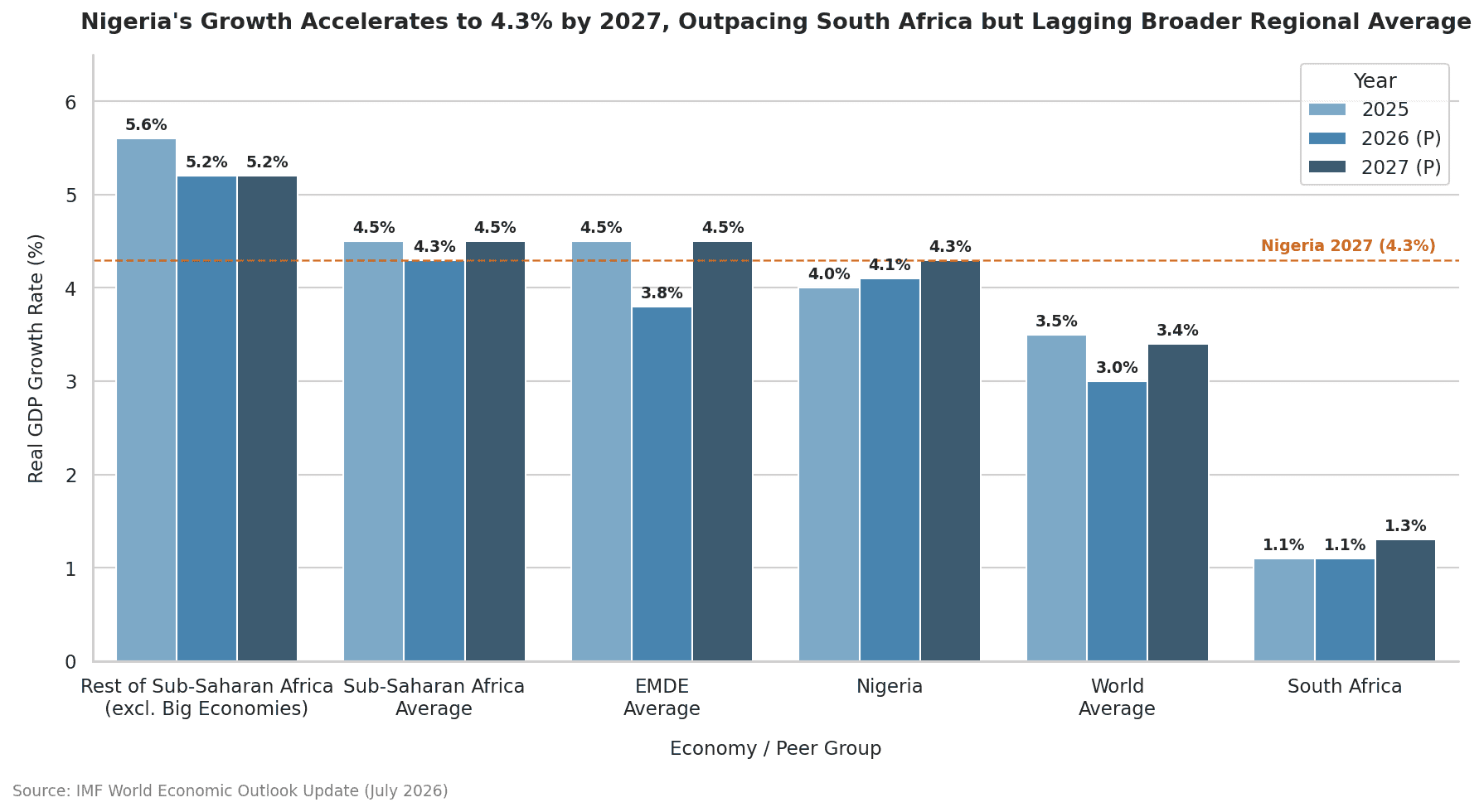
Nigeria’s economy is projected to grow by 4.1 per cent in 2026 and 4.3 per cent in 2027, putting its growth trajectory significantly ahead of South Africa, which the IMF expects to expand by only 1.1 per cent and 1.3 per cent, respectively, over the same period.
The projections were contained in the International Monetary Fund’s July 2026 Economic Update and highlighted within the broader context of its 2026 Annual Report, released on Wednesday.
The figures show Nigeria expanding at almost four times South Africa’s projected growth rate in 2026, with the gap widening slightly in 2027.
Nigeria’s projected growth advantage over South Africa is three percentage points in 2026 and three percentage points in 2027.
Nigeria’s growth is also expected to remain relatively steady, rising from 4.0 per cent in 2025 to 4.1 per cent in 2026 and 4.3 per cent in 2027.
South Africa, by contrast, is projected to remain at 1.1 per cent growth in 2026 before edging up to 1.3 per cent in 2027.
The IMF’s projections place Nigeria slightly below the overall Sub-Saharan African average, which is expected to grow by 4.3 per cent in 2026 and 4.5 per cent in 2027.
The rest of the region, excluding the larger economies, is projected to grow faster at 5.2 per cent in both years.
Oil prices support Nigeria’s growth outlook
The IMF attributes Nigeria’s growth outlook partly to improved macroeconomic stability and favourable terms-of-trade effects arising from higher global oil export prices.
For Nigeria, higher oil export prices can improve foreign exchange earnings and government revenue because crude oil remains a major export.
This provides an important difference between Nigeria and many oil-importing economies in Sub-Saharan Africa, which face greater pressure when global energy and food prices rise.
However, the IMF’s assessment also shows that stronger headline growth does not remove Nigeria’s structural challenges.

The July Economic Update warns that higher prices for essential goods could worsen poverty and food insecurity in Nigeria.
Global commodity prices are projected to remain a source of pressure, with crude oil prices expected to rise by 31.8 per cent in 2026, food prices by 8 per cent and fertiliser prices by 25.6 per cent.
The report states that “higher prices for essentials are expected to further aggravate poverty and food insecurity”.
Nigeria’s lead over South Africa contrasts with regional picture
Nigeria’s projected growth performance is particularly notable when compared with South Africa, another major economy in Sub-Saharan Africa.
While Nigeria is expected to accelerate from 4.1 per cent growth in 2026 to 4.3 per cent in 2027, South Africa is projected to record only a modest improvement from 1.1 per cent to 1.3 per cent.
The difference also means that Nigeria’s projected growth rate is three times higher than South Africa’s in both years.
READ ALSO:
- Nigeria, Africa Could Add 4% to GDP by Removing AI Barriers — IMF
- Middle East War Threatens Africa’s Economic Gains — IMF’s Selassie Warns
- IMF Cuts Nigeria’s 2026 Growth Outlook to 4.1% on Middle East War Shock
- CBN Cuts Rate to 23%: 10 Ways It Will Affect Your Money
However, Nigeria is not the fastest-growing part of the region. Smaller and less resource-intensive Sub-Saharan African economies, taken together, are projected to grow by 5.2 per cent in 2026 and 2027.
That group is nevertheless expected to slow from 5.6 per cent in 2025, partly because higher food and energy import costs are weighing on economies that depend more heavily on imports.
Nigeria’s projected expansion therefore places it between the region’s overall average and the faster-growing smaller economies.
Growth comes with fiscal and debt pressures
The IMF’s broader assessment shows that global public debt is rising again after falling from pandemic-era highs, while global interest payments have increased sharply.
Interest payments rose from about two per cent to nearly three per cent of global GDP over three years.
For Nigeria and other African economies, higher global borrowing costs can make debt financing more expensive and reduce the fiscal space available for development spending.
Fiscal space refers to the government’s ability to increase spending or respond to economic shocks without creating unsustainable financial pressure.
The IMF also highlights the need for stronger domestic revenue mobilisation across Africa.
For Nigeria, the Annual Report does not provide a standalone figure or specific analysis of national public debt. Instead, Nigeria’s debt and fiscal vulnerabilities are addressed within broader regional and multilateral initiatives.
The Fund’s recommendations include stronger fiscal prioritisation, improved domestic revenue collection and better-targeted support for vulnerable households.
Nigeria’s growth remains exposed to global shocks
The projected growth advantage over South Africa does not mean Nigeria is insulated from external risks.
The IMF identifies higher food and energy import costs, rising debt-service burdens and declining official development assistance as major challenges for Sub-Saharan Africa.
Nigeria is also described as being “largely absent from the AI-driven global technology upswing”, limiting its participation in the technology-led growth benefiting some emerging markets.
At the same time, the country remains dependent on favourable oil prices and improved macroeconomic stability to sustain its growth momentum.
The IMF’s Annual Report therefore emphasises strengthening economic institutions alongside maintaining growth.
Sub-Saharan Africa accounted for 36 per cent of the IMF’s global Capacity Development delivery in FY2026, the largest share of any region.
Nigeria participates in AFRITAC West 2, the IMF’s Regional Technical Assistance Centre for West Africa, which provides support in areas including public financial management, tax administration, central bank operations and financial-sector supervision.
The Fund also provided analytical support on African macroeconomic vulnerabilities, domestic revenue mobilisation and debt restructuring under the 2025 South African G20 Presidency.
The IMF said, “Analysis on macroeconomic vulnerabilities in Africa, preparations for the Financing for Development Conference, and efforts to strengthen domestic revenue mobilization were also provided.”

Alex is a business journalist cum data enthusiast with the Pinnacle Daily. He can be reached via ealex@thepinnacleng.com, @ehime_alex on X