

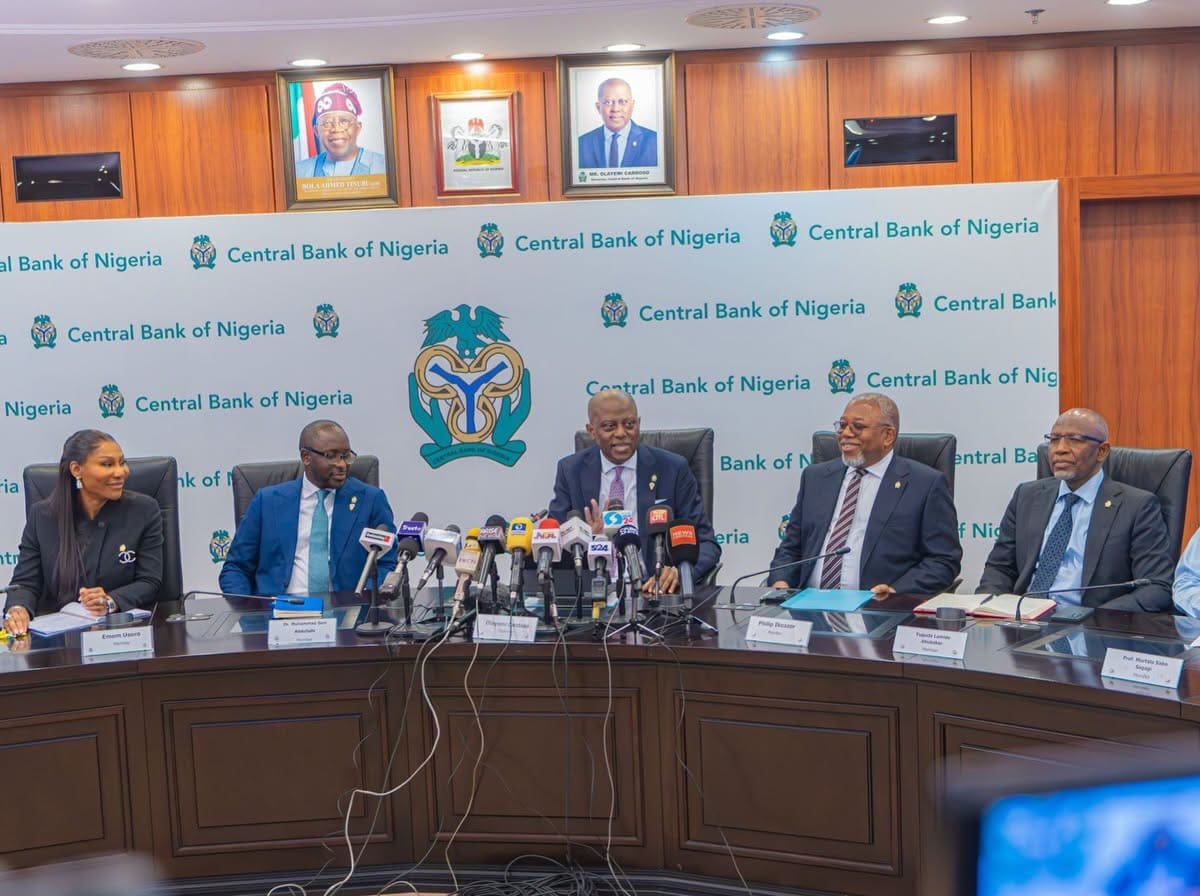
The Central Bank of Nigeria (CBN) has cut its benchmark interest rate — the Monetary Policy Rate (MPR) — from 26.5% to 23%, a reduction of 350 basis points. The decision was taken by the Monetary Policy Committee (MPC) at its 307th meeting on September 22, 2026.
The MPR is the rate at which the CBN lends to commercial banks, and it sets the tone for borrowing and lending costs across the economy.
For more than a year, the apex bank had kept this rate high to fight inflation. This latest cut signals that the CBN believes inflation is now coming under control, and it is easing off, a shift many analysts did not expect to come this fast or this large.
Development economist Professor Uche Uwaleke described the size and timing of the move as fitting the current economic picture.
He said the MPC’s decision to cut the MPR by 350 basis points “is justified by moderating inflation, exchange rate stability, improvement in Fx market liquidity, and accretion to external reserves.”
He added that the cut aligns with a recent agreement between the Minister of Finance and the CBN Governor to coordinate fiscal and monetary policy more closely.
The Centre for the Promotion of Private Enterprise (CPPE), led by its CEO, Dr Muda Yusuf, also welcomed the decision.
In a policy brief, Yusuf’s organisation noted that the adjustment was larger than the market had anticipated, describing it as a significant shift from the prolonged restrictive monetary policy regime that signals a rebalancing of monetary policy towards supporting growth, investment and economic recovery, while preserving price and financial-system stability.
The CPPE also pointed out that the CBN narrowed the interest-rate corridor around the MPR, a technical adjustment that reinforces the shift toward a less restrictive stance.
With the background out of the way, here is what the rate cut could mean for your money.
1. Interest rates will start to fall.
The MPR guides borrowing and lending rates across the economy. When it drops, loan rates and returns on some investments tend to follow — gradually, not overnight.
A small business owner in Onitsha who got a bank loan at 30% p.a. in 2025 might find new loans in the market priced closer to 25-27% in the coming months as banks adjust to the lower MPR.
2. Loans could get cheaper — but not instantly.
Banks and lending apps may begin lowering their rates, making credit more accessible for businesses and individuals. But each lender still weighs its own risk, costs and liquidity, so don’t expect every loan to drop at once.
Someone applying for a car loan from GTBank or Access Bank today may not see a rate cut immediately — the bank still checks their credit history and income before adjusting terms, even though the CBN’s benchmark has dropped.
3. Savings interest rates may shrink.
The attractive rates currently offered on savings products by digital platforms and fintechs could ease downward over time. Today’s rate isn’t guaranteed to last.
A civil servant in Abuja who has been earning 18% on a fixed savings plan with a fintech app like PiggyVest or Cowrywise may notice the rate on new deposits gradually drop to 15% or lower in coming weeks as platforms adjust to cheaper money.
READ ALSO:
- https://thepinnacleng.com/banking-finance/cbns-omo-blitz-pulls-in-%e2%82%a63-3trn-as-investors-chase-high-yields
- https://thepinnacleng.com/economy/cbn-cuts-interest-rate-to-23-to-strengthen-policy-transmission
- https://thepinnacleng.com/banking-finance/only-6-of-nigerians-feel-financially-secure-report
- https://thepinnacleng.com/economy/august-2025-fgn-savings-bonds-offer-n1-43bn-returns-to-investors
4. Money market fund yields may decline.
Money market funds invest in short-term interest-bearing instruments. As rates fall, the yields these funds pay out are likely to come down too.
A trader who has ₦500,000 parked in a money market fund earning 20% p.a. through an app like Cowrywise or Bamboo could see that yield trend down to the mid-teens as the fund’s underlying Treasury Bills and short-term instruments reprice lower.
5. Treasury Bills and FGN Savings Bonds could offer lower returns.
Future issuances of these instruments may carry lower rates as the overall interest-rate environment shifts.
A retiree in Enugu who has been buying 91-day Treasury Bills at auction for attractive returns may find the next few auctions clearing at noticeably lower stop rates than earlier in the year.
6. Existing bondholders may come out ahead.
If you’re already holding a fixed-rate bond, a falling-rate environment works in your favour — your bond’s higher coupon becomes more attractive compared to new bonds issued at lower rates.
An investor holding a 3-year FGN Bond bought earlier this year at a high coupon rate is now sitting on a more valuable asset — new bonds issued after this rate cut will likely carry lower coupons, making the older, higher-paying bond more attractive if sold on the secondary market.
7. The stock market could get a boost.
As returns on fixed-income options like Treasury Bills and fixed deposits become less attractive, some investors may shift money into equities in search of better returns—which can support share prices. That said, a lower MPR doesn’t guarantee every stock will rise.
With fixed deposits and T-Bills less attractive, some investors who parked money in banks may start moving funds into NGX-listed stocks like Dangote Cement, GTCO or Zenith Bank in search of better returns — a shift that has historically helped push the All-Share Index higher.
8. Don’t rush to borrow just because rates are falling
A rate cut isn’t an invitation to take on debt. Borrow only for a clear, productive purpose, and only if you can comfortably repay it. Cheaper debt is still debt.
A trader in Balogun Market tempted to take a quick business loan because “rates are coming down” should still ask: can my sales comfortably cover the repayment? A cheaper loan for a business that isn’t generating enough revenue is still a risk.
9. It may be time to review your investment mix.
If your portfolio leans heavily on short-term fixed-income instruments because of their high yields, this is a good moment to check whether your spread across money market funds, bonds, equities and other assets still matches your goals and risk appetite. A professional adviser can help if you’re unsure.
Someone who moved most of their savings into high-yield money market funds in 2025 (when yields were 20%+) should now check whether it makes sense to spread some of that money into equities or long-term bonds, given that MMF yields are set to soften.
10. Keep saving and investing — don’t stop.
Rate cycles rise and fall, but the basics don’t change: save consistently, invest consistently, diversify, and think long-term. Let your financial discipline outlast the news cycle.
Whether the MPR is 26.5% or 23%, the discipline of setting aside a fixed amount monthly — say, ₦20,000 into a savings or investment plan — still matters more long-term than chasing the highest rate of the moment.

Sunday Michael Ogwu is a Nigerian journalist and editor of Pinnacle Daily. He is known for his work in business and economic reporting. He has held editorial roles in prominent Nigerian media outlets, where he has focused on economic policy, financial markets, and developmental issues affecting Nigeria and Africa more broadly.