

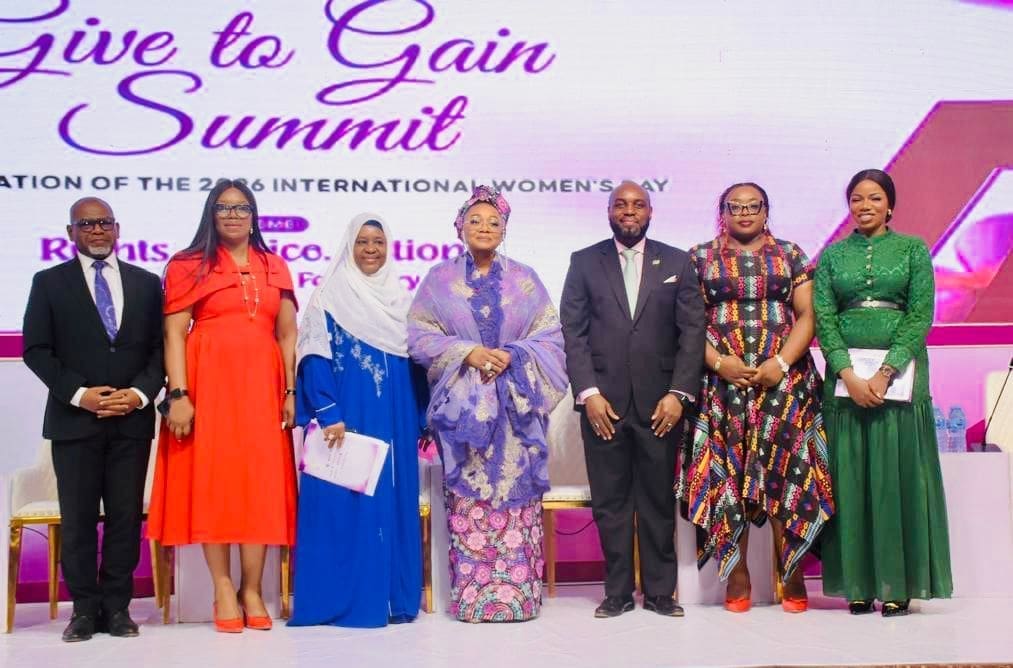
The Federal Government has unveiled a set of financing and procurement reforms aimed at breaking long-standing barriers limiting the growth of women-owned businesses in Nigeria, particularly access to credit, markets, and long-term capital.
Speaking at the grand finale of the “Give to Gain” Summit in Abuja to mark the 2026 International Women’s Month, the Minister of Women Affairs and Social Development, Imaan Sulaiman-Ibrahim, said the government is moving beyond advocacy to practical interventions that can unlock women’s economic potential.
She revealed that over 80 per cent of women-owned businesses in Nigeria lack access to formal credit, leaving many trapped in the informal sector and limiting their ability to scale.
To address this, the minister announced the rollout of the Renewed Hope Social Impact Interventions (RH-SII 774), a nationwide programme designed to provide grants, microcredit and enterprise financing across all 774 local government areas.
She explained that the initiative also covers skills acquisition, vocational training, agricultural value chain support, clean energy solutions and mentorship to help women grow sustainable businesses.
Sulaiman-Ibrahim added that the intervention is backed by the Women’s Economic Empowerment (WEE) Policy (2023), which provides a framework for delivering measurable outcomes.
Procurement Reform Opens Government Contracts
In what she described as a major policy shift, the minister disclosed that the government has approved an Affirmative Procurement Policy to improve women’s access to public contracts.
READ ALSO:
- Stakeholders Call for Stronger Women’s Participation in Nigeria’s Capital Market
- NUPRC Digitises Procurement System, Targets 95% Compliance for Transparency
- CAPPA Slams Lagos Over ‘Secret’ Water PPP Deals
- Stronger Naira a Double-Edged Sword for Nigeria — Expert
- FX Losses, Rising Costs, Legal Risks Hit UBA Profit, Force Dividend Cut
“This landmark intervention ensures structured and equitable access for women-owned enterprises to participate in public procurement processes, thereby opening government contracting systems as engines of inclusion and shared prosperity.
“It represents a decisive shift from policy intention to enforceable economic access. In the spirit of our theme, ‘Give to Gain,’ it affirms that when the State deliberately gives women fair opportunity in procurement systems, the nation gains in productivity, competitiveness, and inclusive growth,” she said.
SEC Pushes Capital Market Access for Women
Also speaking, Director-General of the Securities and Exchange Commission, Emomotimi Agama, represented by Executive Commissioner, Operations, Bola Ajomale, said the focus must shift from short-term financing to long-term wealth creation through the capital market.
He noted that while millions of Nigerian women are active in micro and small businesses, they remain excluded from investment tools that support expansion and asset building.
“Nigerian women currently own 41 per cent of micro-businesses in this country, with 23 million female entrepreneurs operating in that segment — placing Nigeria among the highest rates of female entrepreneurship globally, surpassing the 21 per cent global average.
“These women are not waiting to be empowered. They are already driving commerce. What they lack is not ambition. They lack access to the instruments that would allow their ambition to compound,” he said.
Agama said the Commission is expanding retail access to the capital market through technology-driven platforms, scaling investor education in local languages, and promoting low-cost investment products tailored to women and small businesses.
He added that the SEC is integrating gender-focused strategies into Nigeria’s sustainable finance framework, enabling women-led businesses to access funding through instruments such as gender-responsive and sustainability-linked securities.
Efforts are also underway to strengthen investor protection through improved transparency, disclosure standards and dispute resolution mechanisms, while calling on private sector players to deepen financial inclusion and increase women’s representation in leadership.

Alex is a business journalist cum data enthusiast with the Pinnacle Daily. He can be reached via ealex@thepinnacleng.com, @ehime_alex on X