

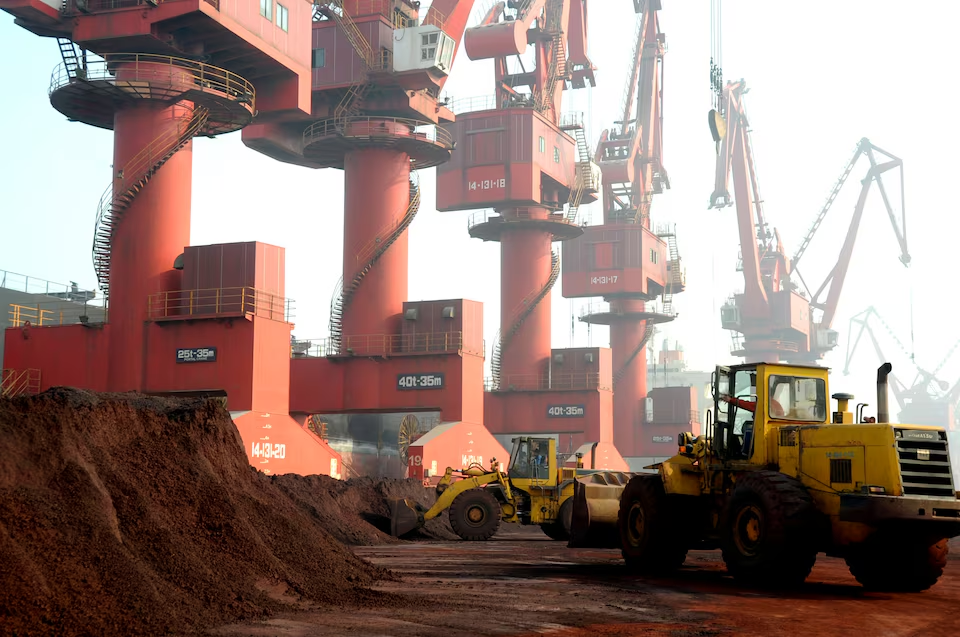
The United States will press its allies to move faster in reducing reliance on China for rare earths and other critical minerals. Treasury Secretary Scott Bessent will lead talks with senior finance officials this week, a U.S. official said.
The meeting begins with a dinner on Sunday and continues on Monday. It will include ministers from the Group of Seven, the European Union, Australia, India, South Korea and Mexico. Together, these countries account for about 60 per cent of global demand for critical minerals.
“Urgency is the theme of the day,” the official said. “We need to move faster.”
Bessent has pushed for stronger action since the G7 leaders’ summit in Canada in June. At that meeting, he briefed leaders on the risks tied to rare earth dependence.
READ ALSO: U.S Oil Giants Highlight Challenges as Trump Discusses Investment in Venezuela
G7 leaders agreed on an action plan to secure supply chains. U.S. officials say progress since then has been slow.
Japan remains the only G7 country to reduce its dependence significantly. It acted after China cut off mineral exports in 2010. Other members still rely heavily on Chinese supply.
China controls much of the global critical minerals market. It refines between 47 and 87 per cent of copper, lithium, cobalt, graphite and rare earths, according to the International Energy Agency.
These minerals support defence systems, semiconductors, renewable energy projects and battery production. U.S. officials warn that export controls from Beijing pose a major risk.
U.S. Seeks to Lead Partners
U.S. officials say Washington will issue a statement after the meeting. They do not expect a joint action plan yet.
“The United States is calling partners together and showing leadership,” the official said. “We are ready to move with those who feel the same urgency.”
The Trump administration is expanding domestic production and securing foreign partnerships. It has reached agreements with Australia, Ukraine and other producers.
In October, the U.S. signed a deal with Australia to counter China’s dominance. The agreement includes an $8.5 billion project pipeline and access to Australia’s proposed strategic mineral reserve.
READ ALSO: US Suspends Aid to Somalia Over Alleged Misuse of Food Assistance
Officials say progress has begun, but major gaps remain. Australia has since drawn interest from Europe, Japan, South Korea and Singapore.
The talks come days after reports that China restricted rare earth and magnet exports to Japanese firms. Beijing also banned some dual-use exports to Japan’s military.
U.S. officials said they planned the meeting before those reports. They added that China continues to meet commitments to U.S. firms and soybean purchases.

Esther Ososanya is an investigative journalist with Pinnacle Daily, reporting across health, business, environment, metro, Fct and crime. Known for her bold, empathetic storytelling, she uncovers hidden truths, challenges broken systems, and gives voice to overlooked Nigerians. Her work drives national conversations and demands accountability one powerful story at a time.