

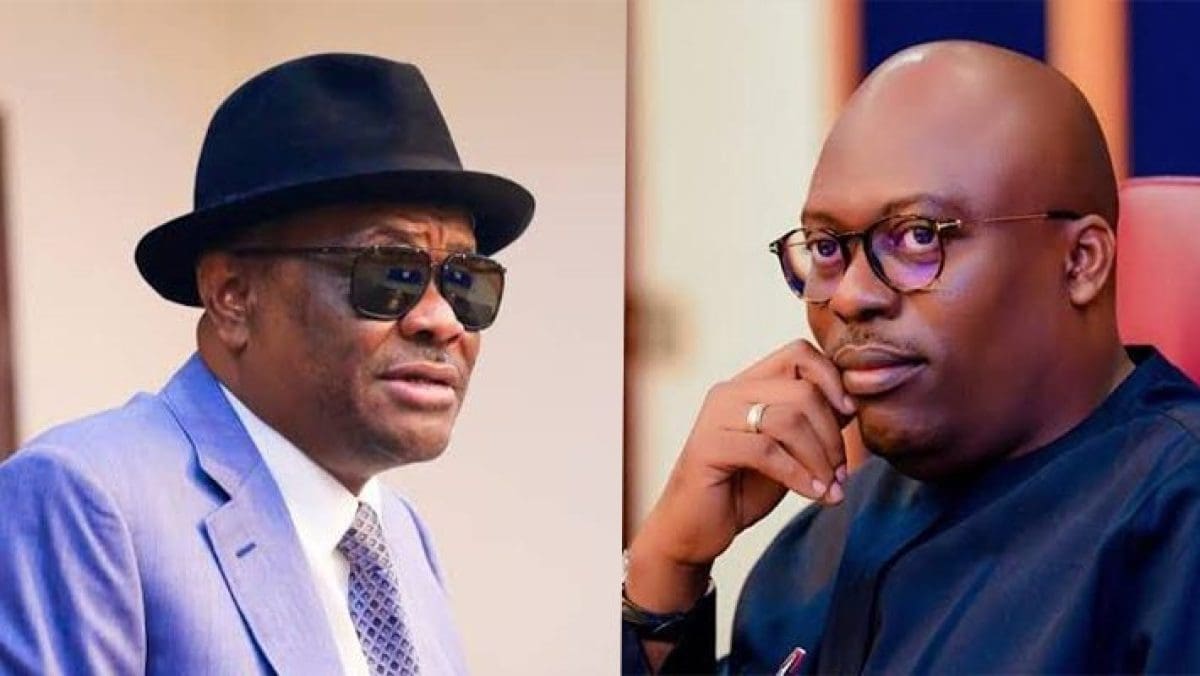
The just-concluded Rivers State local government election has triggered heated debates over legality, democratic legitimacy, and the entrenched power struggle between Governor Siminalayi Fubara and his estranged political benefactor and FCT Minister Nyesom Wike.
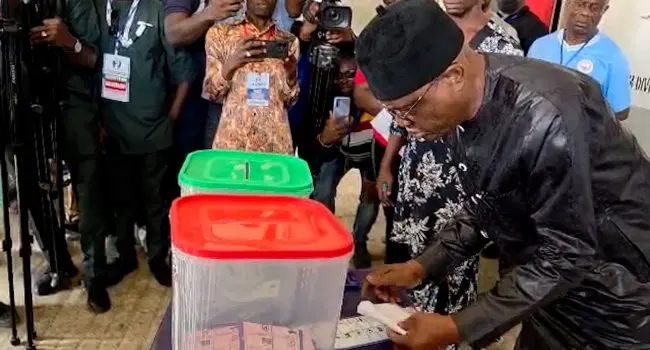
The polls, which saw the APC sweep 20 chairmanship seats while the PDP managed only three, were conducted under the supervision of a sole administrator, a decision lawyers, civil society groups, and opposition leaders have condemned as unconstitutional.
BACKGROUND
In the height of the Rivers political crisis, Governor Siminalayi Fubara supervised a controversial local government election on October 4, 2024, where his loyalists, running on the platform of the Action Peoples Party (APP), won 22 out of 23 chairmanship seats.
However, the Supreme Court nullified the exercise on February 28, 2025, after the All Progressives Congress (APC) challenged its validity.
Delivering the unanimous judgement, Justice Jamilu Tukur reinstated an earlier Federal High Court ruling which had restrained the Rivers State Independent Electoral Commission (RSIEC) from conducting the poll until the state’s voter register was updated.
The development coincided with heightened tensions between Fubara and his estranged political benefactor, Nyesom Wike. On March 18, President Bola Tinubu, citing the escalating feud, declared a state of emergency in Rivers and suspended Governor Fubara, his deputy Ngozi Odu, and all elected members of the House of Assembly for six months, stressing that the move was necessary to restore order.
President Tinubu also appointed Ibok-Ete Ibas as Sole Administrator of Rivers State to oversee state affairs until Fubara’s scheduled resumption on September 18.
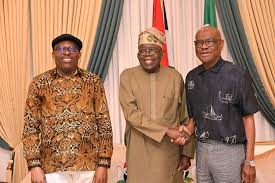
Months later, Tinubu convened a peace meeting at the State House with both men, where a truce was reached. According to the report, under the agreement, Wike’s loyalists were to be reinstated into the local government structure, setting the stage for Saturday’s fresh council election across the state.
Wike’s Grip and Tinubu’s Role
Although still formally a PDP member, Wike openly celebrated the outcome, declaring the election “peaceful” and praising President Tinubu for insisting that the polls hold. Wike argued that elected council officials could now access federal allocations directly.
Analysts, however, note that all 20 APC chairmen declared winners are his loyalists — underscoring his dominance in Rivers politics and his alignment with Tinubu’s APC despite his PDP membership.
Behind the scenes, reports suggest that Fubara’s reinstatement deal, brokered after Tinubu declared a state of emergency in March, included conditions that he abandon his 2027 re-election bid, recognise Wike’s leadership, and allow him to nominate all local government chairmanship candidates. The APC sweep appears to validate those claims.
Absence of Fubara and His Loyalists
Governor Fubara and his allies were absent from the exercise. Notably, the governor lost his own LGA, Opobo, to the APC. Prominent allies of the suspended governor, including the Chief of Staff to the Government House, Edison Ehie; Secretary to the Government, Dr Tammy Danagogo; the sacked 23 local government chairmen; and members of the Simplified Movement, a socio-political organisation loyal to him, were also absent — signalling deep political isolation.
Legal and Civil Society Pushback
Legal experts argue that the polls lack constitutional backing. Victor Giwa, a lawyer, declared the exercise “illegal, unconstitutional, null and void”, stressing that only a duly elected governor and State House of Assembly can appoint a valid electoral commission under the 2018 RSIEC law.
Civil society groups, including ACCESS, also faulted the 21-day election notice, pointing out that it violated Section 150(3) of the Electoral Act, which requires at least 90 days’ notice.
Speaking to Pinnacle Daily, the group’s spokesperson, Engr. Kenneth Eze, who also heads Speak Out Africa Initiative, described the situation in the state as “a direct assault on Nigeria’s democratic structure”.
He said the appointment of a sole administrator in place of an elected governor has no legal basis and questioned the legitimacy of any decisions made under such an arrangement.
He further referenced the Supreme Court’s February 2025 nullification of the October 2024 Rivers LG polls on similar grounds.
RELATED STORIES:
- Atiku Slams Rivers LG Polls, Urges Opposition to Reject Results
- Rivers LG Election a Mockery of Democracy – Peter Obi
- APC Sweeps Rivers LG Polls, PDP Takes Three
- Wike Says Rivers Ready as Emergency Rule Nears End
Election Day Irregularities
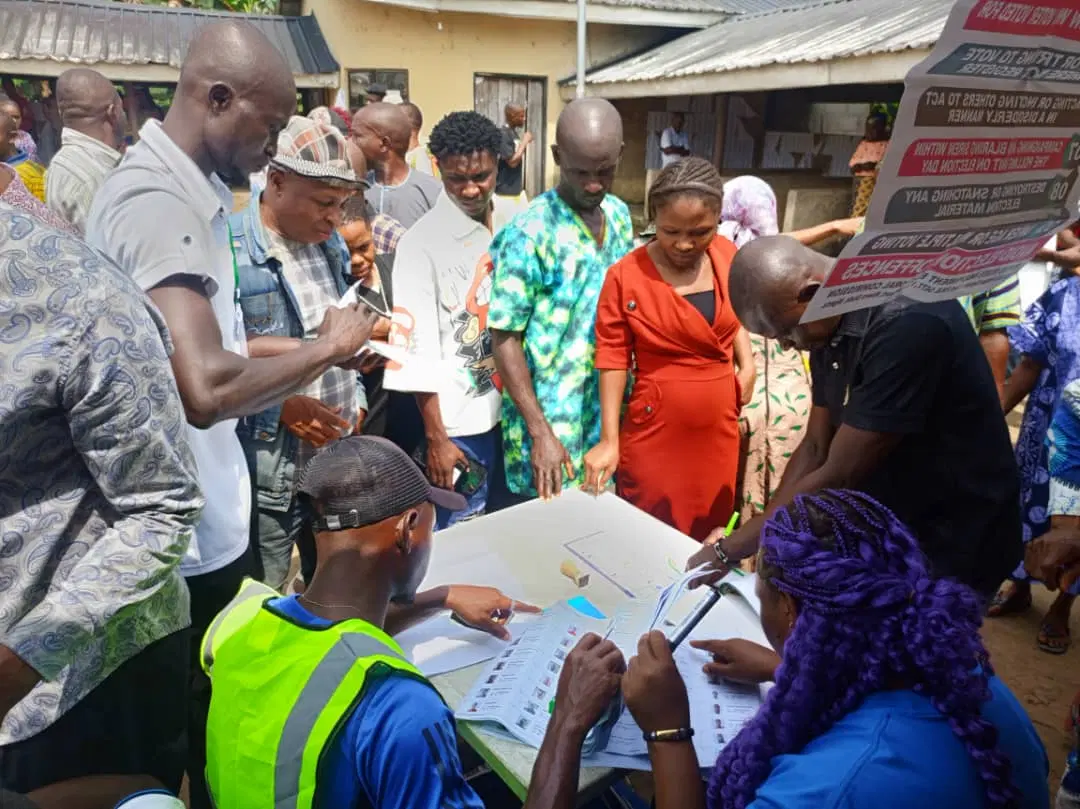
According to Sunday PUNCH, the polls were marred by widespread voter apathy, low turnout in urban centres, absence of original result sheets, non-availability of BVAS machines, and late arrival of materials. In the Ibaa community, ballot stuffing was observed as individuals were seen thumb-printing multiple ballots.
Despite the alleged irregularities, the Sole Administrator of Rivers State, Ibok-Ete Ibas, has described Saturday’s local government (LG) election as peaceful and orderly, calling it a decisive step toward restoring democratic governance at the grassroots.
Ibas, who monitored the exercise across several areas including Emohua, Ahoada East, and Port Harcourt, said the conduct of voters and officials created a calm and secure atmosphere for the polls.
Key Opposition Figures Reject Rivers LG Polls
Former Anambra State Governor and Labour Party’s 2023 presidential candidate, Peter Obi, has denounced the Rivers State local government election, calling it “a mockery of democracy”. In a statement on his official X handle, Obi faulted the process conducted under a sole administrator, whom he described as “illegally appointed”. He stressed that “illegality can never give birth to legitimacy” and warned that the practice undermines the rule of law and silences the will of the people.
Similarly, former Vice President and PDP presidential candidate Atiku Abubakar condemned the exercise as “an awful absurdity” and “a travesty to the very notion of elective democracy”. He accused the ruling APC of pursuing political advantage through unconstitutional means and urged opposition parties in Rivers State to reject the results. Atiku also called on Nigerians and the international community to take note of what he described as a dangerous drift under President Bola Tinubu’s administration while expressing solidarity with Rivers people, whom he said had been denied their democratic rights.
APC Hits Back at Atiku Over Rivers LG Polls
The All Progressives Congress (APC) has mocked former Vice President Atiku Abubakar over his criticism of the Rivers State local government elections, accusing him of “goofing again” with unfounded allegations of foul play. He slammed Atiku’s preferred African Democratic Congress (ADC) for performing poorly and failing to win a single council.
In a statement issued in Abuja, APC National Publicity Secretary Felix Morka described the outcome as a resounding endorsement of President Bola Tinubu’s Renewed Hope Agenda.
The APC accused Atiku of attempting to stoke tension to distract from what it described as his party’s “miserable no-show” at the polls. Branding him a “forlorn serial presidential contender”, the ruling party urged Rivers residents to ignore his claims and instead rally behind the new council leaders to build what it called a stronger, more united state.
Rivers LG Polls – Struggle for Grassroots Power
In an interview with Pinnacle Daily, Hon. Nonso Okeke, a public affairs analyst and the vice chairmanship candidate for Zenith Labour Party (AMAC), described the Rivers State local government election as more than a routine contest but a fierce struggle for control of state resources and grassroots power.
He argued that Governor Fubara faces an uphill task, as many of the chairmanship candidates are seen as loyal to former Governor Wike, raising doubts about their dedication to the sitting governor.
“Whoever controls the grassroots controls the votes,” he said, warning that Rivers politics risks being hijacked at the local level.
He further urged politicians to place people’s welfare above personal power struggles, warning that ordinary citizens bear the cost when local governments are reduced to pawns in political battles.
The Bigger Question
With Wike’s loyalists entrenched at the local government level, the state of emergency nearing its end, and Fubara sidelined by political deals, the broader question emerges: was this election a democratic exercise or a carefully choreographed consolidation of power?

Rafiyat Sadiq is a political, justice, and human rights reporter with Pinnacle Daily, known for fearless reporting and impactful storytelling. At Pinnacle Daily, she brings clarity and depth to issues shaping governance, democracy, and the protection of citizens’ rights.