


After months of heated legislative battles, street protests, elite lobbying and public outrage, President Bola Tinubu signed the Electoral Act Amendment Bill 2026 into law, setting the legal framework that will govern Nigeria’s elections heading into the pivotal 2027 general polls.
The recently concluded FCT council elections on Saturday, February 21, marked the first polls conducted under the amended 2026 electoral law.
In the election, the All Progressives Congress (APC) won 5 chairmanship seats, while the People’s Democratic Party (PDP) won 1 seat across the six area councils in the Federal Capital Territory.
However a key feature of the election was the uploading of results after Form EC8A was completed, signed, and stamped at each polling unit.
This process aligns with the procedure proposed by the Senate but has drawn criticism from opposition parties and some Nigerians, who had strongly advocated for the full live transmission of results.
The signing, which took place on February 18, 2026, at the Presidential Villa, was witnessed by Senate President Godswill Akpabio, Speaker of the House of Representatives Abbas Tajudeen, Senate Leader Opeyemi Bamidele, Deputy Speaker Benjamin Kalu, and other top government officials.

While the presidency hailed the amendment as a milestone for democratic stability, critics and opposition including the African Democratic Party ADC, argue that its most controversial provision which is the electronic transmission of election results exposes unresolved tensions between technology, politics and trust in Nigeria’s electoral system.
Push For Electronic Transmission, Triggered by the 2023 Elections
The push to amend the Electoral Act 2022 gained momentum in late 2025, largely driven by disputes arising from the 2023 general elections, where failures in result transmission and reliance on manual processes became central to election petitions and public distrust.
At the centre of the amendment was Clause 60, which governs how polling unit results are transmitted and collated by the Independent National Electoral Commission (INEC).
RELATED NEWS:
- Senate Adopts Electronic, Manual Transmission of Election Results
- BREAKING: Senate Adopts Electronic, Manual Transmission of Election Results
- ADC, PDP, NNPP Fault APC, Senate Over Rejection of Electronic Transmission of Results
- FCT Council Elections: APC Clinches 5 Seats, PDP Wins 1
The House of Representatives initially adopted a firm position, passing a version of the bill in December 2025 that mandated real-time electronic transmission of results from polling units directly to INEC’s Result Viewing Portal (IReV) immediately after vote counting.
The Senate, however, rejected that position.
Senate Resistance, House Walkouts
Senators opposed to mandatory electronic transmission argued that Nigeria’s uneven internet coverage could disenfranchise rural voters and expose the process to legal challenges if uploads failed.
That position triggered widespread backlash with Civil society organisations staged protests around the National Assembly, while opposition lawmakers and activists accused the Senate of attempting to preserve loopholes that enabled manipulation.
In the House of Representatives, minority lawmakers staged a walkout, demanding that mandatory real-time transmission be restored.
Social media campaigns amplified public anger, framing the debate as a test of whether Nigeria was serious about electoral transparency.
The Compromise That Changed Everything
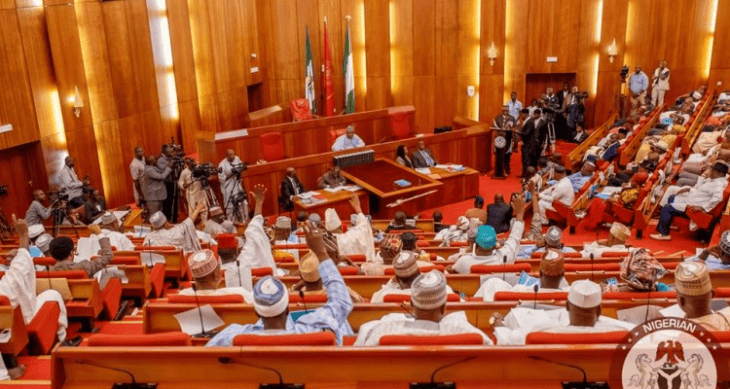
When the Senate revisited the issue, the chamber voted by division.
Fifty-five senators voted to retain electronic transmission as optional, while 15 senators voted to make it mandatory including Ireti Kingibe, Aminu Tambuwal, Abdul Ningi and Natasha Akpoti-Uduaghan among others most of whom where from the opposition parties.
Following the vote, the House of Representatives reversed its earlier position and adopted the Senate’s version, clearing the bill for presidential assent.
Under the final version of Clause 60(3):
• Results must be electronically transmitted after Form EC8A is completed, signed and stamped at the polling unit.
• Where electronic transmission fails due to network challenges, the physically signed EC8A becomes the primary basis for collation and declaration.
Supporters described this as a pragmatic balance. Critics called it a dilution of reform.
Tinubu Explains His Decision

President Tinubu defended his assent, arguing that while technology enhances transparency, elections ultimately remain a human process.
He cited concerns about broadband capacity, technical glitches and cyber interference, insisting that reliance on Form EC8A would reduce risks of hacking and system failure.
“No matter how good the system is, it’s managed by the people,” the president said, adding that ballots are still cast, sorted and counted manually before any transmission occurs.
Legal Pushback and Expert Warnings
In an interview with Pinnacle Daily, a senior lawyer Monday Adjeh described the Senate’s position as a setback that could weaken Nigeria’s electoral integrity.
He argued that manual result transmission contributed to the collapse of several election petitions after 2023, noting that when the law allows options, manipulation becomes easier.
Adjeh dismissed claims of network inadequacy, suggesting satellite internet solutions such as Starlink, as part of solution that can be deployed.
He accused political actors of hiding self-interest behind infrastructure arguments.
“If network issues affected lawmakers’ salaries, solutions would appear overnight,” he said.
He added that arguing that technology is not Nigeria’s real problem — political will is.
Mike Igini: ‘The Judiciary Is the Missing Link’
Former INEC commissioner Mike Igini, speaking on Arise Television, traced Nigeria’s electoral crisis to judicial interpretations that, in his view, weakened technological reforms.
He cited Supreme Court rulings that limited the legal authority of smart card readers and later reduced IReV to a “viewing centre,” undermining its evidentiary value.
According to Igini, optional e-transmission and heavy reliance on EC8A revive a system vulnerable to abuse, intimidation and post-election violence.
He added that the most visible option is the judiciary “The judiciary must stand tall in defence of democracy,” he said, warning that inconsistent rulings send dangerous signals about the sanctity of the vote.
Timeline of E-Transmission of Result Development in Nigeria
- 2011: Early Experiments
The Independent National Electoral Commission (INEC) first experimented with transmitting results via Short Messaging System (SMS) during off-cycle and bye-elections. - 2020: Introduction of IReV
The INEC Result Viewing (IReV) portal was introduced during the Nasarawa Central State Constituency bye-election. It was later used in the 2020 Edo and Ondo State governorship elections to upload scanned copies of result sheets (Form EC8A) directly from polling units. - 2022: Legal Framework
The Electoral Act 2022 empowered INEC to determine the “manner” of result transmission, though it did not explicitly mandate electronic transmission as the sole legal method. - 2023: Full-Scale Deployment
The Bimodal Voter Accreditation System(BVAS) was used for both accreditation and result transmission in the 2023 General Elections. Over 530,000 result sheets were expected to be uploaded to the IReV portal, though technical delays in presidential result uploads sparked significant controversy. - 2026: Mandatory Mandate
In February 2026, President Bola Tinubu signed an amended Electoral Act that formally mandates presiding officers to electronically transmit results from polling units immediately after recording them. However, manual collation remains a legal fallback in cases of technical glitches or network failure.
Key Changes In the Electoral Act 2026
The new law introduces several significant reforms Including:
1. Voter registration documents reduced to birth certificate, passport or NIN.
2. Voters can download their voter cards online.
3. Electronic transmission to IReV is compulsory, subject to EC8A fallback.
4. Political parties may use only direct primaries or consensus.
5. INEC election funds must be released at least six months before polls.
6. Parties must submit candidates 120 days before elections.
7. INEC must publish final candidate lists 60 days before election day.
8.The Act significantly raises campaign finance ceilings. Presidential candidates can now spend up to ₦10 billion, while governorship candidates are capped at ₦3 billion, reflecting inflation and the rising cost of electioneering.
The 2026 Act also raises the campaign spending limit for Senate candidates from ₦100 million to ₦500 million, while the ceiling for House of Representatives candidates has been increased from ₦70 million to ₦250 million.
For State House of Assembly elections, the spending limit has been raised from ₦30 million to ₦100 million.
9. Penalty of two years’ imprisonment or a fine ranging from ₦500,000 to ₦2 million, or both, for offences such as vote-buying, impersonation and result manipulation.
10. Six-month jail term or a fine of ₦500,000, or both, for any presiding officer who wilfully frustrates the electronic transmission of election results.
11. A certified true copy of a court order shall be sufficient for the swearing-in of any candidate declared winner by the court where INEC fails, refuses, or neglects to issue a certificate of return.
What Lies Ahead
In signing the Electoral Act Amendment Bill 2026, President Bola Tinubu has settled the legal framework for the 2027 general elections but not the national argument over credibility, trust and reform.
While the new Electoral Act is certain, what remains unclear is the intention behind the resistance to using live transmission of election results.
Although the law now recognises both electronic and manual transmission of results, opposition politicians argue that opportunities for electoral manipulation through Form EC8A still exist.
This is because the law allows electronic uploading of results only after Form EC8A has been completed, signed, and stamped at each polling unit, leaving room for potential interference despite the approved live transmission framework.
While the government insists the new law balances innovation with Nigeria’s realities, opposition voices, including the African Democratic Congress, civil society groups and election experts see a compromise that stops short of the transparency Nigerians demanded after 2023.
As Nigeria moves closer to 2027, attention now shifts from lawmakers to institutions like INEC and the Judiciary.
Senator Natasha Akpoti-Uduaghan of Kogi Central in her facebook post, urged Nigerians to actively hold INEC accountable, calling for strict compliance with the law, equitable treatment of all parties, effective use of technology for voter accreditation and result transmission, timely logistics, and protection of the voters’ register.
She stressed the need for close collaboration with security agencies to ensure peaceful elections, prompt publication of results, and transparency in the ₦873 billion election budget.
Akpoti-Uduaghan also encouraged scrutiny of BVAS quality, software improvements for BVAS and IReV, and possible partnerships with network providers such as Starlink to ensure nationwide coverage. She reminded citizens that laws are dynamic and can be challenged in court, urging judicial recourse for any concerns with the Electoral Act 2026.

Rafiyat Sadiq is a political, justice, and human rights reporter with Pinnacle Daily, known for fearless reporting and impactful storytelling. At Pinnacle Daily, she brings clarity and depth to issues shaping governance, democracy, and the protection of citizens’ rights.