

Nigeria has more adults, more registered voters and better election technology than at any other time in its democratic history. Yet one problem continues to grow quietly with every election cycle: millions of Nigerians no longer believe their votes matter.
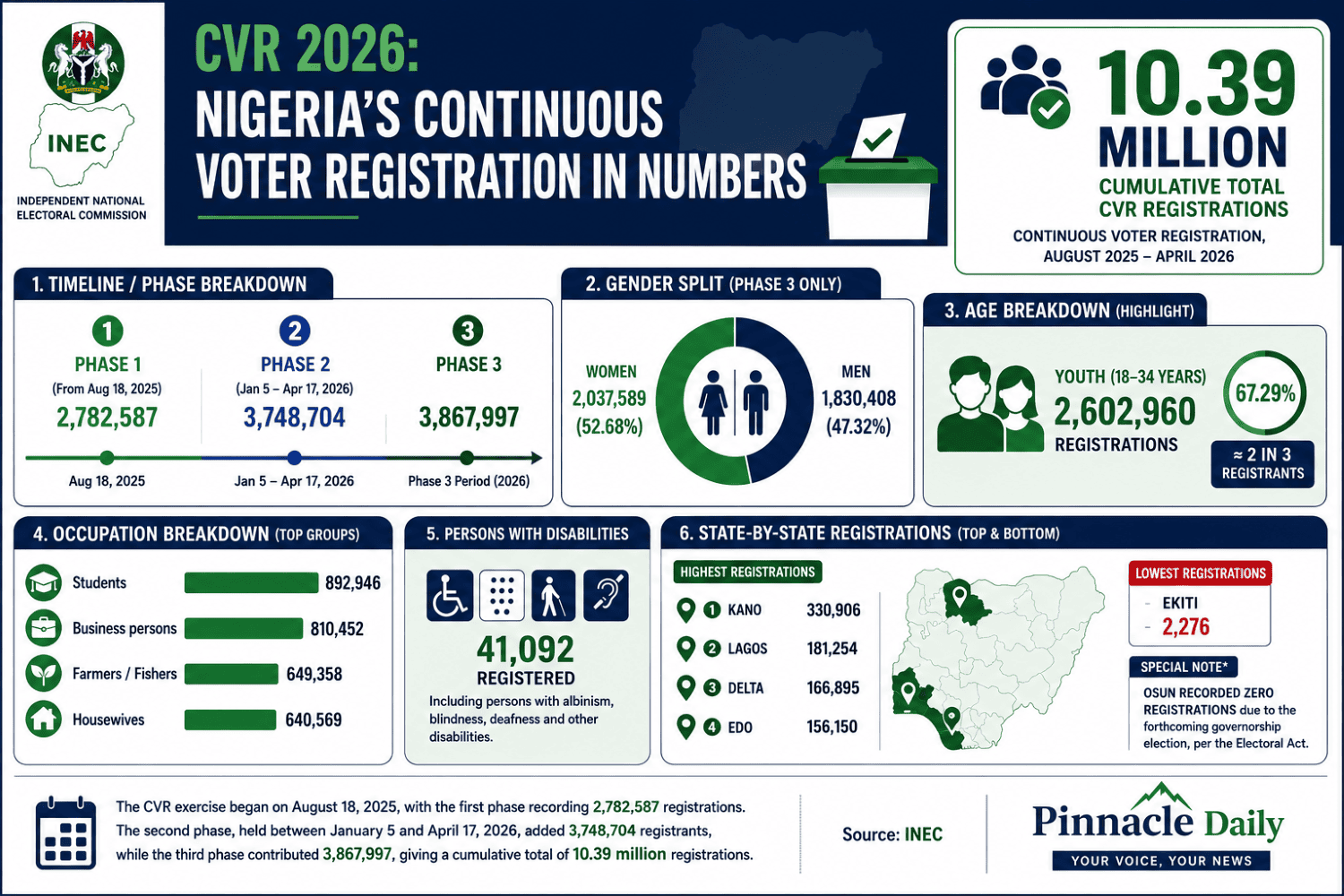
Ahead of the 2027 general election, the Independent National Electoral Commission (INEC) has registered a cumulative 10,399,288 new prospective voters across the three phases of the Continuous Voter Registration (CVR) exercise.
The exercise, initially scheduled to end on July 10, was extended by two weeks to July 26, 2026, after the commission cited the need to accommodate more prospective voters.
Yet beneath the growing voter register lies a deeper crisis.
According to Worldometer’s analysis of the latest United Nations data, Nigeria’s population has risen to an estimated 242.4 million in 2026, with between 123 million and 126 million citizens now aged 18 years and above—the largest voting-age population in the country’s history.


Break Down of Nigeria’s New Voter Register
Figures released by INEC on Wednesday show that the third phase, which ended on July 26, 2026, comprised 1,170,134 online registrations and 2,697,863 physical registrations, bringing the year-long exercise to a close.
If all the registrations are validated, Nigeria’s voter register could increase from 93,469,008 used for the 2023 general election to about 103.9 million ahead of the 2027 polls.
However, INEC said the final figure would be lower after data clean-up to remove duplicate registrations, deceased voters and other invalid entries.
RELATED NEWS:
- INEC Dismisses Fake Reports of Revised 2027 Campaign Timetable
- INEC Extends PVC Collection in Osun Ahead of Governorship Poll
- INEC Restores 21 Suppressed Assembly Constituencies in Four States Ahead of 2027 Elections
- Women’s Groups Storm N’Assembly, Demand Urgent Passage of Special Seats Bill Ahead of INEC Deadline
- INEC Reports 6.2m Voter Registrations, Majorly Youths, Students
- The Prince of Daura: Can Yusuf Buhari Build a Legacy in His Father’s Shadow?
The CVR exercise began on August 18, 2025, with the first phase recording 2,782,587 registrations. The second phase, held between January 5 and April 17, 2026, added 3,748,704 registrants, while the third phase contributed 3,867,997, giving a cumulative total of 10.39 million registrations.
Women accounted for 2,037,589 (52.68%) of registrants in the third phase, while men recorded 1,830,408 (47.32%). Young people aged 18 to 34 years dominated the exercise with 2,602,960 registrations (67.29%).
Students formed the largest occupational group with 892,946 registrations, followed by business persons (810,452), farmers and fishers (649,358) and housewives (640,569).
INEC also registered 41,092 persons with disabilities, including persons with albinism, blindness, deafness and other disabilities.
State-by-state figures showed Kano recorded the highest number of registrations (330,906), followed by Lagos (181,254), Delta (166,895) and Edo (156,150). Ekiti recorded the lowest figure with 2,276 registrations, while no registration took place in Osun State because of the forthcoming governorship election, in line with the Electoral Act.
A Registration Exercise Marked by Challenges
While INEC introduced new innovations during the latest CVR exercise, including an online self-service registration portal that allowed first-time voters to begin the registration process remotely, the exercise was not without difficulties.
Pinnacle Daily observed persistent technical glitches on the CVR portal, including delays in generating verification codes for prospective registrants.
The commission’s CVR mobile application on the Google Play Store also attracted numerous negative reviews from users who reported difficulties downloading or using the app, while others said they could only complete the process through a web browser.
Beyond technical challenges, the exercise was repeatedly disrupted by controversies.
Apart from temporary suspensions to accommodate off-cycle elections, INEC extended registration deadlines because of operational challenges and later faced widespread criticism over its proposed nationwide voter revalidation exercise.
The commission explained that the proposed exercise was intended to remove deceased voters, eliminate duplicate registrations and update voter records. However, following public backlash, it suspended the physical rollout while continuing internal preparations.
The PVC collection process also generated controversy.
In Anambra State, a commotion erupted at an INEC office in Onitsha South Local Government Area after officials were accused of demanding ₦2,000 from applicants to process voter registration and issue Permanent Voter Cards.
Although the allegation, which surfaced in a viral video, generated widespread public reaction, INEC maintained that voter registration and PVC collection remain free of charge and urged Nigerians to report any cases of extortion.
Decline in Voter Participation Affects Nigeria’s Elections.
Despite the increase in newly registered voters, voter turnout has continued to decline with every election cycle.
Rather than signalling renewed democratic enthusiasm, the figures have revived an uncomfortable question that has shadowed Nigeria’s elections for nearly two decades:
Why are millions of eligible Nigerians choosing not to participate?
The question has become even more urgent following the 2023 general election, which produced the lowest voter turnout since Nigeria returned to democratic rule in 1999.
Although 93,469,008 million Nigerians registered to vote and 87.2 million collected their Permanent Voter Cards (PVCs), only 24.9 million people (26.72 per cent of registered voters) eventually cast their ballots in the presidential election.
The implication was striking. President Bola Tinubu won the election with 8.79 million votes—almost 16 million fewer votes than were secured by the winner of the 2007 presidential election, despite Nigeria’s significantly larger population and voter register.
INEC’s own records show a steady decline in voter turnout over the years.
Participation fell from 57.54 per cent in 2007 to 53.68 per cent in 2011, dropped further to 43.65 per cent in 2015, declined to 34.75 per cent in 2019, before reaching 26.72 per cent in 2023.
The trend contrasts sharply with Nigeria’s early democratic years. Following the return to civilian rule in 1999, voter participation exceeded 50 per cent and peaked at almost 70 per cent during the 2003 elections.
Today, despite a larger population, improved voter registration technology and wider access to electoral information, fewer Nigerians are willing to vote.
Beyond Registration Lies a Crisis of Confidence
Available research suggests that the problem extends beyond voter registration.
Studies by Friedrich-Ebert-Stiftung and SEAHI Publications identify deep public distrust, election-related violence, voter suppression, technological failures, weaknesses in the voter register and gender exclusion as major barriers to electoral participation.
Former President Goodluck Jonathan, who has observed elections across Africa and Asia since leaving office, recently described Nigeria as having one of the lowest voter turnouts among the countries where he has monitored elections.
“We have the worst voter apathy,” Jonathan said, urging INEC to investigate the causes and urgently reverse the trend before the 2027 general election.
That warning is shared by election stakeholders.
Former INEC spokesman Rotimi Oyakanmi blamed voter apathy partly on provisions of the Electoral Act that restrict voters to their registered polling units, effectively disenfranchising many Nigerians working outside their places of registration on election day.
He also cited unfulfilled campaign promises and the spread of misinformation as reasons many citizens have become disillusioned with elections.
Similarly, Convener of the Movement for Credible Elections (MCE), Wale Okunniyi, warned that the defining question ahead of the 2027 elections may not be which political party wins power, but whether enough Nigerians still believe the ballot remains an effective instrument for democratic change.
The President of the Nigeria Youths in Politics, Blessing Oyefeso, identified voter apathy among young Nigerians as a major threat to the country’s democracy, attributing it to widespread distrust in the electoral system and the belief that votes do not count.
He stressed that rebuilding confidence in the electoral process is essential to increasing youth participation and mobilising young Nigerians ahead of the 2027 general elections.
Why Confidence Has Worn Thin


High Costs and Monetised Politics
A Crisis of Governance and Judicialised Elections
READ ALSO:
- APC Did Not Use INEC to Weaken ADC, Opposition: Aliyu Faruk
- Nigeria @ 65: Why Citizens Are No Longer Interested in Elections, Crisis Bedevilling Democracy
- Nigeria @65: How Erosion of Trust Has Challenged Judicial Integrity
- Did Staying in Buhari’s Cabinet Cost Malami His Political Future?
- FCT Election: Does Wike’s Triumph Over Atiku, Obi Change Power Dynamics?
Prof. Fage described the situation as a “voters’ revolt. In political science, he explained, this phenomenon manifests in two ways: some citizens withdraw completely from the process because they have lost hope, while others participate actively with the sole purpose of voting out an unpopular government.
In Nigeria’s case, however, many citizens have been discouraged from participating entirely due to the belief that corruption, systemic manipulation, and structural irregularities completely undermine the value of their votes,” he explained.
“Unfortunately, in Nigeria, we often practise what I call the ‘rule of opportunity’ rather than the rule of law. Every Nigerian, regardless of status, should be subject to the law. There should be no sacred cows, and there must be consequences for violating the law,” he said.
The Legal Path to Reclaiming the Ballot

Rafiyat Sadiq is a political, justice, and human rights reporter with Pinnacle Daily, known for fearless reporting and impactful storytelling. At Pinnacle Daily, she brings clarity and depth to issues shaping governance, democracy, and the protection of citizens’ rights.