

The National Economic Council (NEC) has resolved to intensify stakeholder engagement to boost Nigeria’s non-oil revenue base and reduce dependence on crude oil earnings.
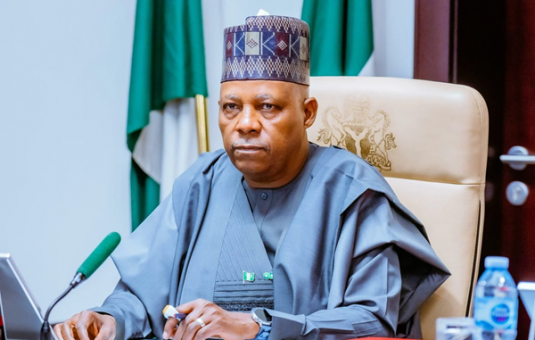
The decision followed deliberations at the Council’s 156th meeting, held virtually on Thursday and chaired by Vice President Kashim Shettima.
Shettima urged faster movement toward a non-oil economy driven by competitive manufacturing, export diversification, and stronger private sector participation. He said the shift aligns with the economic blueprint of President Bola Ahmed Tinubu’s administration.
According to a statement by the Senior Special Assistant to the President on Media and Communications, Office of the Vice President, Mr Stanley Nkwocha, NEC also approved the establishment of a committee to implement the President’s directive on priority legacy projects nationwide.
The newly constituted committee will be chaired by the Governor of Cross River State. It will include one governor from each geopolitical zone: Sokoto (North-West), Gombe (North-East), Niger (North-Central), Abia (South-East), and Lagos (South-West).
The ministers of works and transportation will also serve as members. The Permanent Secretary of the Federal Ministry of Budget and Economic Planning, Mrs Deborah Odoh, will act as secretary to the committee.
NEC took the decision after reviewing a presentation on Nigeria’s economic priorities for 2026 by the Minister of Finance and Coordinating Minister of the Economy, Mr Wale Edun.
Edun told the Council that reforms under the Tinubu administration have removed long-standing distortions in the economy. He said the measures have stabilised key indicators and positioned Nigeria for sustained recovery.
He added that global recognition of Nigeria’s reforms has strengthened investor confidence. The economy, he said, is projected to grow by 4.68 per cent in 2026.
According to Edun, the government will focus on maintaining economic competitiveness through sound governance. Other priorities include improving food availability and affordability, strengthening human capital development, expanding social protection, and ensuring timely payment of salaries, pensions, and debt obligations.
NEC commended the Federal Government’s plans to unlock job-rich growth, expand entrepreneurship, and create high-quality employment across the country.
Food security takes centre stage
The Council also resolved to dedicate a special session to Nigeria’s food security challenges. Members agreed to focus on issues limiting agricultural productivity and food supply.
In his opening remarks, Vice President Shettima warned that global economic conditions would remain unstable. He said rising geopolitical tensions would continue to affect commodity markets.
“Oil prices, exchange rates, and capital flows will keep frustrating national policies,” he said.
Shettima stressed the need for stronger fiscal risk management. He said Nigeria must further reduce its exposure to oil-related revenue shocks.
Shettima revealed that the non-oil economy now accounts for about 96 per cent of Nigeria’s Gross Domestic Product (GDP). He said it continues to grow at an average rate of four per cent.
“Services, agriculture, and other non-oil sectors now carry the economy,” he said. “More importantly, non-oil revenues contribute nearly three-quarters of total government collections.”
He described the development as a gradual but significant break from Nigeria’s historic reliance on oil receipts. He urged the Council to deepen the transition through export diversification, competitive manufacturing, and private sector investment.
READ ALSO:
- Oil Falls as Trump Eases Iran Tensions; Tech Stocks Lift Global Markets
- NUPRC Set to Host Pre-bid Conference on 2025 Oil and Gas Licensing Round
- Oil Prices Jump 1.7% Amid Iran Unrest, Supply Disruption Concerns
- Access, Oando, Conoil Among 2025’s Biggest Stock Laggards
Although this marked NEC’s first meeting of 2026, Shettima said decisions taken in 2025 demand consistency and courage in the new year.
He noted that Nigeria recorded strong growth in 2025, which he attributed to President Tinubu’s leadership.
“In 2025, the economy expanded by 3.9 per cent, the fastest growth in over a decade,” he said. “Growth rose from 3.13 per cent in the first quarter to 4.23 per cent in the second, before moderating to 3.98 per cent in the third.”
However, the vice president cautioned that the growth rate remains insufficient.
“A 3.9 per cent growth rate cannot decisively reduce poverty or create jobs at the scale Nigerians need,” he said. “With population growth at about 2.6 per cent, our ambition must be higher.”
The Accountant-General of the Federation briefed the Council on national account balances as of January 14, 2026. He reported that the Excess Crude Account stood at $535,823.39. The Stabilisation Account recorded ₦64.65 billion, while the Natural Resources Account stood at ₦97.37 billion.
NEC also received updates on the implementation of President Tinubu’s directives on the Lagos-Calabar and Sokoto-Badagry Super Highways.
Members recalled that the President addressed the NEC at its 150th meeting on July 31, 2025. He had stressed the need to manage setbacks along the corridors to attract investment and stimulate economic activity.
The NEC Secretariat confirmed that implementation has commenced under the supervision of the Office of the Secretary to the Government of the Federation (SGF). It also disclosed that the Office of the Surveyor-General of the Federation has moved to the Presidency in compliance with the directive.
The Presidential Fiscal Policy and Tax Reforms Committee also presented an update on Nigeria’s tax reform laws.
The committee outlined efforts to address inequity, fix the fragmented tax system, and promote shared prosperity. NEC directed the committee to prepare a comprehensive brief for its February conference.
The Council said the session would help sub-national governments prepare for effective implementation of the new tax regime. It also resolved to deepen engagement on the reforms nationwide.

Esther Ososanya is an investigative journalist with Pinnacle Daily, reporting across health, business, environment, metro, Fct and crime. Known for her bold, empathetic storytelling, she uncovers hidden truths, challenges broken systems, and gives voice to overlooked Nigerians. Her work drives national conversations and demands accountability one powerful story at a time.