

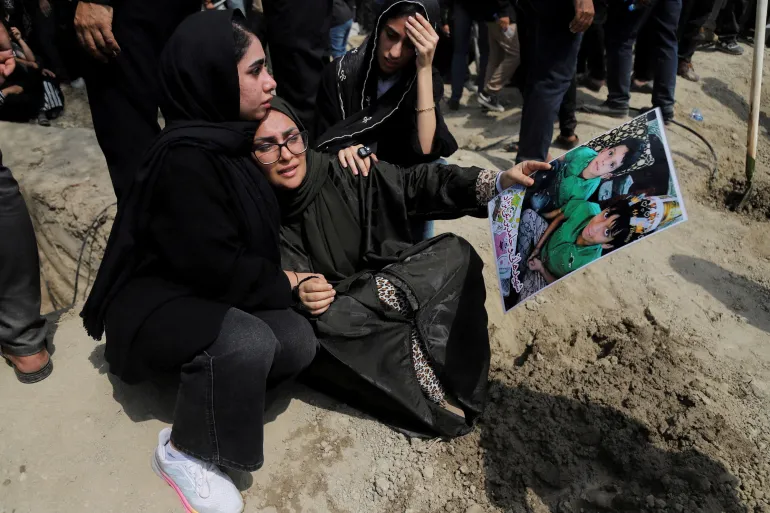
On the sixth day of the war between the United States, Israel and Iran, the conflict has intensified inside Iran while tensions continue to spread across the Middle East.
Iran has threatened global shipping in the Strait of Hormuz, while hostilities are expanding across several fronts, including the Gulf region, Lebanon and Iraq. In a separate development, a U.S. submarine reportedly sank an Iranian warship off the coast of Sri Lanka.
Situation Inside Iran
Iranian state media reported that the death toll from five days of US-Israeli attacks had risen to 1,045, with more than 6,000 people injured.
Attention has also turned to the issue of succession following the death of Iran’s Supreme Leader, Ali Khamenei. His son, Mojtaba Khamenei, has emerged as a leading contender for the position after years of building influence within the political establishment and forging close ties with the Islamic Revolutionary Guard Corps (IRGC).
Iran’s Ministry of Foreign Affairs has accused the United States and Israel of striking 33 civilian sites across the country. The locations reportedly include hospitals, schools, residential areas, the Tehran Grand Bazaar and the historic Golestan Palace complex.
RELATED NEWS:
- At Least 100 Missing After Iranian Military Ship Sinks Off Sri Lanka Coast
- Thousands of Flights Remain Cancelled, Billions of Dollars Lost as U.S.-Israel War Against Iran Continues
- Iran–US–Israel War: CPPE Flags Inflation Threat to Nigeria
On Wednesday, a US submarine reportedly fired a torpedo that sank the Iranian frigate Iris Dena in the Indian Ocean off the southern coast of Sri Lanka, widening the scope of the conflict. Sri Lanka’s navy said it recovered 87 bodies and rescued 32 survivors.
Meanwhile, Kurdish-Iranian armed groups are reportedly launching a ground offensive in northwestern Iran against the government. United States officials have also reportedly asked Kurdish forces in northern Iraq to assist in cross-border military operations, placing them on standby for possible involvement in the conflict.
The IRGC also announced the closure of the Strait of Hormuz on Wednesday, warning that Iranian forces could target ships in the strategic waterway. The threat has significantly disrupted maritime activity in the area.
Iranian President Masoud Pezeshkian also praised Spain for refusing to allow the United States to use its military bases for operations related to the war. In response, US President Donald Trump threatened to halt trade with Spain.
Developments in Gulf Countries
Iran’s retaliatory strikes have begun affecting oil flows across the Middle East.
In Saudi Arabia, the US Secretary of State and the Saudi foreign minister discussed what they described as continued threats posed by Iran to regional stability. The Saudi Ministry of Foreign Affairs also condemned an Iranian drone attack on the US embassy in Riyadh on Tuesday.
Authorities in Qatar have started evacuating residents living near the US Embassy in Doha, describing the move as a temporary precautionary measure.
Qatar’s Foreign Minister, Mohammed bin Abdulrahman bin Jassim Al Thani, has also spoken with Iran’s Foreign Minister, Abbas Araghchi, for the first time since the conflict began. During the call, he called for an immediate halt to the strikes and warned that Iran was attempting to draw neighbouring countries into the conflict.
Meanwhile, an explosion was reported near a tanker anchored about 30 nautical miles southeast of Mubarak al-Kabeer in Kuwait.
Volodymyr Zelenskyy, President of Ukraine, also held discussions with officials in Qatar and other Gulf nations on plans to deploy Ukrainian experts to assist in defending against Iranian drone and missile attacks.
Situation in Israel
The Israeli military announced a new wave of strikes targeting military infrastructure in Tehran.
United States and Western officials said the joint operations had destroyed a significant portion of Iran’s military capabilities. According to them, Israeli and US aircraft are now able to operate over Iranian territory with little resistance.
Inside Israel, the military has slightly relaxed wartime safety regulations, moving from “essential activities only” to allowing limited civilian activities.
Developments in the United States
In Washington, the United States Senate voted 53–47 against a proposal that would have required the Trump administration to obtain congressional approval to continue the war with Iran, effectively halting a bipartisan War Powers resolution.
Public opinion in the United States appears divided. A Reuters/Ipsos poll found that about 25 percent of respondents supported the US-Israeli attacks, while 43 percent opposed them.
The White House has strongly defended the military action. Press Secretary Karoline Leavitt said the administration’s objectives were to eliminate Iran’s nuclear ambitions and destroy its naval capabilities.
President Trump also claimed that Iran was close to developing a nuclear weapon.
“If we didn’t hit within two weeks, they would’ve had a nuclear weapon,” he said.
Developments in Lebanon, Iraq and Beyond
In Lebanon, tensions have escalated as Israeli forces launched attacks on several areas, including Beirut and Khiam, while exchanging heavy fire with the militant group Hezbollah.
In Iraq, a drone struck a building near Erbil International Airport, while Kurdish forces in the region are reportedly on standby for possible cross-border operations into Iran.
Meanwhile, NATO air defence systems in the eastern Mediterranean intercepted and destroyed an Iranian ballistic missile that had entered the airspace of Turkiye.
Mark Kimmitt, a retired US general, said the incident represented a deliberate attempt by Iran to fire into the territory of a country not directly involved in the conflict.
China has also weighed in on the situation. The foreign minister of China called for an immediate halt to the military action during a phone call with his Israeli counterpart, according to the Chinese foreign ministry.

Rafiyat Sadiq is a political, justice, and human rights reporter with Pinnacle Daily, known for fearless reporting and impactful storytelling. At Pinnacle Daily, she brings clarity and depth to issues shaping governance, democracy, and the protection of citizens’ rights.