

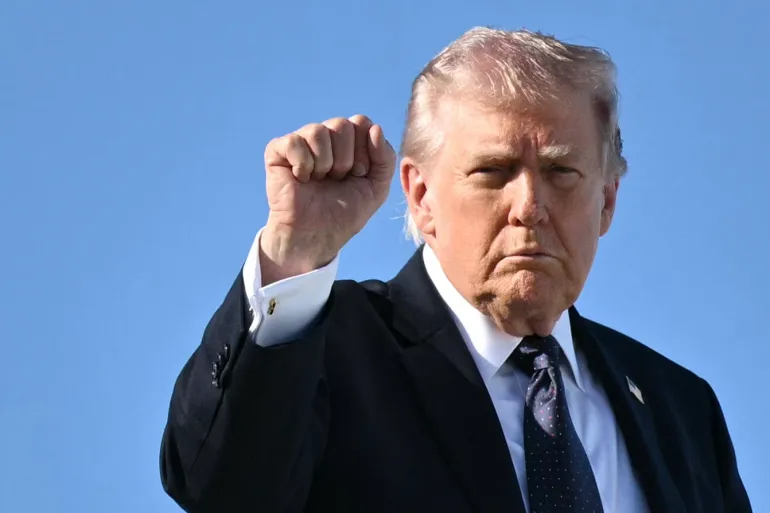
United States President Donald Trump has pledged to continue military operations against Iran, describing the campaign as a “righteous mission” that will persist until “all objectives are achieved”, while acknowledging that additional US troops are likely to be killed.
Trump made the remarks in a video posted on his Truth Social account on Sunday, where he again framed the conflict as a response to what he described as an existential threat to the United States.
He said an Iranian government equipped with long-range missiles and nuclear weapons would pose a grave danger to Americans.
The comments followed Saturday’s US-led attacks, carried out alongside Israel, which killed Iran’s Supreme Leader Ayatollah Ali Khamenei and several senior figures within the country’s leadership.
US officials have repeatedly asserted that Iran posed an imminent threat, though no evidence has been publicly presented to show that Tehran was developing a missile capable of striking the United States or was close to acquiring nuclear weapons.
Iran has consistently denied pursuing nuclear arms, and experts have stated that any such effort would still be several years from completion.
The attacks occurred amid ongoing US-Iran talks over Tehran’s nuclear programme.
Acknowledgement of US Casualties
Trump also referred to the deaths of three US military personnel confirmed on Sunday, following Iran’s regional retaliation.
“As one nation, we grieve for the true American patriots who have made the ultimate sacrifice for our nation, even as we continue the righteous mission for which they gave their lives,” Trump said.
“And sadly, there will likely be more before it ends,” he added. “That’s the way it is — likely be more, but we’ll do everything possible where that won’t be the case.”
He said the United States would avenge the deaths and deliver what he described as a decisive blow against those he accused of waging war on civilisation.
Diplomatic Signals Absent From Speech
Trump’s remarks contrasted with comments he made earlier in the day, in which he suggested that diplomatic engagement with Iran remained possible.
“They want to talk, and I have agreed to talk, so I will be talking to them,” Trump told The Atlantic, referring to what the publication described as Iran’s new leadership.
He said negotiations could have been concluded earlier, but accused Tehran of delaying.
A White House official later confirmed that Trump was open to talks with Iran’s new leaders.
Earlier on Sunday, Tehran announced the formation of a three-member interim leadership council following Khamenei’s killing. The council includes President Masoud Pezeshkian, Chief Justice Gholam-Hossein Mohseni-Ejei, and Guardian Council member Alireza Arafi.
RELATED NEWS:
- Iran–US–Israel War: CPPE Flags Inflation Threat to Nigeria
- Iran Forms Interim Govt after Supreme Leader Killed in US-Israeli Strikes
- U.S.-Israeli Attack on Iran: FAAN Issues Travel Advisory as Flight Disruptions Rock Middle East
Trump acknowledged that some Iranian negotiators involved in previous talks with the United States had since been killed in the attacks.
Analysts have suggested that Iran’s new leadership may be reluctant to engage with the Trump administration, pointing to previous negotiations during which US and Israeli strikes were launched. Some experts have warned that Tehran could instead pursue a prolonged conflict that may prove politically damaging for Trump.
Calls for Regime Change
In his Sunday address, Trump made no reference to diplomacy, instead renewing calls for regime change in Iran.
He again offered amnesty to members of Iran’s security forces, including the Islamic Revolutionary Guard Corps (IRGC), who lay down their arms, warning that those who do not would face “certain death”.
Trump also urged what he described as Iranian patriots to seize the moment and reclaim their country, referencing earlier threats made in January in response to Tehran’s crackdown on protesters.
“I made a promise to you, and I fulfilled that promise,” he said. “The rest will be up to you. We’ll be there to help.”
Fighting Spreads Across the Region
Trump’s comments came as fighting continued across the Middle East.
The US military’s Central Command (CENTCOM) confirmed the deaths of three US service members on Sunday, stating that five others were seriously wounded. While CENTCOM did not disclose further details, US media reported that the troops were based in Kuwait.
Iran has launched attacks on multiple countries in the region, including Qatar, the United Arab Emirates, Saudi Arabia, Jordan, Bahrain and Oman.
At least 201 people have been killed in Iran, with 747 wounded, while at least nine people have been killed and 121 wounded in Israel. In Kuwait, one person has been reported killed, with three deaths in the UAE and two in Iraq since the escalation began.
Iran’s IRGC claimed on Sunday that it had targeted the USS Abraham Lincoln aircraft carrier with four ballistic missiles. A US official, however, told Al Jazeera that the carrier sustained no damage.
In a separate interview with Fox News, Trump said 48 Iranian “leaders” had been killed, though no comprehensive list has been released. In posts on Truth Social, he said US forces had destroyed and sunk nine Iranian naval vessels and largely destroyed Iran’s naval headquarters.
CENTCOM later said in a post on X that the IRGC “no longer has a headquarters”.
Iran’s Foreign Minister Abbas Araghchi said the country’s military command had been disrupted, with units operating independently under previously issued instructions. Despite this, he said Iran would continue to defend its people without limitation.

Rafiyat Sadiq is a political, justice, and human rights reporter with Pinnacle Daily, known for fearless reporting and impactful storytelling. At Pinnacle Daily, she brings clarity and depth to issues shaping governance, democracy, and the protection of citizens’ rights.