

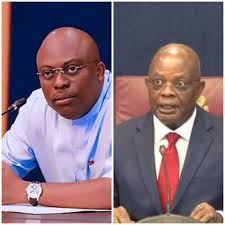
A Federal High Court in Abuja has dismissed three separate suits challenging the declaration of emergency rule in Rivers State, the suspension of elected officials, and the activities of the appointed administrator.
The suits were dismissed by Justice James Omotosho, who ruled that the cases were filed in the wrong court and that the plaintiffs lacked the necessary locus standi to institute the suits.
Court Dismisses First Suit
The first suit, filed by Belema Briggs, Princess Wai-Ogosu, I. Acho, Emmanuel Mark, and Hadassa Ada, sought to challenge the suspension of Governor Siminalayi Fubara and other elected officials.
The defendants included the President, Attorney General of the Federation, outgone administrator Vice Admiral Ibok-Ette Ibas (retired), and the Nigerian Navy.
READ ALSO: Court Dismisses Suit Challenging Rivers LG Election, Emergency Rule
Justice Omotosho upheld a preliminary objection raised by the defendants, noting that the plaintiffs had no right to file on behalf of all residents of the state without including the suspended officials as parties.
He stated that the plaintiffs failed to show that they were more affected by the emergency declaration than other residents and did not obtain consent from the state’s Attorney General before approaching the court.
The judge further held that the Federal High Court lacked jurisdiction, emphasizing that disputes arising from a state of emergency fall under the exclusive jurisdiction of the Supreme Court under the Emergency Powers (Jurisdiction) Act, 1962, and its 2025 modification.
Justification for Emergency Rule
Justice Omotosho rejected claims that the emergency declaration violated the plaintiffs’ fundamental rights, citing Section 45(1) of the Constitution, which allows for the derogation of rights in the interest of public order and safety.
He noted that Rivers State faced imminent threats to law and order, justifying the suspension of the Governor, Deputy Governor, and members of the House of Assembly, and the appointment of Vice Admiral Ibok-Ette Ibas as Sole Administrator.
READ ALSO: Rivers LG Election: Legality, Controversy and the Politics of Power
The judge explained that the President is vested with executive powers under Section 305(3) of the 1999 Constitution (as amended), where he is authorized to declare a state of emergency and take measures to restore peace, including the appointment of administrators to maintain security.
Judge Dismisses Other Suits
The other two suits were filed by The Incorporated Trustees of Riversbridge Peace Initiative and the Pilex Centre for Civic Education Initiative alongside Courage Nsirimovu.
Both challenged Ibas’ appointment as administrator and sought to restrain the government from releasing funds or appointing sole administrators for the state’s 23 local government areas.
In both cases, Justice Omotosho upheld preliminary objections raised by the defendants, including counsel Kehinde Ogunwumiju (SAN) representing Ibas, and dismissed the suits for lack of jurisdiction and locus standi.
Court’s Observations
The judge expressed concern over the plaintiffs’ lawyers, emphasizing that legal practitioners must conduct proper research before filing suits, determine the appropriate court, and ensure necessary parties are included. He warned that filing cases without proper basis is detrimental to the administration of justice and wastes court resources.
Justice Omotosho concluded: “Even if this court could exercise jurisdiction, the weight of evidence tilts heavily in favour of the defendants. Consequently, these suits are hereby dismissed in their entirety.”

Rafiyat Sadiq is a political, justice, and human rights reporter with Pinnacle Daily, known for fearless reporting and impactful storytelling. At Pinnacle Daily, she brings clarity and depth to issues shaping governance, democracy, and the protection of citizens’ rights.