

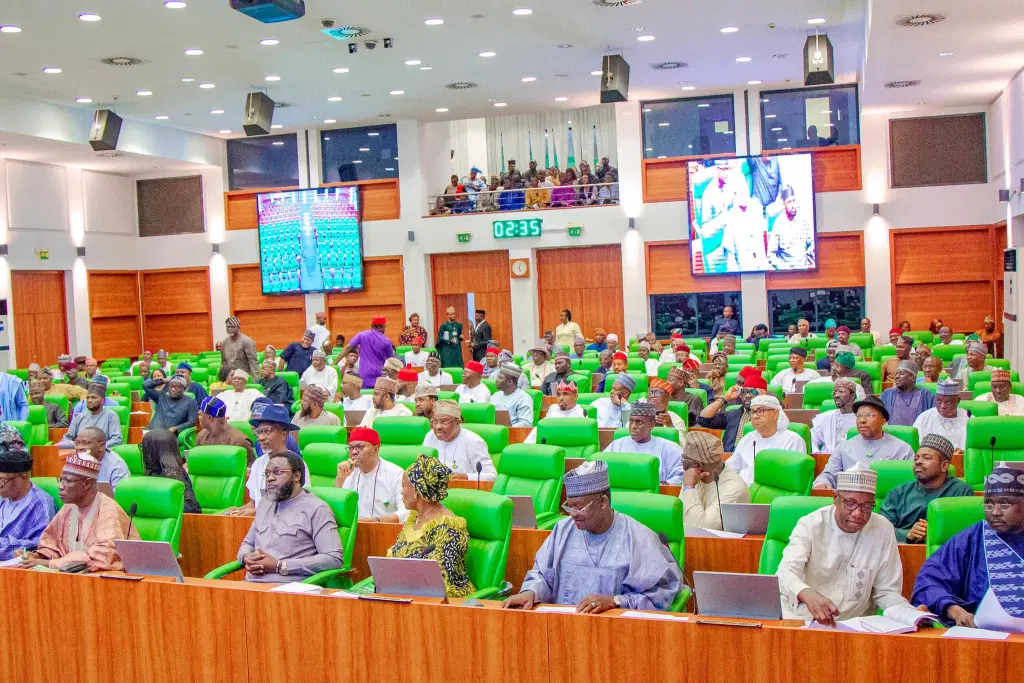
The House of Representatives Ad-hoc Committee investigating pre-shipment inspection of exports and the non-remittance of crude oil proceeds has directed key government agencies and a private sector body to submit comprehensive records related to its ongoing probe.
The directive followed concerns by lawmakers over incomplete documentation submitted by the agencies, as the committee seeks to ensure that all export proceeds due to the federation are fully remitted.
The Chairman of the Committee, Seyi Sowunmi (LP, Lagos), gave the directive on Wednesday during the committee’s resumed investigative hearing at the National Assembly after reviewing submissions presented by representatives of the agencies.
Sowunmi described the documents submitted as incomplete and outdated.
Those directed to provide detailed records are the Nigeria Customs Service (NCS), Nigerian Ports Authority (NPA), Central Bank of Nigeria (CBN) and the Nigerian Association of Chambers of Commerce, Industry, Mines, and Agriculture (NACCIMA).
The committee said it would communicate new dates for the agencies to reappear before the panel and submit the requested documents.
Agencies Explain Roles in Export Process
Earlier at the hearing, representatives of the agencies outlined their statutory responsibilities in the export chain, covering both oil and non-oil shipments.
Representing the Comptroller-General of Customs, Bashir Adeniyi, the Deputy Comptroller-General of the NCS, Caroline Diagwan, told the committee that the Service operates strictly within the provisions of its enabling Act and other applicable laws.
She explained that for food and other exports, the Service processes the Nigeria Export Proceeds (NXP) form, certificates of inspection and export permits.
Customs officers, she said, verify that the documentation corresponds with the goods physically presented at export points.
RELATED NEWS:
- Cocoa Slump Puts Nigeria’s $6.1bn Export Record at Risk — Oye
- Gbajabiamila: Reps Rejected FG Foreign Loan Over South-East Exclusion
- MEXC Releases February Proof of Reserve Report, BTC Coverage Rises to 267%
“Our role as regards the export of food is we get what we call NXP, and then a certificate of inspection, as well as an export permit. We now make sure that those documents tally with what has been exported at the point of export. So we do examination as well as physicalisation of food,” she said.
According to her, the Service conducts examinations and physical inspections to ensure consistency between export documents issued through the Central Bank platform and the export permit issued by the Nigerian Upstream Petroleum Regulatory Commission (NUPRC), particularly for oil-related shipments.
Diagwan, however, stressed that the Customs Service does not collect export duties and is not responsible for tracking payments made to the government from such exports.
She added that export operations are supervised at designated terminals, including the Oil and Gas Command in Port Harcourt and other commands covering Edo and Delta areas, with monthly operational returns submitted to headquarters.
CBN Explains Documentation Process
On its part, the Central Bank said it serves as the coordinating hub for export documentation through its digital platforms.
A director at the bank, Musa Nakurji, who represented the CBN Governor, Yemi Cardoso, said under the Pre-shipment Inspection Act, the apex bank manages the administrative framework for the process but does not appoint pre-shipment inspection agents.
He explained that the NXP process is automated and initiated by the exporter’s commercial bank through the CBN’s trade monitoring system, which is accessible to Customs.
“So in the Central Bank, we have the trade monetary system. This happens in the trade monetary system and the SVP. So from the bank, the commercial bank of the exporter, they open the form NXP,” he said.
Nakurji added that once goods are inspected by accredited pre-shipment agents for quantity, quality and value, a Clean Certificate of Inspection is issued before export proceeds are processed.
NPA, NACCIMA Clarify Roles
The Nigerian Ports Authority, represented by its General Manager, Tariff, Lukman, told the committee that the agency appoints monitoring agents at export terminals to oversee activities and relay information to the authority.
He said the NPA works with other government agencies at the ports within clearly defined jurisdictional boundaries.
Meanwhile, the Nigerian Association of Chambers of Commerce, Industry, Mines, and Agriculture said it does not play any role in crude oil exports.
A director of the association, Emmanuel Akeh, explained that the body issues certificates of origin for non-oil exports to verify the source and authenticity of goods destined for international markets.
Committee Seeks Accountability
In his remarks, Sowunmi said the investigation was aimed at plugging revenue leakages and ensuring full accountability for export proceeds.
He noted that the probe aligns with the administration’s broader objective of improving revenue transparency and strengthening fiscal accountability.
“Part of the problem the President is trying to cure is that we should account for everything that accrues to the nation. And that is what this committee seeks to achieve,” he said.
The committee chairman directed all agencies to submit comprehensive and up-to-date records at their next appearance before the panel.
He also ruled that any official appearing on behalf of the head of an agency must present a formal letter of authorisation empowering them to represent and speak for their institution.
The committee is expected to reconvene on a date to be communicated to the affected organisations.

Rafiyat Sadiq is a political, justice, and human rights reporter with Pinnacle Daily, known for fearless reporting and impactful storytelling. At Pinnacle Daily, she brings clarity and depth to issues shaping governance, democracy, and the protection of citizens’ rights.