Osun 2026: How Vote-Buying Could Shape the Governorship Election

As voters across Osun State prepare to head to the polls on Saturday, August 15, 2026, the contest has entered its most sensitive phase; the threshold where political mobilisation, state power, and the secret ballot intersect.
The build-up to the election has not been free from friction. Allegations and counter-allegations of political violence, voter intimidation, high-profile arrests, and increasingly sophisticated vote-buying schemes have dominated the final days of campaigning across all thirty local government areas.
Officially, the election is a contest of ideas, policy frameworks, and candidate merit. Yet beneath the public rallies lies a parallel competition: a high-stakes race to track voter preferences, harvest personal identity data, and put a monetary price on individual ballots.
Yiaga Africa reported alleged early cash transfers of about ₦10,000 to prospective voters and raised concerns over a data-driven inducement model in which voters’ VINs, NINs and bank details were reportedly collected before payments were made.
The concerns were further heightened by the police arrest of Osun’s Secretary to the State Government, Teslim Igbalaye, and others over alleged vote buying, with ₦4.8 million, voter registers, PVCs and other materials reportedly recovered.
Taken together, the reports suggest that the battle for Osun is being fought not only through manifestos and political mobilisation, but increasingly through cash, voter data and organised inducement—raising questions about how much influence money will have over the choices voters make at the ballot box.

Electoral Readiness and the Political Field
 

osun election

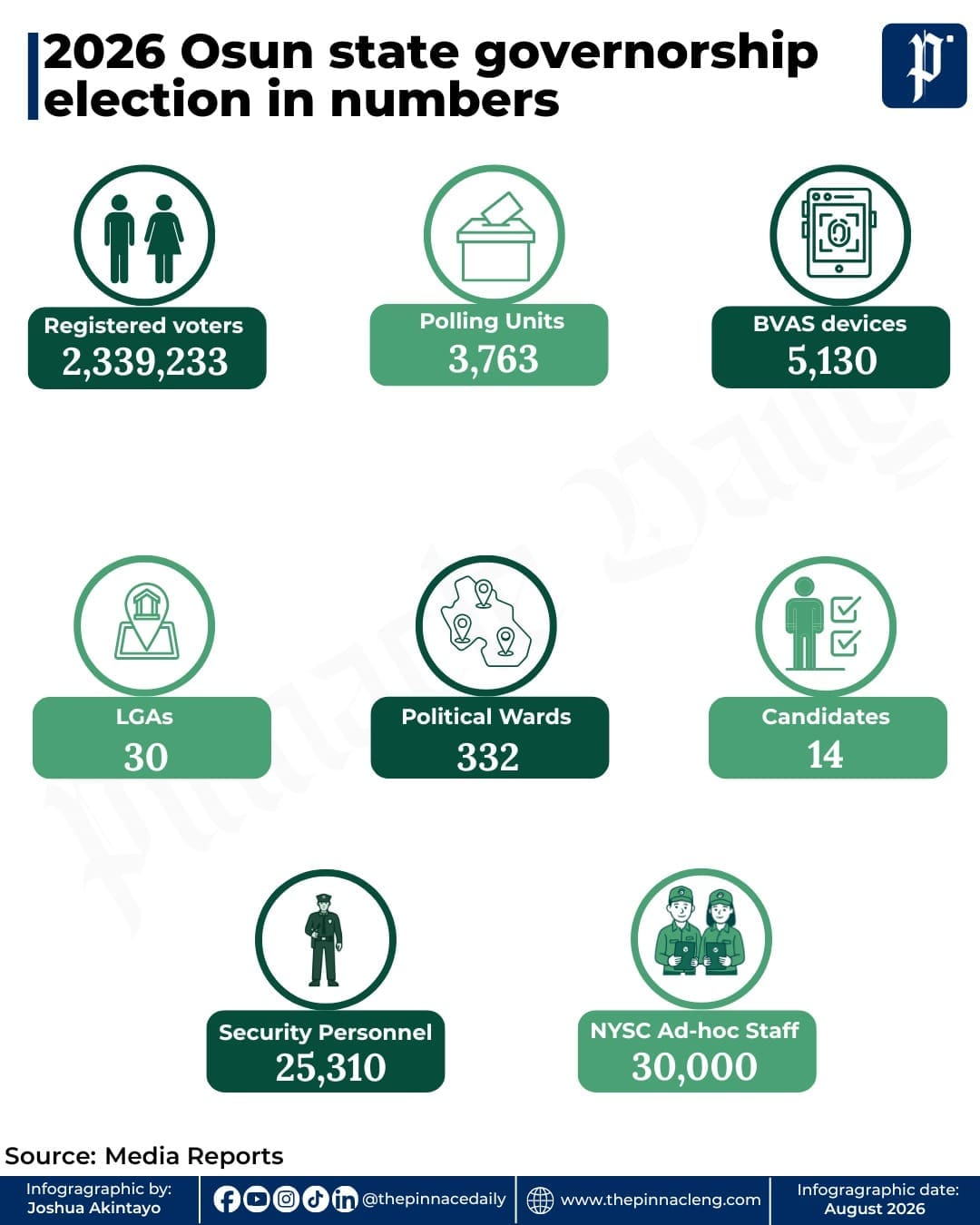
Data released by the Independent National Electoral Commission (INEC) indicates that electoral readiness across Osun’s 30 Local Government Areas and 332 wards stands at a high threshold.
Exactly 1,906,390 voter cards have been collected, representing 81.5 percent of the state’s 2,339,233 registered voters.
The remaining 432,843 uncollected cards have been deposited for safekeeping with the Central Bank of Nigeria, while 6,101 voters who applied for replacements printed temporary downloadable copies.
Voting will span 3,763 polling units, supported by 5,130 Bimodal Voter Accreditation System devices, 30,000 National Youth Service Corps ad-hoc personnel, and a security deployment of 25,310 officers.
RELATED NEWS:
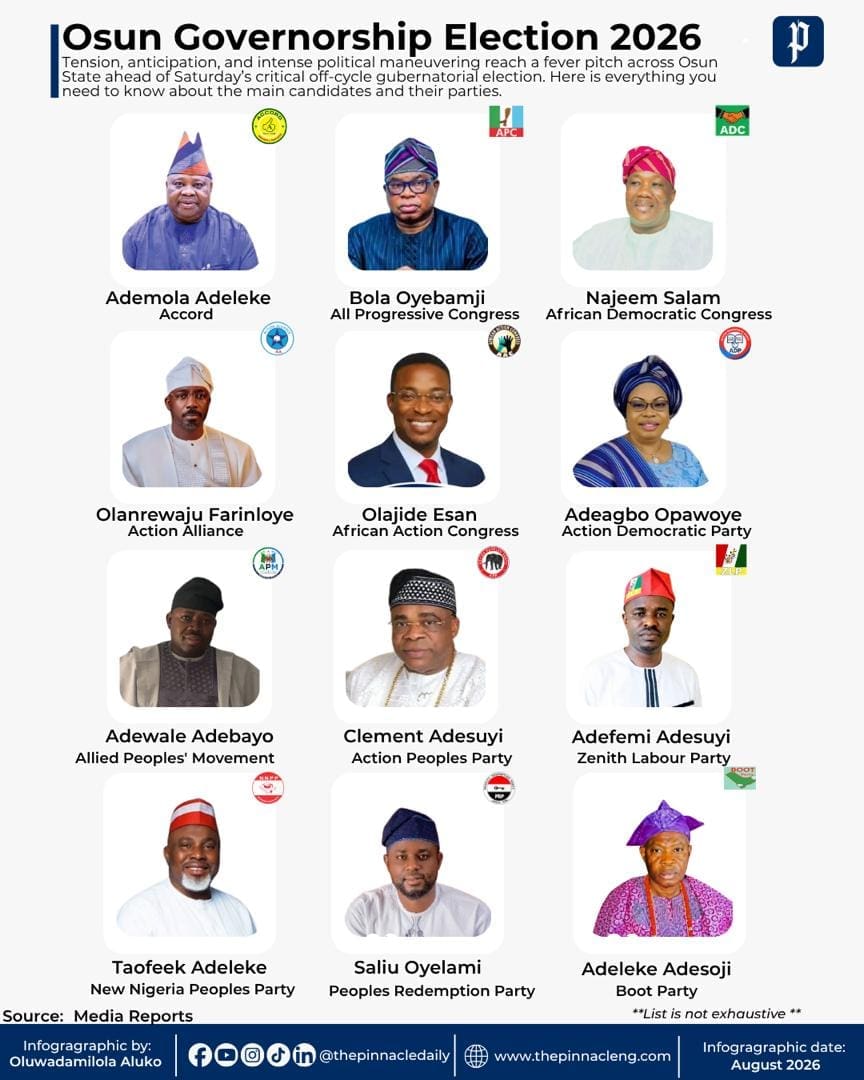
While thirteen candidates were initially cleared by the commission, political realignments have concentrated the race around three primary figures. Incumbent Governor Ademola Adeleke, who seeking a second term, is contesting under the Accord Party following severe internal crises within the Peoples Democratic Party (PDP).
His platform recently gained the endorsement of the Allied Peoples Movement (APM) candidate, Adebayo Simon Adewale, along with major local PDP structures.
Challenging Adeleke is Bola Oyebamiji of the All Progressives Congress (APC), the former Commissioner for Finance widely known as “AMBO.” Oyebamiji runs on a platform focused on structural welfare, security, and healthcare reforms. He is supported by the recent withdrawal and endorsement of the All Progressives Grand Alliance candidate, Prince Adesina Adeyemi-Doro.
Forming a formidable third force is Najeem Salaam of the African Democratic Congress. The former Speaker of the Osun State House of Assembly has anchored his campaign on agricultural transformation, rural development, and community policing.

Osun governorship candidates

Legal Protections and Financial Operations

Section 121 of the Electoral Act 2022 explicitly criminalises bribery and voter inducement. The law states that giving, promising, or receiving gifts, loans, money, or other valuable consideration to influence a voter is illegal. Candidates who consent to or have knowledge of such acts face direct legal liability.
A conviction under Section 121 carries a maximum fine of ₦500,000, imprisonment for up to 12 months, or both, extending to facilitators and co-conspirators. Under Section 148(2) of the Electoral Act 2026, legal officers of the electoral commission or appointed legal practitioners hold the authority to prosecute offenders in High Courts or Magistrates’ Courts.
To enforce these statutes, the Independent Corrupt Practices and Other Related Offences Commission announced the deployment of operatives across all 30 local government areas to monitor polling stations and track illegal transactions.
Despite these legal provisions, vote-buying in Osun has evolved far beyond the open distribution of cash at polling booths.
Intermediaries reportedly build coordinated networks prior to election day, organizing voters, tracking polling unit locations, providing transport or food, collecting personal identification, and dispersing funds.

The arrest of Osun SSG Teslim Igbalaye and others over alleged vote buying, with ₦4.8 million recovered, has heightened concerns about political financing, while the state government’s ₦20,000 palliative payment to public workers has also triggered allegations of voter inducement by the APC, which the government says is a legitimate welfare programme.

Video evidence has also emerged as a major point of contention. One viral video reportedly showed individuals taking oaths to secure political support before receiving money.
Another showed prominent Osun businesswoman Alhaja Yusuf Falilat Arike, popularly known as “Ero Arike,” distributing rice while soliciting support for APC candidate Bola Oyebamiji near party-branded materials.

Osun Vote-Buying Allegations — Timeline

Date Election/event Organisation/source What was alleged or documented
September 2018 Osun governorship election Saturday PUNCH / media investigation Political associates of contestants were reported to be using WhatsApp to approach PVC holders, with offers reportedly reaching ₦10,000 in exchange for votes. The report also said the EFCC was monitoring suspicious money transfers.
August–September 2018 Osun governorship election INEC / Osun Resident Electoral Commissioner INEC expressed concern about vote buying and warned against voters photographing their ballots to prove how they voted in exchange for money. Security agencies were asked to arrest those buying or selling votes.
July 15, 2022 Eve of Osun governorship election YIAGA Africa YIAGA said its monitoring had recorded voter inducement in Egbedore, Iwo, Orolu, Ifedayo, Irepodun and Ede North LGAs and called for action against vote buying.
July 16, 2022 Osun governorship election YIAGA Africa YIAGA reported and verified incidents of vote buying involving APC and PDP agents, including an incident at PU 009, Akinlalu Commercial Grammar School, Ward 01, Ife North.
July 16, 2022 Osun governorship election Nigeria Civil Society Situation Room The coalition reported open negotiations to buy and sell votes and said vote buying was coordinated by party agents. It later estimated that blatant vote buying was reported in 32.6% of polling units observed.
July 16, 2022 Osun governorship election Nigeria Civil Society Situation Room The group documented a shift from direct cash exchanges to coded communication and coupons used to obtain commitments from voters. It said the method was more discreet than what observers had seen during the Ekiti election.
July 16, 2022 Osun governorship election ICPC ICPC announced the arrest of three suspected vote buyers. One suspect was allegedly found with a list of voters and a phone; two others were arrested with a phone and notebook containing voters’ names. Another suspected buyer had a list of 100 people allegedly expecting ₦5,000 each.
July 16, 2022 Osun governorship election Nigeria Police Force Police said they deployed undercover operatives to monitor vote buyers, describing vote buying as a “silent transaction” requiring intelligence gathering.
July 2022 Osun governorship election Nigeria Civil Society Situation Room The organisation said vote buying and selling had become a “key feature” of Nigerian elections and urged the police to enforce electoral laws against it.
July 2026 Ahead of Osun 2026 governorship election Police The Osun Police Command arrested SSG Teslim Igbalaye and five others over alleged vote-buying and related electoral offences ahead of the August 15 election.
August 2026 Ahead of Osun governorship election CISLAC The Civil Society Legislative Advocacy Centre raised concerns about vote buying, voter inducement, political violence and intimidation, warning that such practices could undermine the credibility of the election.
August 2026 Ahead of Osun governorship election APC and Accord Party The parties traded allegations over vote buying. A video purportedly showing voters receiving money and taking an oath to support Governor Ademola Adeleke circulated ahead of the election. The allegations were politically contested and should therefore be reported as claims, not established facts.
August 2026 Ahead of Osun governorship election Nigeria Civil Society Situation Room The Situation Room urged police to properly document evidence of electoral infractions and vote buying, identify those responsible and share information with INEC.

Structural Poverty and Democratic Integrity

Speaking with Pinnacle Daily, Professor Kamilu Sani Fage, a Professor of Political Science at Bayero University, Kano, noted that Nigeria’s off-cycle elections have historically been volatile because voters are often denied the opportunity to freely choose their leaders.
Prof. Fage described allegations of voter intimidation, vote-buying, and electoral manipulation as dangerous developments.
He referenced a circulating video in which an individual was allegedly seen giving bags of rice to APC supporters while threatening them over how they should vote.
“We see how voters are being intimidated and threatened. I think it is a very dangerous trend,” he said.
According to Prof. Fage, the development is particularly worrying because Nigerian politicians appear not to have learned from the political violence that accompanied elections in the past.
He added that the manipulation of elections and the use of violence, particularly during off-cycle polls, could undermine public confidence in the democratic process.

‘They Deliberately Make People Hungry, Poor, and Politically Illiterate’

Prof. Fage described a “triple” strategy allegedly used by political elites to maintain influence: deliberately keeping people hungry, poor, and politically illiterate.
By political illiteracy, he explained that he meant a lack of political awareness and consciousness, rather than an inability to read or write. According to him, politicians exploit this vulnerability by making citizens view political assistance as a favour rather than a right.
He cited force and political intimidation as a fourth factor sustaining the problem, warning that “a hungry man is easy to buy.”

Fage Urges Voters to Reject Inducement, Ethnic, and Religious Politics

Prof. Fage urged voters to reject electoral inducement and resist manipulation through ethnicity, religion, and intimidation.  He advised them to choose credible and competent candidates based on track records and their ability to improve citizens’ lives.
He noted that Nigeria could learn from other African countries where voters have refused to be bought, intimidated, or corrupted, stressing that citizens’ willingness to hold political leaders accountable is essential to making democracy work.

Rule of Law, Poverty, and Political Consciousness

On the way forward, Prof. Fage admitted that it would be difficult to address the immediate challenges ahead of Saturday’s election because the poll is too close. However, he called for long-term reforms to strengthen Nigeria’s democracy.
He identified the rule of law as one of the most important requirements for a functioning democracy, arguing that political actors should not be allowed to openly deploy money and power to influence elections without consequences.
“We cannot see all these things where money and power are flagrantly used openly, and nobody gets caught. Everybody gets off free. So, we need the rule of law,” he said.
Prof. Fage also called for greater attention to poverty, unemployment, insecurity, and political education, arguing that these conditions leave voters vulnerable to political manipulation.
“These are being used deliberately by politicians in order to get power,” he said.
According to him, widespread poverty means that some voters may accept small amounts of money or basic food items in exchange for political support.
He cited instances where voters could be given substantial sums of money and pressured to swear an oath to vote for a particular candidate, while others could be influenced with items as basic as rice or noodles.
The Political Science scholar maintained that such practices thrive primarily because of hunger, poverty, and a lack of political consciousness.

Section 126 of the Electoral Act 2026 protects ballot secrecy, but the Osun election will test whether that protection can withstand vote-buying, intimidation and voter manipulation.

Ultimately, the credibility of the election will depend on whether voters can cast their ballots freely and secretly, without being bought, threatened or forced to prove how they voted.

Website |  + posts

Rafiyat Sadiq is a political, justice, and human rights reporter with Pinnacle Daily, known for fearless reporting and impactful storytelling. At Pinnacle Daily, she brings clarity and depth to issues shaping governance, democracy, and the protection of citizens’ rights.

Pinnacle Daily Newsletter

Elevate Your News Experience Join Pinnacle Daily’s newsletter and receive exclusive content, deep dives, and the latest news from experts.