

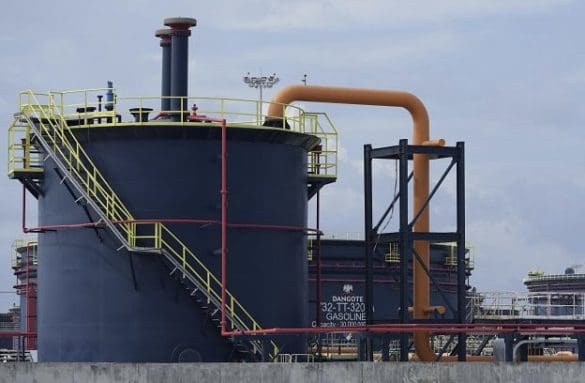
As the world continues to experience global supply disruptions and surging crude oil prices, Dangote Petroleum Refinery has reassured its commitment to a steady fuel supply in Nigeria, emphasising that the nation’s domestic refining capacity provides a crucial buffer against international market shocks.
The refinery’s Managing Director, David Bird, who spoke in a media chat on Monday, said the facility is operating at full capacity to ensure fuel availability and prevent the scarcity affecting import-dependent countries.
He stated that “Domestic refining gives Nigeria supply security, ensuring the country avoids fuel shortages and queues even when global markets are disrupted.”
He, however, pointed out that the 650,000 barrels per day refinery is fully exposed to international commodity markets, including crude oil prices, freight rates, insurance, and financing costs.
Bird clarified that the refinery buys Nigerian crude at international benchmark prices even under the Naira-for-Crude arrangement, and does not receive crude at discounted rates.
According to him, freight costs have surged dramatically, with tanker costs rising from about $800,000 to roughly $3.5 million per shipment in the current market environment.
The Dangote Refinery MD maintained that despite these market realities, Nigeria is better off with the presence of the facility, as import-dependent countries are worst hit as the global oil crisis worsens.
The escalating conflict in the Middle East, involving the United States, Israel and Iran, has disrupted the global supply of crude oil, pushing prices to above $100 from about $60 per barrel within a week.
Bird said that despite the refinery operating at full capacity, the volatility in global oil markets influences its pricing, hence the reason for the recent adjustments of its ex-depot price for petrol and diesel.
READ ALSO:
Dangote Refinery Hikes Petrol to ₦1,175/Litre, Diesel ₦1,620/Litre at Gantry
Fuel Sufficiency Boost as Dangote Refinery Finally Hits 650,000bpd Capacity
Middle East Tensions: Concerns as Fuel Prices Rise in Nigeria After Oil Price Surge
Dangote Refinery Denies Fuel Imports, Handles Multiple Crude Types
Speaking on the composition of the refinery’s feedstock, Bird said Nigerian crude accounted for about 30 to 35 per cent, while the rest is sourced through imports that require access to dollars in the open market.
“All that does is add further costs and premiums to purchasing those Nigerian barrels and processing them through Dangote Refinery,” he said.
While acknowledging the impact of the rising fuel prices on consumers, Bird said the company was doing all it could to minimize costs across its supply chain.
According to a statement titled “8 Key talking points from a media Chat with the Managing Director/CEO, Dangote Petroleum Refinery, David Bird” posted by the Dangote Group on its official X account, Bird assured that the refinery currently operates at its full nameplate capacity of 650,000 barrels per day, adding that it has potential to increase production to around 700,000 barrels per day.
The clarifications in the media chat came after the refinery adjusted its gantry price for petrol three times within a week, from ₦774 to ₦1,175 per litre, in response to surging crude oil prices.
The adjustment has sent shockwaves across Nigeria’s downstream oil industry, with retail prices rising above ₦1,300, causing a significant increase in transport fares.
To maintain supply stability, the refinery’s management urged the Nigerian government to act in the national interest. Bird called on the government and the Nigerian National Petroleum Company Limited (NNPCL) to ensure the domestic refining industry has access to the right grades of crude oil.
According to him, many countries that have refining hubs, including China, Thailand, and Vietnam, have banned exports to ensure an adequate supply of crude feedstock to domestic refineries.
He called on the Nigerian government to consider acting in self-interest, adding that this means “ensuring that the domestic refining industry in Nigeria gets access to crude, abundant access to crude, the right grades of crude, and prioritise the domestic industry.”
He also called on government agencies to consider reducing regulatory charges that add more operational costs across the value chain. According to him, the refinery currently deals with 47 different government agencies, which adds to operational costs.
His message was clear: that with consistent government support in crude supply, the refinery can continue to prioritize the Nigerian market and shield the country from the worst of global supply shocks.

Victor Ezeja is a Nigerian journalist skilled in producing insightful news analyses, feature stories, and interviews that simplify complex issues and drive informed public discourse. His work combines rigorous research, balanced reporting, and compelling storytelling to highlight developments shaping industries and society. Victor, who holds a Master's Degree in Mass Communication, specializes in energy, aviation, business, and economic reporting. He can be reached via @VICTOREZEJA on X