

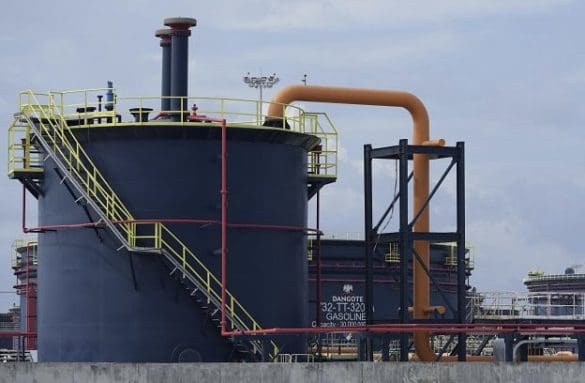
Nigeria’s long-standing quest for fuel self-sufficiency has received a significant boost as the Dangote Refinery successfully ramps up its Crude Distillation Unit (CDU) and Motor Spirit production block to a full capacity of 650,000 barrels per day (bpd).
This followed a period of scheduled maintenance and technical stabilisation. The refinery made this known in a statement released on Thursday.
The milestone marks a transformative moment for Africa’s largest economy, which has for decades relied heavily on imported refined petroleum products despite being one of the continent’s largest crude oil producers.
The achievement signals that the $20 billion Dangote Refinery, located in the Lekki Free Zone in Lagos, is now operating its core processing units at designed throughput levels. The 650,000 bpd capacity positions it as the largest single-train refinery in the world and the largest in Africa, with the capability to meet Nigeria’s entire domestic demand for petrol, diesel, aviation fuel, and other refined products, while still exporting surplus volumes to regional and international markets.
The refinery management said the company has embarked on an intensive 72‑hour series of performance test runs in collaboration with licensor UOP to validate operational efficiency and confirm that all critical parameters meet global standards.
Chief executive officer of Dangote Petroleum Refinery, David Bird, stated that the units’ smooth integration and good performance demonstrate the refinery’s superior technical and operating capabilities.
“This performance testing phase enables us to validate the entire plant under real operating conditions,” Bird stated.
He expressed confidence that the refinery remains firmly on track to deliver consistent, world‑class output.
Bird assured that the refinery remains committed to delivering “high‑quality refined products that will transform Nigeria’s energy landscape, eliminate import dependence, and position the nation as a net exporter of petroleum products.”
He further stated that the Crude Distillation Unit and Motor Spirit Block, which comprise the naphtha hydrotreater, isomerisation unit, and reformer unit, are now operating steadily at the full nameplate capacity of 650,000 barrels per day.
READ ALSO:
- Dangote Refinery Cuts Petrol Ex-Depot Price to ₦774 per Litre Amid Rising Competition with Importers
- Dangote, NNPC Sign Landmark Gas Agreements to Boost Industrial Expansion
- Nigeria Targets $10bn Investments from 2025 Licensing Round As NUPRC Opens Portal
- Dangote Refinery Denies Fuel Imports, Handles Multiple Crude Types
He disclosed that the refinery plans to begin Phase 2 performance tests next week for the remaining processing units to ensure the entire integrated complex is fully validated.
He also affirmed that with the MS Block now operating at full capacity, the refinery is positioned to supply up to 75 million litres of petrol daily. Nigeria’s average daily consumption is currently estimated at around 50 million litres.
While thanking customers and Nigerians generally for their support, Bird reaffirmed the refinery’s unwavering commitment to enhancing Nigeria’s energy security while supporting industrial development, job creation, and economic diversification.
Meanwhile, this milestone comes just as the refinery has also set out to expand capacity to 1.4 million bpd.
Impact on Ending Nigeria’s Import Dependence
Analysts believe the move to 100 per cent capacity will end Nigeria’s dependence on imports, thereby meeting domestic demand for refined petroleum products.
For years, Nigeria has grappled with the paradox of exporting crude oil while importing refined petroleum products due to inadequate domestic refining capacity. The country’s state-owned refineries (located in Port Harcourt, Warri, and Kaduna) have operated far below optimal capacity, leading to persistent fuel import bills and foreign exchange pressures.
With the Dangote Refinery now reaching full CDU capacity, Nigeria stands on the brink of significantly reducing petrol imports.
Economic expert Prof. Ken Ife estimated that domestic fuel production at scale, as championed by Dangote Refinery, could save billions of dollars in foreign exchange annually, strengthen the naira, and reduce exposure to global supply shocks.
Stabilizing Fuel Supply and Prices
The refinery’s full operational capacity is expected to stabilise fuel supply across the country. Periodic fuel scarcity, long queues at filling stations, and price volatility have been recurring challenges in Nigeria’s downstream petroleum sector.
Energy expert Dan Kunle said increased local refining capacity would improve supply chain efficiency, reduce logistics costs, and potentially moderate pump prices over time.
The Motor Spirit production block reaching full output suggests that petrol will be consistently available in larger volumes. This development is crucial for transportation, power generation, and small businesses that depend heavily on petrol-powered equipment.
Kunle said that beyond Nigeria, the refinery’s 650,000 bpd capacity positions the country as a net exporter of refined petroleum products to West Africa and the broader continent.
Many African nations currently import refined products from Europe and other distant markets. A reliable supply hub in Nigeria could lower transportation costs and enhance energy security across the region.
Industry experts believe this could strengthen Nigeria’s influence in the African Continental Free Trade Area (AfCFTA), as refined petroleum products become a major export commodity.
Economic and Industrial Ripple Effects
Dr Ebikabowei Aduku, a lecturer at the Department of Economics, University of Africa Toru-Orua (UAT) in Bayelsa State, observed that the refinery’s full-scale operations are expected to stimulate broader economic growth. He noted that the establishment of the refinery has led to the creation of thousands of direct and indirect jobs across construction, logistics, marine operations, and distribution networks. “Ancillary industries, including petrochemicals, plastics, fertilisers, and manufacturing, stand to benefit from a stable feedstock supply,” Aduku added.
He further stated that improved refining capacity could encourage further investments in Nigeria’s oil and gas value chain, including pipeline infrastructure and storage facilities.

Victor Ezeja is a Nigerian journalist skilled in producing insightful news analyses, feature stories, and interviews that simplify complex issues and drive informed public discourse. His work combines rigorous research, balanced reporting, and compelling storytelling to highlight developments shaping industries and society. Victor, who holds a Master's Degree in Mass Communication, specializes in energy, aviation, business, and economic reporting. He can be reached via @VICTOREZEJA on X