

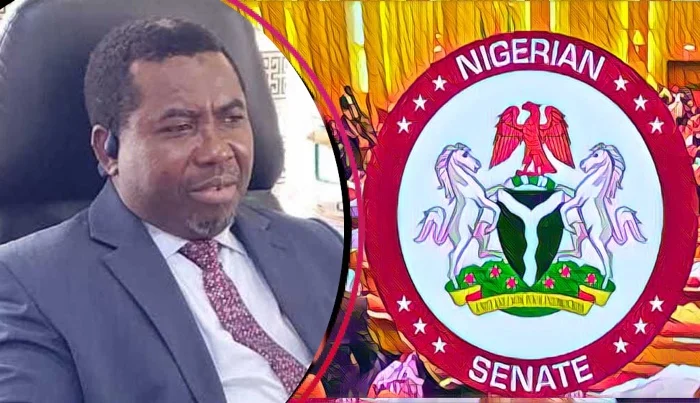
In a high-stake session at the National Assembly on Thursday, Professor Joash Ojo Amupitan, the newly appointed chairman of the Independent National Electoral Commission (INEC), faced intense scrutiny from senators as he sought confirmation.
The hearing, held before a Senate Committee of the Whole, featured probing questions about his past affiliations, plans for electoral reform, and his vision for restoring public confidence in Nigeria’s electoral system.
Denial of Partisanship: Rebutting Claims of Legal Representation
One of the most contentious issues during the screening was an allegation circulating in public discourse that Amupitan had served on President Bola Tinubu’s legal team during the 2023 presidential election petition. Several senators asked whether such involvement might compromise his impartiality if appointed INEC chairman.
READ ALSO: The Plausible Truth About Prof Amupitan’s Academic Journey
Amupitan responded without equivocation: “I never appeared in the presidential election tribunal at the Supreme Court.” He emphasised that mentorship or professional associations would not compromise his principles or ethical standards.
He stressed the importance of addressing the question transparently, asserting that “mentorship will not compromise my principle or my standard.”
His clarification was apparently intended to reassure lawmakers and the public that he would administer the commission without political bias.
Reform Agenda: From Inclusivity to Technological Integration
Beyond rebutting allegations, Amupitan presented a detailed blueprint for what he termed a “new INEC” — more inclusive, accountable, and technologically savvy.
Inclusivity and Voter Empowerment
He announced a commitment to improving participation by women, youth, and persons with disabilities. He argued that existing laws and policies need strengthening and, where necessary, legislative intervention to ensure such groups are not marginalized. Amupitan proposed a collaboration between INEC and the National Identity Management Commission (NIMC) to better capture and authenticate the identities of underserved voter segments.
Local Government Elections: Proceed with Caution
On the issue of local government elections, some of which have been dysfunctional in many states, some stakeholders have advocated that INEC should takeover the responsibility of conducting the polls.
Amupitan acknowledged the debate but warned against overburdening the commission. He told senators that the matter “requires careful consideration,” stressing that he would not commit to the proposal immediately but expressed openness to more review.
Voter Education, Civic Training & Electoral Culture
Central to his vision is an enhanced civic and voter education drive. He proposed deploying online training modules, downloadable resources for citizens, and integrating civics education into early schooling to foster democratic habits. Strengthening the capabilities of election stakeholders, he argued, is essential for accountability.
Internal Ethics, Whistleblower Policy & Accountability Mechanisms
To address public distrust and alleged impunity within electoral bodies, Amupitan pledged to establish
An internal ethics committee to monitor conduct and prosecute internal complaints;
A whistleblower policy to encourage reporting of wrongdoing;
Mechanisms for following up complaints. “We will pursue every complaint and follow through,” he stated.
READ ALSO: INEC Reports 6.2m Voter Registrations, Majorly Youths, Students
He also said he plans to work with the National Assembly to establish an Electoral Offences Commission, which can independently investigate and sanction electoral violations, possibly using forensic tools.
Security, Logistics & Innovation
Recognizing the logistical and security obstacles that hamper elections, especially in remote or insecure areas, Amupitan insisted no voter should be disenfranchised. He proposed stronger collaboration with security agencies and insisted INEC would invest in logistics, even considering “drones” in some cases to deliver materials or monitor polling zones.
On safeguarding election materials, he pledged streamlined procedures, better tracking, and clear timelines to prevent ambiguities or delays which often erode trust.
Real-time Result Transmission & Legislative Reform
Addressing the hotly debated subject of real-time results transmission, Amupitan maintained that the existing Electoral Act leaves ambiguities. He pledged to make substantive inputs to strengthen laws and systems for transparent reporting, thereby reducing manipulation and suspicion.

Challenges & Stakes: What Lies Ahead
Following his confirmation by the Senate on Thursday, to lead the commission henceforth, Amupitan’s first major task will include overseeing forthcoming off-cycle governorship elections, starting with Anambra in November. He also has the task of preparing ground for the 2027 general elections.
Outlook: A Cautious Optimism
Professor Joash Amupitan’s detailed programme signals an awareness of Nigeria’s longstanding electoral deficits; lack of trust, delayed results, underrepresentation, and the influence of money and manipulation. If he successfully translates his proposals into action, Nigeria hopes to see meaningful reform. But success will depend on political will, institutional buy-in, adequate resources, and above all, demonstrable integrity.
