


The historic merger of Nigeria’s major opposition parties on February 6, 2013, which birthed the All Progressives Congress (APC) and subsequently unseated an incumbent president in 2015, established a high-stakes precedent for Nigerian politics.
Today, opposition politicians are attempting to replicate that political model ahead of the 2027 general elections.
However, with just five months to the election, two major political forces have recently reaffirmed their determination to retain their respective positions, raising concerns that the foundation of the coalition movement may be weakening.
Once again, opposition forces face the recurring dilemma that triggered past fallouts and realignments: who will agree to step down for whom?
Cracks in the Unitary Front: Independent Stances of the ADC and OK Movement
Despite widespread calls for a unified platform, individual political entities are asserting their independence. The African Democratic Congress (ADC) expressed firm confidence in its ability to challenge President Bola Tinubu in 2027 without depending on an opposition coalition.
ADC spokesperson Bolaji Abdullahi stated during an appearance on Arise TV that while discussions regarding broad political cooperation remain open, ADC had built enough political support across the country to prosecute the election independently.
Speaking at the 2026 Nigerian Bar Association conference in Port Harcourt, ADC vice-presidential candidate Rotimi Amaechi admitted that efforts to forge a united opposition coalition ahead of the 2027 election remain difficult, blaming the challenge largely on the personal ambitions of political leaders.
Amaechi said “everybody has ambition; nobody wants to give up.”
Simultaneously, the Obi-Kwankwaso Movement (OK Movement) has firmly rejected any proposal to merge or be absorbed into another political entity.
Formed to mobilize support around the joint ticket of Peter Obi and Senator Rabiu Musa Kwankwaso, the group resolved to maintain its structural autonomy following a National Leadership Summit in Abuja that convened coordinators from all 36 states and the Federal Capital Territory.
The movement emphasised that accepting an externally imposed merger would dilute its identity, disrupt ongoing programmes, and undermine grassroots momentum.
Genesis of the Coalition: From the ADA Project to the ADC Platform
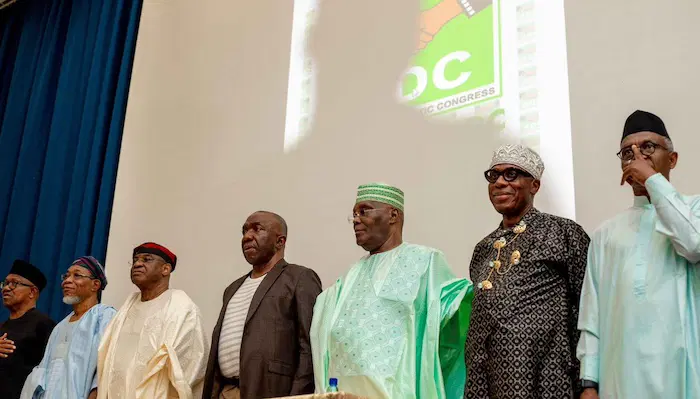
The push to form a viable political counterweight began in early 2025 when opposition factions attempted to launch a brand-new mega-party known as the All Democratic Alliance (ADA).
Heavyweight political figures, including Atiku Abubakar, David Mark, Nasir El-Rufai, Rotimi Amaechi and Peter obi backed the movement under the slogan “Justice for All” and the maize symbol.
RELATED NEWS:
- Beyond Osun Election: Lessons for Opposition Parties Ahead of 2027
- Amaechi Threatened to Quit Coalition Over Obi Favouritism Claims — ADC Spokesman
- Keyamo: ‘Atiku Reviving Retired Politicians for Empty Coalition’
- 2027: ADC says No Coalition Needed to Defeat Tinubu, Obi-Kwankwaso Movement Rejects Merger
- How Much Do You Need to Start Akara Business in Nigeria
- Is 4 Years Enough? The Big Question Behind Obi’s One-Term Promise
However, concerns that the Independent National Electoral Commission (INEC) might delay or complicate the registration of a new party led to a strategic shift.
In July 2025, the coalition abandoned the primary push for the ADA and formally adopted the already-registered African Democratic Congress (ADC) to bypass administrative delays.
Under this framework, David Mark assumed the role of National Chairman, Rauf Aregbesola became National Secretary, and Bolaji Abdullahi was appointed Spokesperson.
The Atiku-Obi Friction and Ideological Fractures
Despite the early promise of the ADC coalition, building a unified ticket between the top two 2023 opposition leaders, former Vice President Atiku Abubakar and Peter Obi proved volatile.
Supporters of Peter Obi maintained that his widespread youth backing made him the natural candidate to lead the 2027 ticket. Conversely, Atiku’s camp argued that his extensive structural reach and political experience positioned him as the logical consensus choice.
Unwillingness from either camp to step down led to a major fracture. While Obi maintained alignment with Kwankwaso and became NDC’s presidential and vice presidential candidates, Atiku later became the ADC flagbearer with Rotimi Amaechi as his Vice.
By late August 2026, the ADC mandated that Atiku remain on its platform, even as broader consensus talks stalled.
Ideological divisions further complicated broader unification efforts. During regional opposition gatherings, such as the summit in Ibadan, Oyo State, smaller blocs like the Peoples Redemption Party (PRP) flatly rejected a single consensus presidential candidate, citing deep fundamental disagreements over economic policies, specifically the handling of fuel subsidies.
Adding to the discord, Omoyele Sowore, who emerged as the AAC presidential candidate in May 2026, dismissed the alliance talks entirely, he consistently blasted the ongoing coalition talks using a signature phrase: “I won’t join thieves to fight thieves.”
The G100 Movement and the Grand Abuja Summit
Recognizing that a fragmented field virtually guarantees an APC victory in 2027, a coalition of prominent political figures and concerned citizens again established the G100 Movement. Operating under the “Doctrine of Necessary Democratic Opposition” and led by figures like Salihu Moh. Lukman, the G100 conducted confidential discussions throughout mid-2026 across six political parties: the ADC, NDC, PDP, APM, PRP, and SDP.
The G100’s core ideology is to unite Nigeria’s fragmented opposition around a common political objective, using negotiation, compromise and a possible consensus candidate to build a credible alternative to the ruling APC ahead of the 2027 elections.
These efforts culminated in the scheduling of the First Summit of Nigeria’s Opposition Political Parties for Monday, August 31, 2026, at the Yar’Adua Centre in Abuja. The summit aims to establish a formal framework for multi-party coordination heading into the final stretch before the election.
Opposition Coalition Faces Unity Challenge
Political analysts remain skeptical about the coalition’s ability to forge a binding union. In an interview with Pinnacle Daily, Professor Kamilu Fage of Bayero University Kano observed that while a single candidate provides the opposition its strongest chance against the ruling party, internal self-interest presents a formidable barrier.
According to him, the experience that led to the formation and success of the APC demonstrated the importance of opposition forces rallying behind a single candidate.
He said politics was fundamentally about compromise and negotiation, but observed that the current opposition actors appeared unwilling to surrender their individual ambitions.
“Each one of them is seeing that he should be the candidate. And politics is about compromise. It’s about negotiation,” he said.
Fage also cited the previous political relationship between Atiku and Peter Obi as an indication of the difficulties involved in bringing the various opposition figures together.
He noted that Atiku and Obi had previously worked together as presidential and vice-presidential candidates under the Peoples Democratic Party (PDP), but later went their separate ways.
The professor further argued that the ruling party and government would have little incentive to allow a strong opposition coalition to emerge.
“The ruling party and the government will not allow them to do that. It will do all that is possible to see that they don’t unite,” he said.
He added that the time available to the opposition was another major obstacle, noting that the parties had struggled to reach an agreement over a longer period and might find it difficult to achieve one within the remaining months before the election.
“Given all this, I am very pessimistic that they can hardly be able to come together,” he said.

Rafiyat Sadiq is a political, justice, and human rights reporter with Pinnacle Daily, known for fearless reporting and impactful storytelling. At Pinnacle Daily, she brings clarity and depth to issues shaping governance, democracy, and the protection of citizens’ rights.