Nigeria’s leading agro-industrial companies, Presco Plc and Okomu Oil Palm Company Plc, ended the 2025 financial year with record earnings. This underscores the resilience of the oil palm sector despite a challenging operating environment. A review of the companies’ unaudited financial statements shows that both producers delivered strong revenue and profit growth in 2025, supported …
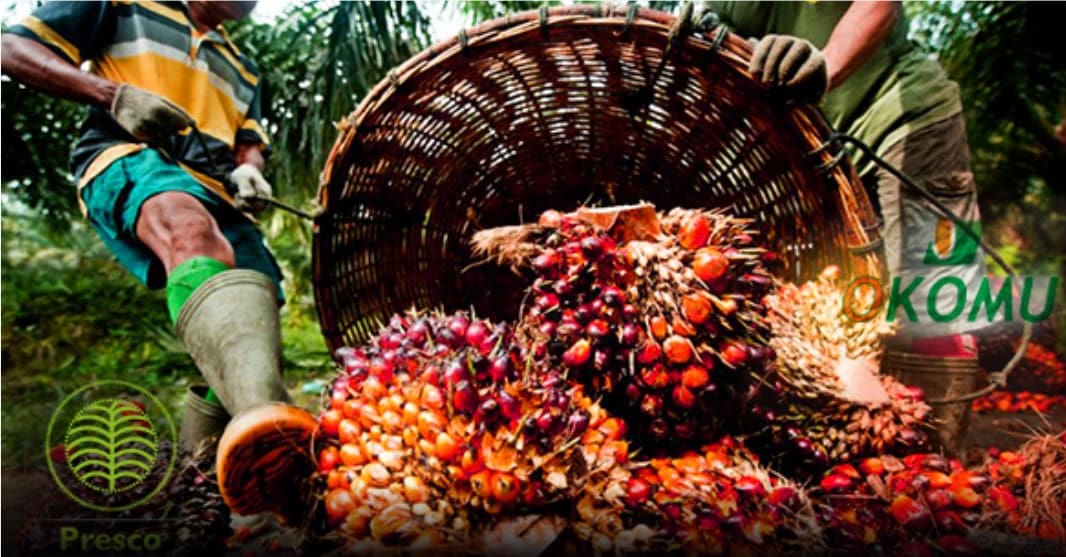
Nigeria’s leading agro-industrial companies, Presco Plc and Okomu Oil Palm Company Plc, ended the 2025 financial year with record earnings.
This underscores the resilience of the oil palm sector despite a challenging operating environment.
A review of the companies’ unaudited financial statements shows that both producers delivered strong revenue and profit growth in 2025, supported by high palm oil prices, solid domestic demand, and expanded production capacity.
The performance came amid currency volatility, rising finance costs, and broader macroeconomic pressures.
Presco recorded the stronger results in absolute terms. Group revenue rose to ₦331.19 billion in 2025 from ₦207.50 billion in the previous year.
The growth translated into a profit after tax of ₦138.12 billion, compared with ₦78.10 billion in 2024.
The company’s performance was supported by capacity expansion and major corporate actions completed during the year.
READ ALSO:
- Nigeria’s Private Sector Slips into Contraction as PMI Falls in January
- PenOp Calls on RSA Holders to Update Records as Data Recapture Goes Live
- How 20 Big and Small-Cap Stocks Powered NGX Gains in January
- AFC Says It Advised FG on ₦501bn Power Sector Bond Issuance
In January 2025, Presco acquired the remaining 48 per cent equity stake in Ghana Oil Palm Development Company (GOPDC), making the Ghanaian operator a wholly owned subsidiary.
Presco also strengthened its capital base through a 1-for-6 rights issue, which raised ₦83 billion in share capital and ₦237.7 billion in share premium.
The transaction improved liquidity and positioned the Group to support further expansion and working capital needs.
Okomu also delivered strong growth in 2025. Turnover rose to ₦198.15 billion for the year ended December 31, 2025, from ₦130.06 billion in the prior year.
Profit after tax increased to ₦63.53 billion, up from ₦39.96 billion in 2024.
The company’s performance was driven largely by domestic demand, with local sales accounting for ₦172.63 billion of total turnover.
As a result of higher earnings, Okomu’s basic earnings per share rose to ₦66.60. Presco Group reported earnings per share of ₦134.38.
Pinnacle Daily reports that analysts at CardinalStone had earlier projected a positive outlook for palm oil companies, including Presco and Okomu, in 2025.
In an equity research report on the oil palm sector published on March 17, 2025, titled ‘Prices to Remain Elevated in H1’25 on Supply Constraints,’ the analysts forecast improved operational performance and margins.
“We forecast an average EBITDA margin of 53.8% in 2025, with a five-year average of 54.59%, compared to a historical five-year mean of 50.0%.
“Despite being one of the world’s largest producers of palm oil, Nigeria still depends on imports for more than half of its domestic demand. Consequently, importers can exert considerable influence over prices, leading to currency fluctuations being directly passed on to consumers through higher costs,” the report stated in part.
Costs pressure effect
Despite the strong top-line and profit growth, both companies faced elevated cost pressures during the year, particularly from finance expenses, exchange losses, and rising operating costs.
READ ALSO:
- Taxes, Fuel Hike Slow Business Growth in January – NESG Report
- Senate Yet to Finalise Electoral Act Amendment after Prolonged Deliberations
- UBA Appoints Loknath Mishra as CEO of UBA UK
- NSIA, IFC Partner on $154m Drive to Expand Cancer Care in Nigeria
Presco Group’s finance costs rose sharply to ₦43.62 billion, largely due to higher interest expenses on loans and overdrafts.
Okomu recorded total finance costs of ₦13.78 billion, including an exchange loss of ₦12.57 billion, reflecting the impact of naira depreciation during the year.
Presco also faced operational challenges linked to its Ghana subsidiary. GOPDC was classified as operating in a hyperinflationary economy for most of 2025 under IAS 29.
This resulted in a ₦12.67 billion loss on net monetary items. However, the company noted that Ghana was removed from the hyperinflation list in October 2025, allowing it to revert to historical cost accounting for GOPDC at year-end.
Operating expenses increased across both companies. Okomu’s net operating expenses rose to ₦49.53 billion, while Presco’s administrative expenses climbed to ₦53.72 billion.
Tax charges also remained significant, amounting to ₦23.79 billion for Okomu and ₦40.44 billion for Presco Group.
Even with these pressures, both companies closed the year with strong earnings and solid balance sheets, reinforcing their positions as leading players in Nigeria’s agro-industrial sector.
Product power
The strong financial results posted by both companies were underpinned by distinct product strategies centred on integration and commodity diversification.
Although Presco and Okomu both operate across the oil palm value chain, their different approaches to product development and market positioning played a key role in driving revenue growth in 2025.
Presco’s ‘fully integrated’ advantage
Presco’s performance was driven by its fully integrated operating model, which covers plantation development, milling, palm kernel crushing, and vegetable oil refining.
It remains the only agro-industrial operator in Nigeria with this level of vertical integration.
This structure enables the company to supply refined and specialty fats and oils tailored to customer requirements, ensuring year-round supply and higher value capture.
In 2025, crude and refined palm products accounted for ₦330.94 billion of Presco Group’s total revenue of ₦331.19 billion.
The focus on higher-value refined products strengthened Presco’s regional presence. Domestic sales contributed ₦245.33 billion, while Ghana operations added ₦80.01 billion, supported by GOPDC.
The Group also built up inventories during the year to meet expected demand growth in future periods.
Okomu’s dual-commodity strategy
Okomu’s revenue growth was driven by commodity diversification. In addition to oil palm, the company operates a sizeable rubber business, providing multiple income streams within its agricultural portfolio.
Its products include crude palm oil, palm kernel oil, palm kernel cake, packaged banga, and rubber cup lumps.
This mix supported turnover of ₦198.15 billion in 2025, with domestic sales accounting for ₦172.63 billion.
Oil palm activities accounted for ₦48.17 billion in cost of sales, while rubber contributed ₦10.42 billion.
By the end of December 2025, Okomu held ₦6.41 billion in finished goods inventory across palm and rubber products.
Beyond the domestic market, both companies also recorded export sales. Okomu generated ₦25.53 billion from exports, while Presco’s refined output strengthened its footprint across West Africa, particularly through Ghana.

Alex is a business journalist cum data enthusiast with the Pinnacle Daily. He can be reached via ealex@thepinnacleng.com, @ehime_alex on X