

Nigeria’s insurance sector recorded mixed fortunes in 2025 as rising claims and fluctuating loss ratios reshaped profitability across leading firms.
A Pinnacle Daily review of the 2025 financial statements of 10 major insurers shows a market driven by large premium volumes, underwriting discipline, and strong investment income.
While some firms successfully balanced claims obligations with profits, others struggled under mounting claims pressure.
The 10 insurance companies discussed in the report are AIICO Insurance, AXA Mansard, Cornerstone Insurance, Fortis Global, Guinea Insurance, Mutual Benefits, Prestige Assurance, Regency Alliance, Sovereign Trust, and Veritas Kapital.
Premiums, claims and loss ratios
Collectively, the 10 insurers generated ₦616.8 billion in gross premiums and paid ₦254.1 billion in claims, resulting in an overall loss ratio of 41.2 per cent.
In practical terms, about 41 kobo of every naira earned in premiums was used to settle policyholder claims.
AIICO Insurance and AXA Mansard dominated the market, accounting for 58.8 per cent of total premiums and 67.4 per cent of total claims paid. Their scale underscores their leadership in both revenue generation and claims settlement.
By contrast, companies such as Sovereign Trust and Cornerstone Insurance strengthened overall industry profitability by maintaining significantly lower claims relative to their premium income.
The billionaire heavyweights
AIICO Insurance posted ₦191.8 billion in gross premiums and paid ₦92.4 billion in claims, delivering a ₦17.8 billion profit while keeping its loss ratio below 50 per cent.
READ ALSO:
- NAICOM Directs Insurers to Submit Recapitalisation Plan by September 30
- PenCom, NAICOM Bar Insurers From Doing Business With Defaulting Employers
- PenCom Opens Pension Scheme to Nigerians Abroad with New Dollar Contribution Guidelines
AXA Mansard followed with ₦170.9 billion in premiums, ₦79 billion in claims, and a ₦5.4 billion profit.
These results demonstrate the ability of large insurers to absorb substantial claims while remaining profitable.
Efficiency leaders and profit champions
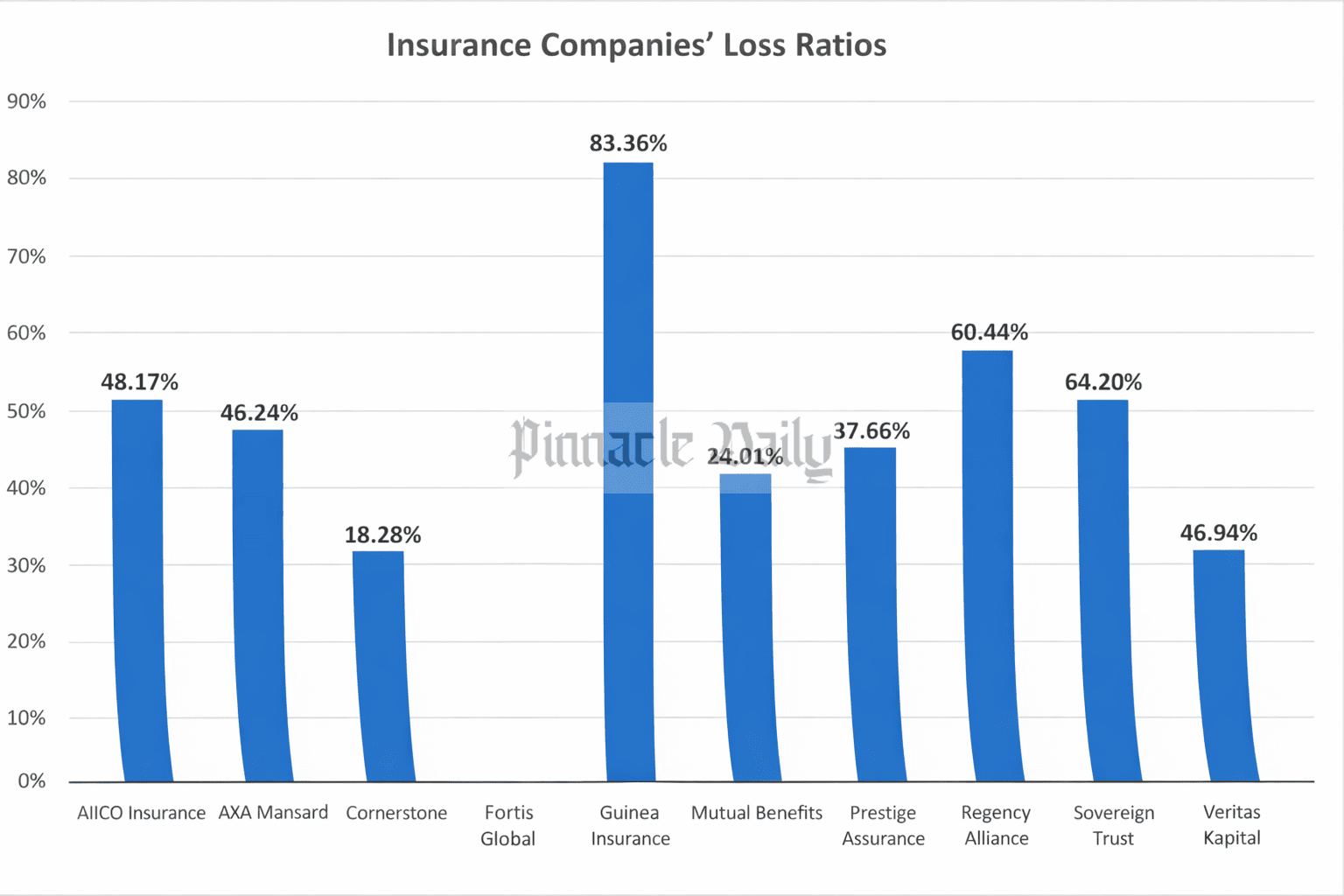
Although AIICO and AXA Mansard led in size, Mutual Benefits emerged as the profit leader, reporting ₦20.8 billion in profit, supported by a disciplined 37.66 per cent loss ratio.
Sovereign Trust and Cornerstone stood out for underwriting efficiency, posting loss ratios of 13.07 per cent and 18.28 per cent, respectively. Their lean claims payments of ₦6.1 billion and ₦11.6 billion translated into solid profitability.
Underwriting headwinds
Not all insurers performed strongly, as Fortis Global recorded a net loss of ₦1.68 billion after claims of ₦384 million consumed 83.36 per cent of its gross premiums.
Regency Alliance and Prestige Assurance also faced elevated loss ratios of 64.2 per cent and 60.44 per cent, respectively. Though both remained profitable, their margins were significantly compressed.
Strategic buffers, investment income
Investment income proved critical in cushioning underwriting pressures.
Veritas Kapital converted a 46.94 per cent loss ratio on ₦24.3 billion in premiums into a ₦6.4 billion profit, supported by strong investment returns.

Similarly, AIICO Insurance relied heavily on ₦61.6 billion in net investment income and ₦24 billion in fair value gains, helping sustain its ₦17.8 billion profit, well above its insurance service result of ₦9.5 billion.
Guinea Insurance also maintained a moderate 24.01 per cent loss ratio and delivered a ₦286 million profit, demonstrating the value of disciplined underwriting.
2025 vs 2024: Growth with volatility
While gross premiums generally increased in 2025, profitability remained volatile.
AIICO Insurance grew its profit from ₦15.2 billion to ₦17.8 billion. Mutual Benefits surged 84 per cent from ₦11.3 billion to ₦20.8 billion. Veritas Kapital rebounded from a ₦1.1 billion loss to a ₦6.5 billion profit.
However, AXA Mansard’s profit fell sharply from ₦25.9 billion to ₦5.4 billion. Cornerstone declined from ₦25.9 billion to ₦8.3 billion. Prestige Assurance and Sovereign Trust recorded profit drops of 81 per cent and 64 per cent, respectively.
Fortis Global swung from a ₦4.99 billion profit in 2024 to a ₦1.68 billion loss in 2025 following its first full year after licence restoration.
Bottom line
The 2025 financial year underscores how claims settlements, loss ratios, and investment income jointly determine profitability in Nigeria’s insurance market.
Large premium bases enabled dominant players to absorb claims shocks, while smaller insurers faced tighter margins amid rising loss ratios.
The year’s performance suggests that disciplined underwriting, effective claims management, and strong investment strategies will remain essential as the industry heads into 2026.
Rising claims push loss ratios higher from 2022 to 2025
Industry-wide data from the National Insurance Commission (NAICOM) show that loss ratios have steadily increased over the past three years, reflecting mounting claims pressure.
Analysts say the loss ratio, calculated as net claims divided by net premiums earned, measures underwriting health.
A lower ratio typically signals stronger profitability and disciplined pricing, while a higher ratio indicates heavier claims burdens.
In 2022, life insurers recorded a net loss ratio of 59.6 per cent, meaning nearly 60 kobo of every naira earned was used to pay claims. Non-life insurers were stronger, with a ratio of about 41 per cent.
In 2023, claims pressure intensified. Non-life insurers’ net loss ratio rose sharply to 76.9 per cent, while life insurers’ ratio increased to 62.6 per cent.
Analysts linked the rise to inflation, higher repair and replacement costs, and increased claims in motor and property segments.
READ ALSO:
- NAICOM Calls for Regional Insurance Collaboration to Bridge Climate Finance Gap
- Balogun Market Inferno Sparks Concerns Over Insurance Coverage for Destroyed Properties
- NIIRA 2025: Insurance Stocks Lead NGX N344Bn Gain in August
By the first half of 2025, the upward trend continued. In Q1, the industry posted ₦769.2 billion in gross premiums and a net loss ratio of 36.7 per cent, indicating relatively contained claims.
However, by Q2, premiums climbed to ₦1.21 trillion, and the net loss ratio jumped to 59.4 per cent. Non-life insurers recorded a 60.5 per cent loss ratio, while life insurance stood at 57.1 per cent.
The sustained increase means a larger share of premium income is being used to settle claims.
While this can enhance policyholder confidence, prolonged high loss ratios may pressure profitability unless matched by improved pricing and risk management.
Industry assets expanded to ₦4.4 trillion by Q2 2025, suggesting insurers are strengthening capital buffers even as claims intensify. Non-life insurance continues to dominate, contributing roughly 67 per cent of total premiums.
NAICOM’s data indicate that although the market is growing, claims dynamics are increasingly shaping performance, requiring insurers to balance expansion with underwriting discipline.
NIIRA 2025 and claims reform
The Nigerian Insurance Industry Reform Act (NIIRA 2025) marks a significant regulatory shift for the sector.
It has strengthened the industry’s framework, said the President of the Nigerian Council of Registered Insurance Brokers, Ekeoma Ezeibe.
Ezeibe noted that insurers are now required to settle claims within 60 days and that the law established a Policyholders’ Protection Fund.
“Most insurance companies don’t even wait for the full 60 days before paying a claim, partly because doing so also benefits their reputation,” Ezeibe said at a Channel TV programme in October 2025.
She explained that for reinsurance claims, the 60-day period begins when the discharge voucher is issued, while in direct insurance, it starts from the day the claim is filed.
“The law also provides avenues for consumers to seek recourse if the 60 days are missed. They can take the matter to court.
“Courts can then direct NAICOM, the regulator, to access the insurance companies’ statutory deposits to settle the claim,” Ezeibe added.

Alex is a business journalist cum data enthusiast with the Pinnacle Daily. He can be reached via ealex@thepinnacleng.com, @ehime_alex on X