

For decades, Abuja was known primarily as Nigeria’s political capital, a city of government offices, diplomatic missions, luxury hotels and a rapidly expanding residential landscape.
That identity is changing.
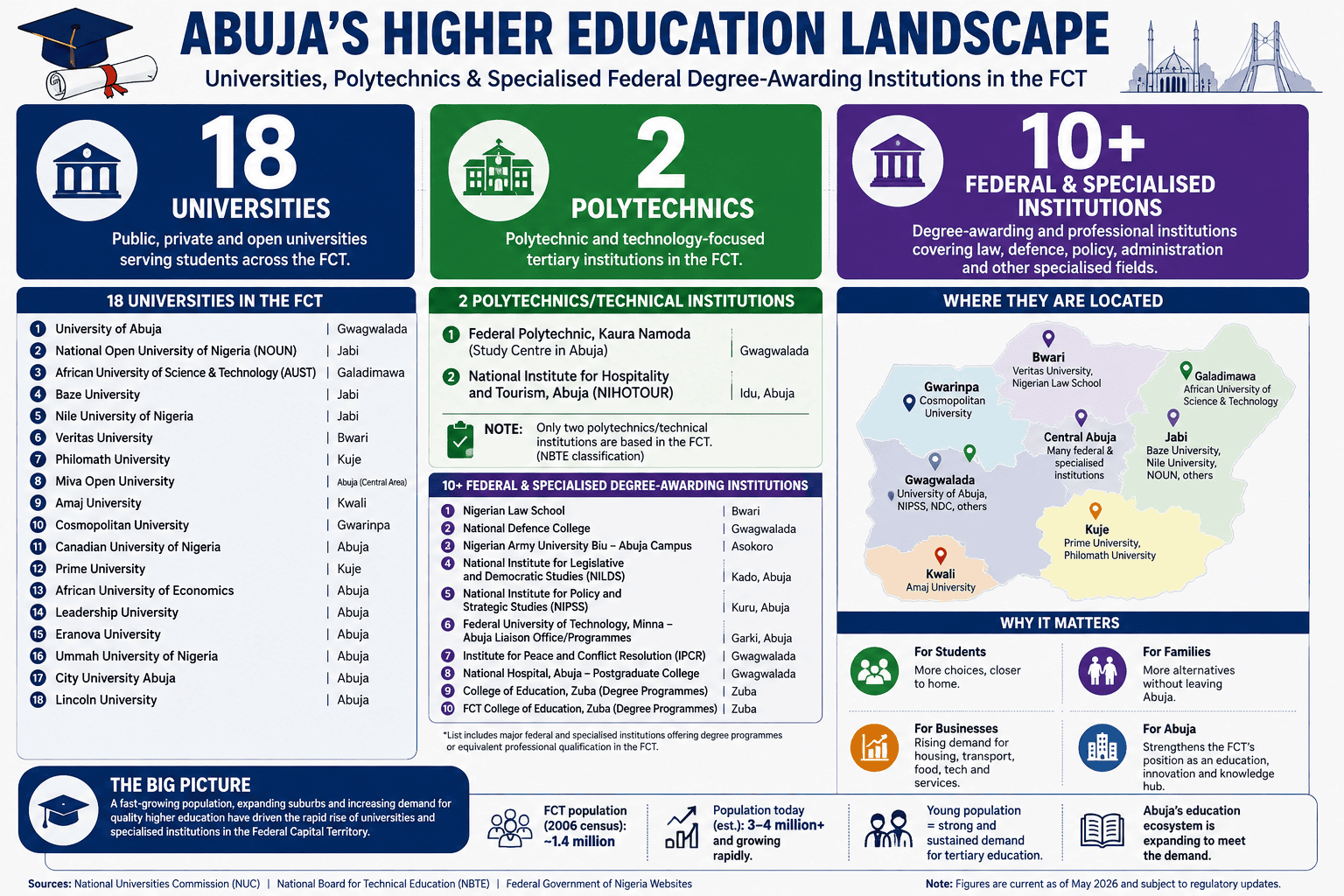
Across Gwarinpa, Jabi, Kuje, Kwali, Galadimawa, Bwari and other parts of the Federal Capital Territory, a different kind of infrastructure is increasingly becoming visible: universities.
The growth of higher institutions in Abuja is creating an education market that barely existed at its current scale a generation ago, giving young people in the capital and surrounding communities more choices over where and what to study.
From the established University of Abuja and National Open University of Nigeria to a new generation of private institutions, Abuja is steadily developing into one of Nigeria’s most competitive university markets.
Among the institutions now serving or positioning themselves to serve students in the FCT are University of Abuja, National Open University of Nigeria, African University of Science and Technology, Baze University, Nile University of Nigeria, Veritas University, Philomath University, Miva Open University, Amaj University, Cosmopolitan University, Canadian University of Nigeria, Prime University, African University of Economics, Leadership University, Eranova University, Ummah University of Nigeria, City University Abuja and Lincoln College University, among others.
The expansion represents more than an increase in the number of university names on a map. It reflects the transformation of Abuja itself.
From administrative capital to education destination
Abuja was designated Nigeria’s capital in 1991, and its population has expanded dramatically since then.
The 2006 population census put the population of the Federal Capital Territory at about 1.4 million people. That figure is now far behind the population Abuja serves. The current metro area population of Abuja in 2026 is estimated at 4,392,000, a 4.32 per cent increase from 2025.
The FCT has experienced sustained migration from virtually every part of Nigeria, driven by employment opportunities, government institutions, construction, real estate, commerce and the concentration of political and diplomatic activities.
The result is a metropolitan population that extends well beyond the traditional Abuja city centre.
Communities such as Gwarinpa, Kubwa, Lugbe, Kuje, Gwagwalada, Bwari, Karu and Kwali have grown as residential and commercial centres, creating new populations of young people who require access to schools, healthcare, transport and other services.
Higher education is naturally following that population.
The university map is no longer concentrated around the city centre. A student living in Gwarinpa can consider an institution nearby. Another living around Jabi has several choices. Students in Kuje, Kwali, Bwari and Gwagwalada increasingly have institutions within or closer to their communities.
That geographical spread matters — and it is being reinforced by federal policy. Speaking in May 2026 on plans to extend critical infrastructure corridors beyond the city centre, FCT Minister Nyesom Wike said one of President Bola Tinubu’s directives was that “development should not be concentrated only in the cities,” adding that satellite towns needed to be opened up “to discourage rural-urban migration.” That push to decentralise infrastructure is, in effect, also decentralising education, as universities follow the corridors the FCT Administration is building.
The private university factor
One of the most important developments in Abuja’s university expansion has been the growth of private higher education.
The University of Abuja remains a major public institution and one of the most important academic anchors in the FCT. The National Open University of Nigeria has also widened access through its open and distance-learning model.
But private universities have changed the competitive landscape.
Institutions such as Baze University, Nile University, Veritas University, African University of Science and Technology and the newer universities have created alternatives for families seeking different combinations of academic programmes, campus facilities, class sizes, accommodation and learning environments.
The emergence of Amaj University in Kwali, Cosmopolitan University, Canadian University of Nigeria, Prime University in Kuje, African University of Economics and Miva Open University, among others, shows that the market is continuing to develop beyond the traditional university locations.
This is significant because private universities do not merely compete for students. They also compete on programmes, technology, facilities, international partnerships, employability and the overall student experience.
That competition can ultimately force institutions to improve — though, as later sections show, it can just as easily produce institutions that compete on marketing rather than substance.
Abuja’s young population is creating demand.
Nigeria’s population is exceptionally young, and Abuja reflects that national demographic reality.
For every new residential district that emerges, there is a corresponding increase in the number of secondary-school graduates seeking university places.
The pressure is not only coming from residents of the FCT.
Abuja’s position at the centre of Nigeria’s road and air transportation networks makes it attractive to students from neighbouring states and other parts of the country.
The FCT borders Niger, Kaduna, Nasarawa and Kogi states, while its proximity to other parts of the North-Central region makes Abuja relatively accessible to students who may not want to travel to Lagos, Ibadan, Benin, Enugu or other established education centres.
This gives universities in Abuja a market that extends beyond the territory itself.
A university in Kuje, for example, is not necessarily competing only for students living in Kuje. It can draw from other parts of the FCT and neighbouring states.
Location is becoming a competitive advantage.
The geographical distribution of the newer universities is perhaps one of the most interesting aspects of Abuja’s education boom.
Gwarinpa, one of Abuja’s largest residential districts, has become associated with institutions such as Cosmopolitan University.
Kuje and Kwali are also emerging as important locations for higher education, with Prime University and Amaj University, respectively.
Galadimawa hosts the African University of Science and Technology, while Jabi and the Airport Road corridor have become important education clusters.
Meanwhile, Bwari is home to institutions including Veritas University and the Nigerian Law School.
This matters because Abuja is becoming increasingly decentralised.
The old idea of Abuja as simply the central districts of Maitama, Asokoro, Wuse and Garki no longer reflects the city’s economic and demographic reality.
The metropolitan area has expanded outward, and universities are moving with it.
More choices but also more competition
For students and parents, the expansion is largely good news.
A young person who once had to leave Abuja to pursue a particular course may now find several options within the FCT.
The choices extend across disciplines, including business, economics, computer science, engineering, law, social sciences, health sciences, information technology and emerging technology-related fields.
The growth of technology-focused institutions is particularly important as the Nigerian economy becomes increasingly digital.
For Abuja, which already has a large concentration of government agencies, technology companies, development organisations, financial institutions and professional services firms, universities can potentially connect students to a broad employment ecosystem.
But more universities also mean more competition. An institution cannot simply open its doors and expect students to arrive.
Parents are increasingly asking questions about accreditation, graduate employability, tuition, facilities, accommodation, academic staff, industry connections and the reputation of individual programmes.
That means Abuja’s university boom could eventually produce a more demanding education market.
Quality concerns amid rapid growth
Abuja’s expansion mirrors a wider, more contested story playing out across Nigerian higher education.
Nigeria’s university system has grown from just 49 universities in 1999 to roughly 300 today, an expansion driven overwhelmingly by the private sector. On the surface, that growth looks like progress. Beneath the numbers, however, education experts have raised concerns that unchecked university proliferation risks collapsing the system from within, turning institutions into business ventures rather than centres of academic rigour.
Writing on the trend, commentator Abel Augustine argued that many of the newer universities, particularly private ones, struggle with poor infrastructure, inadequate funding and a shortage of qualified academic staff. He noted that heavy reliance on part-time and visiting lecturers has produced serious inconsistency in teaching standards, leaving graduates who often lack the practical and intellectual skills demanded by a competitive global economy.
For Abuja specifically, this is the tension sitting underneath the optimism: an institution can be built quickly, but the academic depth, staffing and accreditation credibility that make a degree valuable take considerably longer to establish.
As the FCT’s university count climbs, the question of which institutions are genuinely investing in quality, versus which are simply capturing demand, is likely to become a defining issue for students and parents alike.
The pressure on infrastructure
There is, however, another side to the expansion.
Universities require roads, reliable electricity, water, internet connectivity, accommodation, public transportation and security.
As institutions expand into areas such as Kuje, Kwali and other peripheral parts of the FCT, the quality of surrounding infrastructure becomes increasingly important.
A university can construct an impressive campus, but students and staff still need to reach it.
READ ALSO
- FSI Expands Tech Mentorship Programme to Kano University
- Maths No Longer Compulsory for University Admission, as FG Reforms Education
- Mixed Reactions as FG Exempts Colleges of Education and Agriculture Applicants from UTME
- FG, SSANU, and NASU Resume Talks as University Strike Paralyses Services
FCT Minister Nyesom Wike has repeatedly defended the territory’s capital spending on precisely these grounds. In August 2024, defending infrastructure investment, he argued that development itself depends on roads and bridges: without them, he said, there would be no schools for people to attend and no basis for investors to establish industries.
The scale of that infrastructure bill, however, raises a separate question: how it gets funded. Speaking in Abuja in August 2026, Securities and Exchange Commission Director-General Dr Emomotimi Agama urged the FCT Administration to look beyond annual budgets toward structured private capital and municipal bonds, arguing that cities are ultimately built by capital markets rather than budgets alone, since a bond can finance what would otherwise take decades of annual allocations to fund.
For an administration trying to extend roads, power and water to the same peripheral districts now attracting universities, that financing debate is not abstract — it goes directly to whether Kuje, Kwali, Bwari and Gwagwalada can absorb the institutions now being built there.
This makes education part of the broader conversation about Abuja’s urban planning. The FCT Administration therefore faces an increasingly important question: how can infrastructure development, and its financing, keep pace with the city’s expanding education, residential and commercial corridors?
A bigger opportunity for Abuja
The economic impact of the university boom could extend well beyond tuition fees.
Universities create demand for housing, transport, restaurants, bookshops, printing services, technology, security, healthcare, entertainment and retail businesses.
A growing student population can therefore create entire local economies around campuses.
For property developers, the emergence of universities in previously less-developed parts of the FCT creates new opportunities for student accommodation and commercial real estate.
For entrepreneurs, it creates a large and relatively predictable consumer market.
For the government, it creates an opportunity to develop education clusters that can stimulate economic activity outside the traditional Abuja city centre, provided the financing and infrastructure questions raised above are resolved.
From university city to knowledge economy
The real test, however, will not be the number of universities Abuja can accumulate.
It will be what those universities produce.
Nigeria needs graduates who can create businesses, develop technology, solve public-sector problems, conduct research and compete in a global economy.
Abuja has an unusual advantage in this regard.
It is simultaneously the nation’s political capital, a diplomatic centre, a growing business destination and an increasingly important technology and services market.
If its universities can connect academic training with those opportunities, the FCT could gradually evolve from simply being Nigeria’s administrative capital into a major knowledge and innovation hub.
The emergence of institutions such as the African University of Economics, the African University of Science and Technology, Miva Open University and the growing number of private universities points towards that possibility.
The university boom is therefore about more than buildings, lecture halls and admission numbers.
It is a reflection of Abuja’s transformation.
A city created to house Nigeria’s government is now becoming home to a generation of students who may ultimately shape the country’s next phase of economic and technological development.
And as Abuja continues to grow, the demand for universities is unlikely to disappear.
The bigger question is whether the city can ensure that its expanding higher-education sector produces quality, affordable and relevant education and whether, against the backdrop of Nigeria’s national proliferation concerns, those institutions can turn Abuja’s rapidly growing young population into the skilled workforce the Nigerian economy desperately needs.

Sunday Michael Ogwu is a Nigerian journalist and editor of Pinnacle Daily. He is known for his work in business and economic reporting. He has held editorial roles in prominent Nigerian media outlets, where he has focused on economic policy, financial markets, and developmental issues affecting Nigeria and Africa more broadly.