
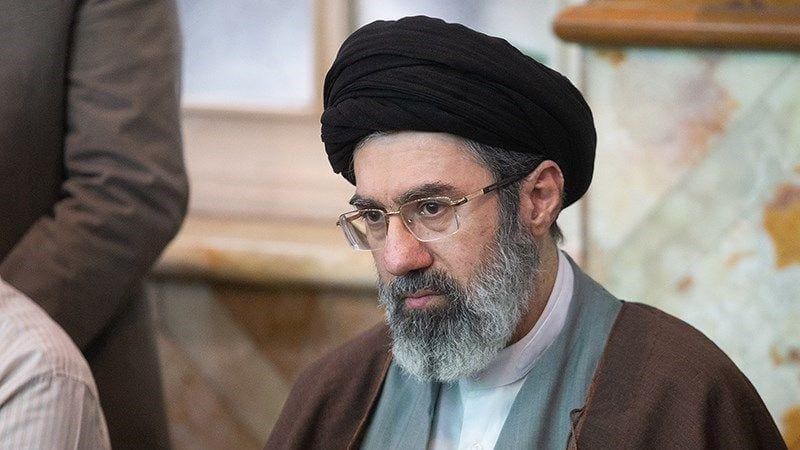
Mojtaba Khamenei, the second son of Iran’s late Supreme Leader, Ali Khamenei, has been selected as the new leader of the Islamic Republic following his father’s death in a joint military strike by the United States and Israel.
With Mojtaba Khamenei’s appointment, he is now the 3rd supreme leader Iran has produced, marking the first instance of hereditary-style succession in the history of the Islamic Republic of Iran.
The office of the Supreme Leader of Iran was established by the Constitution of Iran in 1979, pursuant to Ayatollah Ruhollah Khomeini’s concept of the Guardianship of the Islamic Jurist, and is a lifetime appointment.
State media reported that the 56-year-old cleric was chosen by the Assembly of Experts, the 88-member clerical body responsible for appointing the country’s supreme leader.
Ali Khamenei was killed on the first day of the ongoing conflict after strikes targeted his compound in Tehran on February 28. The attack also claimed the lives of Mojtaba Khamenei’s mother, wife and one of his sisters. The younger Khamenei was not present at the time and survived the assault.
Assembly of Experts Urges Unity
In a statement broadcast by state media on Sunday, the Assembly of Experts said Mojtaba Khamenei was selected through a “decisive vote” and called on Iranians to support the new leadership.
The body urged citizens, particularly intellectuals and religious scholars, to pledge allegiance and maintain unity during the ongoing conflict.
Although Mojtaba Khamenei has never held elected office or participated in a public vote, he has long been regarded as an influential figure within Iran’s political establishment. For decades, he maintained close ties with his father’s inner circle and built strong connections with the Islamic Revolutionary Guard Corps (IRGC).
In recent years, he had increasingly been mentioned as a possible successor to his father, who served as president before becoming Iran’s supreme leader in 1989 and remained in power for 36 years.
Low Public Profile
Despite his influence, Mojtaba Khamenei has largely kept a low public profile. He rarely delivers public lectures or political speeches and has seldom appeared in the media, leading to a situation where many Iranians have never heard his voice.
RELATED NEWS:
- U.S.-Iran War: More Pressure on Domestic Fuel Prices as Oil Rises Above $100
- Risks, Opportunities US-Iran War Poses for Nigeria
- U.S./Israeli-Iran War: Updates on Day 6
The issue of succession has remained highly sensitive in Iran, with critics warning that his appointment could create a dynastic leadership reminiscent of the Pahlavi dynasty that ruled the country before the 1979 Iranian Revolution.
Allegations and Controversies
For nearly two decades, critics inside and outside Iran have linked Mojtaba Khamenei to the suppression of protests.
Reformist groups within the Islamic Republic first accused him of influencing the controversial 2009 presidential election that returned Mahmoud Ahmadinejad to power and sparked the Green Movement protests.
During the protests, the IRGC’s Basij militia was widely accused of violently suppressing demonstrators. Similar allegations resurfaced during later nationwide protests, including demonstrations earlier this year that international organisations said resulted in thousands of deaths.
Iranian authorities, however, blamed the unrest on armed groups and foreign interference, accusing the United States and Israel of supporting what they described as riots and acts of terrorism.
Background and Influence
Mojtaba Khamenei developed ties with the IRGC during the Iran–Iraq War of the 1980s, when he served in the Habib Battalion during several military operations.
Many of his wartime associates later assumed senior roles within Iran’s intelligence and security institutions.
Western reports have also alleged that he oversees an extensive financial network controlling assets in several countries, though his name does not appear directly in the transactions. These reports claim billions of dollars have been moved through associates linked to Iran’s political establishment.
Some reports have also linked him to Iranian businessman Ali Ansari, whose Bank Ayandeh collapsed last year after accumulating large debts through loans to politically connected insiders. Neither man has publicly addressed the allegations.
Religious Rank Debate
Questions have also been raised about Mojtaba Khamenei’s religious credentials. He currently holds the clerical rank of hojatoleslam, a mid-level position below the title of Ayatollah.
However, his father also did not hold the rank of Ayatollah when he assumed leadership in 1989, and Iran’s constitution was later amended to accommodate his position.
A similar adjustment could occur again if the political establishment moves to consolidate Mojtaba Khamenei’s authority.
For now, it remains unclear when Iran will formally complete the leadership transition as the country continues to face intense bombardment and has imposed nationwide internet restrictions amid the ongoing war.
Iran’s New Death Toll
While Iran celebrates its new leader, a new rise in death toll has been recorded, with the Iranian Deputy Health Minister Ali Jafarian saying the United States-Israeli attacks across the country have killed and wounded mostly civilians, and the bombardments on oil facilities have caused toxic smoke to spread across the capital, Tehran.
Speaking to Al Jazeera on Monday, Jafarian said at least 1,255 people have been killed in Iran, including 200 children and 11 healthcare workers. Their ages ranged from eight months to 88.
More than 12,000 people have also been wounded, mostly from burns and crush injuries, he added. Twenty-nine clinical facilities so far have been damaged, and 10 of them were forced to shut down, Jafarian continued. Additionally, 52 health centres, 18 emergency services locations and 15 ambulances have also been damaged or destroyed.

Rafiyat Sadiq is a political, justice, and human rights reporter with Pinnacle Daily, known for fearless reporting and impactful storytelling. At Pinnacle Daily, she brings clarity and depth to issues shaping governance, democracy, and the protection of citizens’ rights.