

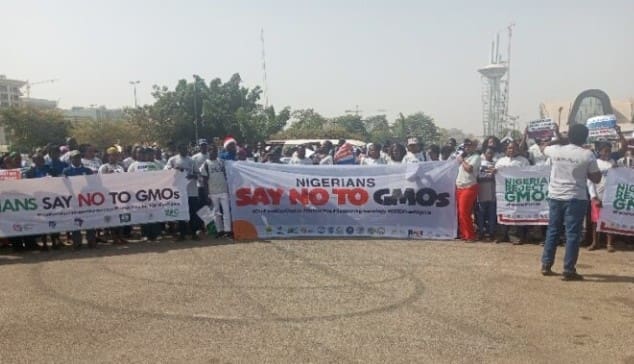
A coalition of farmers, scientists, nutritionists, legal and medical practitioners, civil society organisations, women and youth groups has called on the Federal Government to immediately ban genetically modified organisms (GMOs) in Nigeria.
The call follows a 2024 House of Representatives recommendation urging the suspension of GMOs pending a full investigation into their regulatory framework.
The demand was made during a national rally for food sovereignty and environmental justice held on Tuesday in Abuja, organised by the Health of Mother Earth Foundation (HOMEF) and the GMO-Free Nigeria Alliance.
Participants submitted a petition to the House of Representatives, insisting that the continued commercialisation of GMOs threatens food sovereignty, biodiversity, farmers’ livelihoods, public health, and environmental safety.
READ ALSO: Nigerian GMO Debate: Fear, Science, & Opportunity
The coalition emphasised that the House’s 2024 recommendation requires urgent enforcement to prevent further ecological and economic harm.
Opposition to GMOs in Nigeria has persisted for years, dating back to the establishment of the National Biosafety Management Agency (NBMA) and the issuance of early permits to Monsanto Nigeria Limited and the National Biotechnology Research and Development Agency.
The debate intensified in 2024 following the approval of genetically modified TELA maize, raising concerns over contamination, corporate control of seeds, and long-term agricultural sustainability.
Global GMO Restrictions
Mariann Bassey-Olsson, Deputy Director of ERA/FoEN, highlighted that Nigeria is not alone in regulating GMOs:
- Europe: France, Germany, Austria, Italy, Hungary, and several others have banned GMOs.
- Asia-Pacific: Australia, Japan, Turkey, Bhutan, and Saudi Arabia have restrictions.
- Americas: Belize, Ecuador, Mexico, Peru, and Venezuela have banned GMO crops.
- Africa: Algeria, Madagascar, and Zimbabwe prohibit GMO cultivation or importation.
“These countries have acted to protect public health and maintain agricultural independence,” she said.
Dr Jacqueline Ikeotuonye, Country Director of the Bio-Integrity and Natural Food Awareness Initiative, cited a 2024 NACOTAN report showing that GMO cotton did not produce higher yields than local varieties. Farmers also reported that GMO seeds cannot be replanted, forcing them to purchase new seeds each season, with some fields unable to support other crops for years.
Mr Martins Ogunlade, Associate Director at CAPPA, urged the NBMA to ensure full transparency and accountability, noting that long-term risk assessments and clinical trials have not been conducted before the commercial release of GMOs in Nigeria.
Farmer Lovelyn Ejim stressed that government decisions must reflect the will of Nigerians. “Since 2013, there has been persistent demand online and offline for a GMO ban,” she said. “Continued approvals show disregard for public interest and hint at vested corporate interests.”
Rally Demands
The coalition issued clear demands:
- Immediate ban on all GMO materials for planting, food, and feed.
- Ban on imported processed foods containing genetically engineered ingredients.
- Nullification of all existing GMO permits.
- Greater investment in agroecology, organic farming, and sustainable food systems to protect food security, sovereignty, and economic resilience.
READ ALSO: Reducing Pesticide Dependence: Sustainable Practices Farmers Can Adopt – Agric Economist
The statement was endorsed by HOMEF, GMO-Free Nigeria Alliance, Bio-integrity and Natural Food Awareness Initiative, CAPPA, and 74 other organisations, including Kebetkache Women Development and Resource Centre, Women Environmental Programme, ERA/FoEN, Global Prolife Alliance, and CEHRD.

Esther Ososanya is an investigative journalist with Pinnacle Daily, reporting across health, business, environment, metro, Fct and crime. Known for her bold, empathetic storytelling, she uncovers hidden truths, challenges broken systems, and gives voice to overlooked Nigerians. Her work drives national conversations and demands accountability one powerful story at a time.