

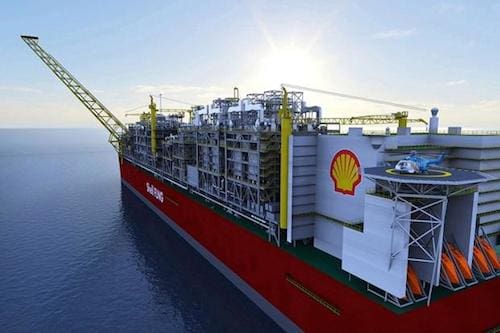
There are concerns that Nigeria may lose about 6.75 million barrels of crude oil in February as Shell Nigeria Exploration and Production Company (SNEPCo) embarks on turnaround maintenance on the Bonga Floating Production Storage and Offloading (FPSO) vessel.
In a statement released on Sunday, February 1, Shell said it has commenced turnaround maintenance on the vessel and that it would last for one month, with production resuming in March.
The company said the maintenance exercise is a statutory and integrity assurance programme aimed at extending the life of the facility by another 15 years.
“The scheduled maintenance activity is designed to ensure the FPSO continues to operate safely and efficiently for the next 15 years, while reducing unplanned deferments and strengthening the asset’s overall resilience,” SNEPCo Managing Director Ronald Adams said. “We expect to resume operations in March following the completion of the turnaround,” he added.
Highlighting the scope of work to be done, the company said it includes statutory inspections, certification and regulatory compliance checks, major asset-integrity upgrades as well as engineering modifications to improve long-term operations and subsea assurance activities.
This scheduled maintenance is considered a significant hit to Nigeria’s oil revenue and export targets, especially as the country has been striving to meet its OPEC production quotas.
The Shell FPSO vessel, located approximately 120 km offshore in water depths, has the capacity to produce 225,000 barrels of oil and 150 million standard cubic feet of gas per day.
This means the shutdown temporarily removes 225,000 barrels of oil per day (bpd) from Nigeria’s export capacity. When multiplied by 30 days, it means a total of 6,750,000 barrels of crude oil may be lost in one month.
READ ALSO:
- Dangote, NNPC Sign Landmark Gas Agreements to Boost Industrial Expansion
- Nigeria’s Oil Revenue Falls 24.7% Short of Target in 2024
- Major Issues that will Shape Nigeria’s Energy Sector in 2026
- Nigeria Targets $10bn Investments from 2025 Licensing Round As NUPRC Opens Portal
In addition to crude oil, the maintenance will halt the production of approximately 150 million standard cubic feet of gas per day.
While the short-term loss is steep, Shell and its partners (including NNPC, Esso, and Agip) have stated that the FPSO is a critical national asset and the turnaround maintenance is necessary to ensure its performance integrity to support stable production and Nigeria’s broader energy, security, and revenue objectives.
SNEPCo said this year’s turnaround comes at a strategic moment for it and its co‑venture partners.
Pinnacle Daily recalls that in 2024, SNEPCo and its partners took the final investment decision on Bonga North, a subsea tie‑back development, which it said will depend on the reliability and enhanced capacity of the Bonga FPSO. “A successful turnaround maintenance is therefore essential to preparing the facility for the additional volumes and operational demands associated with the new development,” it explained in a statement signed by Gladys Afam-Anadu, Communications Manager, SNEPCo.
The last turnaround maintenance activity on the FPSO was in October 2022, after which, on February 1 the following year, the asset delivered its 1 billionth barrel of oil since production commenced in 2005.
READ ALSO: Shell Secures $2bn New Offshore Gas Investment in Nigeria
SNEPCo operates the Bonga field in partnership with Esso Exploration and Production Nigeria (Deepwater) Limited and Nigerian Agip Exploration Limited, under a Production Sharing Contract with the Nigerian National Petroleum Company (NNPC) Limited.
Experts observe that regular turnaround maintenance reduces the risk of sudden, long-term equipment failure, which would be far more costly than a scheduled 30-day break.
Economic Impact
This shutdown comes at a delicate time for Nigeria’s economy. The Bonga field is the country’s first deep-water project and a massive contributor to the national treasury. With oil prices fluctuating, a month-long absence of 225,000 bpd could create a noticeable gap in foreign exchange earnings.

Victor Ezeja is a Nigerian journalist skilled in producing insightful news analyses, feature stories, and interviews that simplify complex issues and drive informed public discourse. His work combines rigorous research, balanced reporting, and compelling storytelling to highlight developments shaping industries and society. Victor, who holds a Master's Degree in Mass Communication, specializes in energy, aviation, business, and economic reporting. He can be reached via @VICTOREZEJA on X