

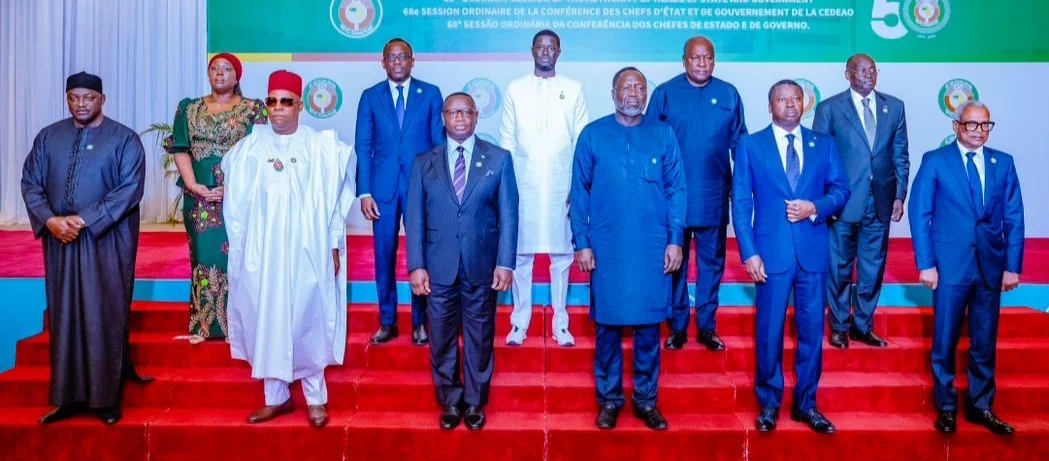
The Economic Community of West African States (ECOWAS) has resolved to impose targeted sanctions on individuals and groups responsible for the unconstitutional change of government in Guinea-Bissau.
The regional bloc also called for a swift transition led by an inclusive government and the immediate release of all political detainees.
ECOWAS Threatens Sanctions
Reading the communiqué of the 68th Ordinary Session in Abuja, ECOWAS Commission President Dr Omar Alieu Touray warned that failure to comply with the transition process would lead to sanctions. “If dialogue fails, our text provides sanctions. They will be applied to any institution or person obstructing the return of constitutional order,” he said.
Touray also rejected the military leadership’s transition programme and authorised the ECOWAS Military Mission in Guinea-Bissau to protect political leaders and national institutions.
Background: Guinea-Bissau Coup
The military ousted Guinea-Bissau’s President Umaro Embaló on November 26, just before the electoral commission was due to publish official results from the November 23 vote.
Soldiers loyal to Brigadier-General Dinis Incanha claimed total control of the country and set up the “High Military Command for the Restoration of National Security and Public Order”, led by General Horta Inta-A Na Man.
The November elections had been described as free, transparent, and peaceful by ECOWAS, the African Union, and the Community of Portuguese-Speaking Countries. Rights groups have since labelled the coup a “sham” aimed at delaying results and favouring allies of the deposed president.
ECOWAS Response
President Julius Bio of Sierra Leone, chair of the ECOWAS Authority, will lead a high-level mission to Guinea-Bissau, with the Committee of Chiefs of Defence Staff engaging military authorities immediately.
Touray stressed that sanctions would be “smart and targeted” to avoid harming ordinary citizens.
The bloc also praised the rapid response to the December 7 attempted coup in the Republic of Benin, highlighting the deployment of troops from Nigeria, Côte d’Ivoire, Ghana, and Sierra Leone to restore stability.
Regional Stability and Future Measures
ECOWAS reaffirmed its zero-tolerance policy for unconstitutional power grabs, whether military or political.
Touray also expressed concern over destabilising remarks from former Gambian President Yahya Jammeh, warning that there would be consequences for any interference in the country’s stability.
The session also addressed milestones in Guinea (Conakry) and other member states, including upcoming elections, constitutional reforms, and strengthened institutional leadership.
ECOWAS leadership positions and commissioner portfolios were also announced, with Senegal set to assume the ECOWAS Commission presidency in July 2026.
Commitment to Deterrence
Touray concluded by emphasising the bloc’s proactive approach to deterring coups, using both political mediation and its Standby Force. “ECOWAS leaders have resolved to ensure zero tolerance for unconstitutional change of government,” he said.
Vice President Kashim Shettima represented President Bola Tinubu at the session in Abuja, marking the first time a Nigerian leader attended an ECOWAS summit on home soil while the President remained in the country.

Rafiyat Sadiq is a political, justice, and human rights reporter with Pinnacle Daily, known for fearless reporting and impactful storytelling. At Pinnacle Daily, she brings clarity and depth to issues shaping governance, democracy, and the protection of citizens’ rights.