

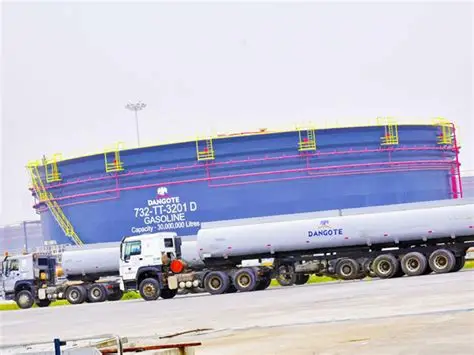
Dangote Group has achieved its first oil from its upstream assets in the Niger Delta, marking its entry into crude production.
The company is currently producing 4,500 barrels per day (bpd) from the Kalaekule field on Oil Mining Lease (OML) 72.
Vice President of Dangote Group’s Oil and Gas Division, Devakumar Edwin, disclosed the development during an interview with Platts, part of S&P Global Energy in Lagos.
Edwin said the crude is currently undergoing standard well testing, which is expected to be completed within three to four weeks. After that, commercial volumes will begin flowing.
“We have opened a well and begun standard testing, which should be completed in the next three to four weeks, maximum,” Edwin stated.
The company aims to ramp up to 15,000 bpd within the next month, according to the Chief Executive Officer of Dangote’s upstream joint venture, West African E&P, Olajumoke Ajayi.
This move secures feedstock for Dangote’s 650,000 bpd refinery, reducing reliance on external suppliers.
Dangote Oil Assets
Production is happening at the Kalaekule field on Oil Mining Lease (OML) 72. Dangote holds an 85 per cent stake in the upstream joint venture (WAEP), with the remaining held by NNPC Limited.
The assets are located in shallow waters 22 km from the Bonny export terminal in the Niger Delta.
Dangote acquired a 45 per cent working interest in OML 71 and OML 72 in 2015 from Shell, Total, and ENI during a period of low oil prices.
The oil field, which was discovered in 1966, had a peak of 21,000 bpd in 1999 before declining in the early 2000s.
Commenting on the development, CEO of Dangote Refinery, David Bird, noted that the drilling campaign is central to Dangote’s vertical integration strategy as to would help to secure feedstock for the 650,000 bpd facility.
Bird also stated that the company is investing in shipping to reduce logistics costs and improve supply stability.
He, however, pointed out that the offtake of the crude would be determined by its commercial viability.
”The refinery will take the crude if it makes sense,” Bird stated, adding that joint venture partners would seek maximum value for output.
Crude Supply Gaps
There are concerns that, despite the ramp-up, the internal production (coming from the wells) will only meet a fraction of the refinery’s needs. Analysts’ forecasts suggest peak output from these licenses may reach 43,000 bpd by 2036.
READ ALSO:
- NUPRC Digitises Procurement System, Targets 95% Compliance for Transparency
- Dangote Refinery Reverses Petrol Price to N1,200/litre after Oil Price Dropped
- NNPC Boosts Crude Supply to Dangote Refinery Amid Global Energy Crisis
- How Improved Pipeline Security Boosts Oil Output – NNPC
The refinery currently relies on imports to meet its feedstock demands as it has continued to experience supply shortages from domestic sources.
The NNPC, which is said to supply the refinery about 15 cargoes a month under the Naira-for-crude agreement, has been supplying about five cargoes a month on average, leaving a significant shortfall covered through external sourcing, often at a premium price.
NNPC, according to industry stakeholders, has been unable to meet its supply obligation to the refinery due to prior crude supply arrangements with other buyers bound by contractual obligations.

Victor Ezeja is a Nigerian journalist skilled in producing insightful news analyses, feature stories, and interviews that simplify complex issues and drive informed public discourse. His work combines rigorous research, balanced reporting, and compelling storytelling to highlight developments shaping industries and society. Victor, who holds a Master's Degree in Mass Communication, specializes in energy, aviation, business, and economic reporting. He can be reached via @VICTOREZEJA on X