

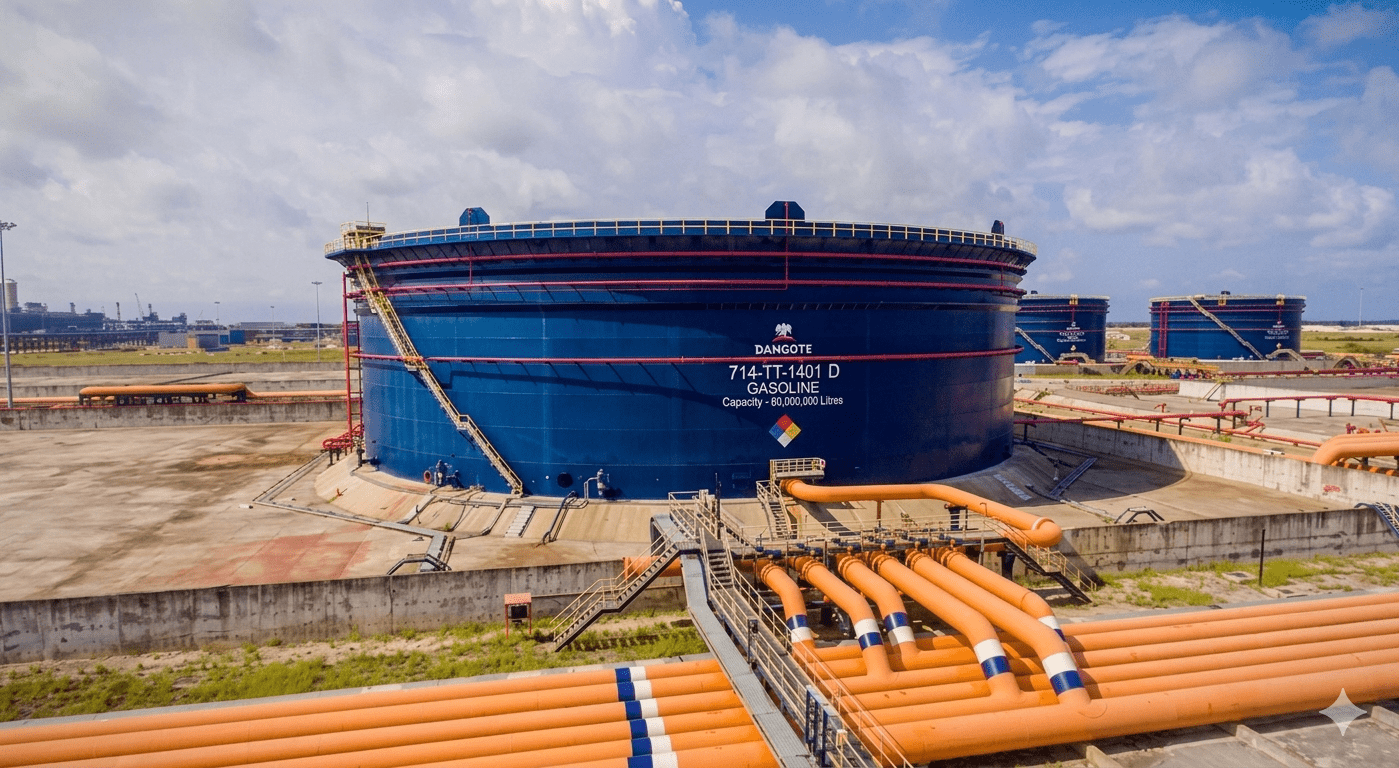
In a major breakthrough for the African energy sector, the Dangote Petroleum Refinery has surpassed its nameplate capacity, ramping up its crude oil processing capacity to 700,000 barrels per day (bpd).
The milestone, confirmed during a recent performance test conducted by the facility’s Process Licensors, means the refinery has officially surpassed its initial nameplate capacity of 650,000 bpd.
The feat cements the company’s status as the world’s largest single-train petroleum refinery and underscores its advanced engineering capability.
A statement released Thursday by the company management quoted Devakumar Edwin, Vice-President for Oil and Gas at Dangote Industries Limited, saying the ramp-up is part of a broader strategy to more than double capacity to 1.4 million bpd within 30 months.
“The expansion is expected to boost Nigeria’s energy self-sufficiency, eliminate the country’s dependence on imported refined products, and steer its position as a regional export hub,” Edwin said, adding that the refinery’s growth trajectory reflects a deliberate move toward continental and global refining dominance.
Owned by Nigerian industrialist and Africa’s richest man, Aliko Dangote, the $20 billion refinery began fuel production in 2024 and has steadily increased output of petrol, diesel, aviation fuel, and other refined products.
It has rapidly become a major supplier to both domestic and international markets, exporting to several African countries as well as key European destinations including the United Kingdom, France, Spain, Italy, and the Netherlands. The refinery has also supplied gasoline to the U.S. market and jet fuel to Saudi Arabia.
Industry analysts note that the Dangote Refinery has strengthened its role as a stabilizer in the oil and gas sector amid ongoing disruptions from Middle East tensions, with many African countries now turning to the refinery for energy security.
In a further sign of its growing global significance, S&P Global Commodities named Dangote Petroleum Refinery the world’s largest exporter of jet fuel in April.
READ ALSO:
- Fuel Sufficiency Boost as Dangote Refinery Finally Hits 650,000bpd Capacity
- Dangote Refinery Reduces Petrol Ex-depot Price to ₦1,250
- Dangote, NNPC Sign Landmark Gas Agreements to Boost Industrial Expansion
- Dangote Refinery Reassures Commitment to Nigeria’s Energy Stability Despite Global Supply Disruptions
- Dangote Refinery Emerges Top Jet Fuel Exporter
The facility has played a pivotal role in stabilizing fuel supplies in Nigeria, helping to eliminate dependence on imported petroleum products and easing pressure on the country’s foreign exchange reserves.
Its expansion aligns with national objectives to enhance local refining capacity and maximize value from Nigeria’s abundant crude oil resources.
Growing production volumes have also attracted increased interest from global crude suppliers and commodity trading firms, with the refinery sourcing feedstock from both domestic and international producers to sustain rising output.
Looking ahead, Aliko Dangote has outlined ambitious plans to transform the facility into the world’s largest refinery by 2028, targeting 1.4 million bpd.
The expansion is expected to deliver substantial economic benefits, including job creation, increased industrial activity, and improved trade balances.
The refinery is also expected to strengthen downstream manufacturing by ensuring a reliable supply of LPG, polypropylene for packaging materials, and—in future plans—linear alkylbenzene (LAB) used in detergent production.
Commenting on the development, financial services firm Comercio Partners said the rapid expansion shows the refinery’s growing participation in Africa’s fuel supply and its increasing relevance to international markets.
It noted that the refinery’s exports rose sharply to 353,000 bpd in April, with approximately half of that volume directed to other African countries and significant flows reaching Europe, the United States, and Saudi Arabia
It added that, with a reported large surplus of jet fuel already available for global supply, “the refinery is well positioned to mount a growing competitive challenge to established exporters.”

Victor Ezeja is a Nigerian journalist skilled in producing insightful news analyses, feature stories, and interviews that simplify complex issues and drive informed public discourse. His work combines rigorous research, balanced reporting, and compelling storytelling to highlight developments shaping industries and society. Victor, who holds a Master's Degree in Mass Communication, specializes in energy, aviation, business, and economic reporting. He can be reached via @VICTOREZEJA on X