

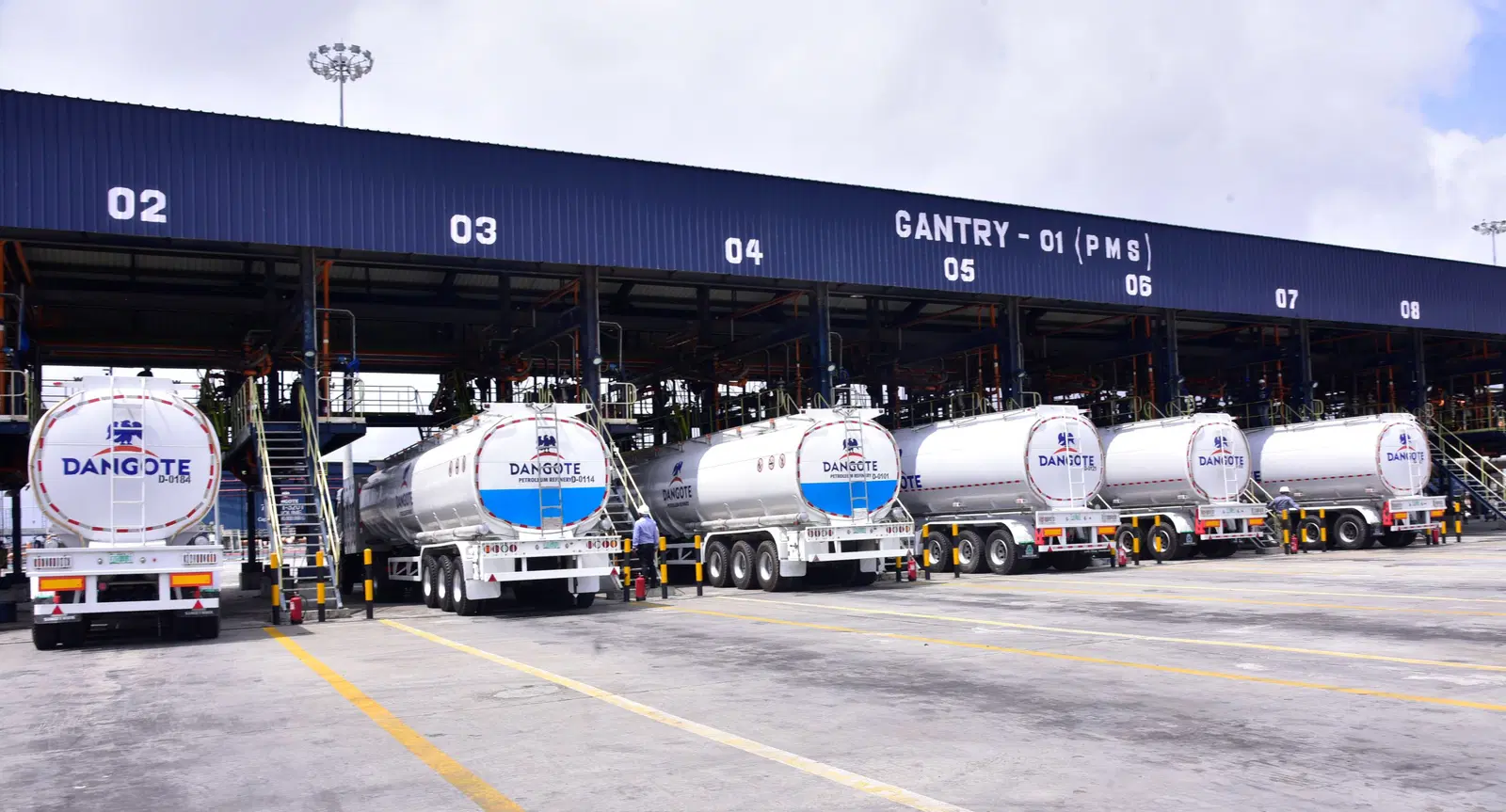
Dangote Refinery has revised its distribution policy, saying marketers are now free to choose between gantry and coastal loading of petroleum products from the refinery.
It said the refinery does not impose restrictions on the evacuation modes chosen by marketers.
Change in Distribution Policy
In a statement released on Thursday night, the refinery, however, warned that coastal logistics come at a premium cost, adding about ₦75 per litre and potentially raising pump prices of petrol to about ₦1,000 per litre.
“Marketers are free to choose between gantry and coastal loading, and the refinery does not impose restrictions on evacuation modes.
“Coastal logistics can add about ₦75 per litre to petrol costs, potentially pushing PMS pump prices close to N1,000 per litre if passed on to consumers,” the refinery stated.
It emphasised that loading petroleum products from the gantry is most cost-efficient because it removes port charges, maritime levies and vessel-related costs that come with loading through the coastal route. Furthermore, it said these charges are passed on to consumers.
Pressure from Major Marketers
Pinnacle Daily reports that the refinery had last year rejected requests from major marketers and depot operators to supply them with petroleum products through ships to their depots. The refinery said it was not ready to pass on over ₦1 trillion additional cost that comes with such logistics mode to consumers.
However, following what analysts described as “renewed pressure” from the major marketers, who have apparently invested so much in their depots over the years, the refinery seems to have backed down. It is now allowing all evacuation modes, including moving petrol by ship, but with a warning about its cost implications for the final consumer.
The Marketer’s Argument
On their part, marketers had argued that having operated in Nigeria’s downstream oil and gas industry over the years, they have acquired large distribution networks that can facilitate a massive supply of petroleum products. This, they said, boosts availability instead of relying on supply through only the gantry.
Dangote Refinery said its gantry facility has 91 loading bays, capable of loading up to 2,900 tankers daily. Furthermore, it can evacuate over 50 million litres of PMS and 14 million litres of diesel through 24-hour operations.
Currently, it sells at a gantry price of ₦799 while pump prices range between ₦839 and ₦900.
The refinery observed that since Nigeria’s daily consumption averages about 50 million litres of petrol and 14 million litres of diesel, reliance on coastal logistics could impose an additional annual cost of approximately ₦1.752 trillion.
READ ALSO:
- Dangote Refinery Denies Fuel Imports, Handles Multiple Crude Types
- Dangote Refinery Boosts Daily Fuel Supply: 75M Litres of Petrol, 25M of Diesel, 20M of Aviation Fuel
- Dangote, NNPC Sign Landmark Gas Agreements to Boost Industrial Expansion
- Dangote Refinery Fuel Sales in Naira Suspension Sparks Fear of Price Hike
Highlighting the impact of the refinery since it came on stream, it said the 650,000 barrels per day facility has significantly reduced fuel prices, with diesel falling from about ₦1,700 to ₦980-₦990 per litre, and PMS dropping from around ₦1,250 to ₦839-₦900 per litre, while also easing foreign exchange pressure and supporting naira stability.
Dangote reiterated its commitment to efficiency, transparency, and affordability, urging marketers, regulators, and policymakers to prioritise logistics decisions that promote consumer protection and the long-term viability of Nigeria’s refining business.
Consumer concerns
The move to accommodate coastal loading is seen as a double-edged sword. While it theoretically improves distribution reach to different parts of Nigeria, there are concerns that it will reintroduce costs that the refinery was designed to eliminate.
Some analysts suggest that the push for gantry loading is also a way to ensure that the “local refining” price advantage isn’t lost to logistics.
Some, however, argue that the move to accommodate coastal loading isn’t necessarily a mandate for higher prices, but rather a shift in who bears the cost. They said if a local fuel station gets its supply through ships (common in certain coastal regions), consumers there are more likely to see the price hit ₦1,000 than if they lift directly from the refinery by truck.
Reacting to the development, an energy expert, Engr Mustapha Samaila Inagawa, hinted at the potential impact on fuel prices nationwide.
He said major marketers are not relenting in their efforts to see that their investments in depots are not rendered useless.

Victor Ezeja is a Nigerian journalist skilled in producing insightful news analyses, feature stories, and interviews that simplify complex issues and drive informed public discourse. His work combines rigorous research, balanced reporting, and compelling storytelling to highlight developments shaping industries and society. Victor, who holds a Master's Degree in Mass Communication, specializes in energy, aviation, business, and economic reporting. He can be reached via @VICTOREZEJA on X