

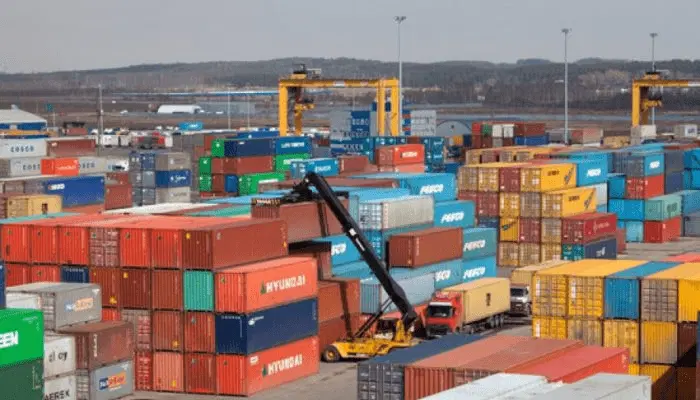
Nigeria’s export of unprocessed raw materials surged to ₦2.9 trillion in the first nine months of 2025, despite the Federal Government’s intensified push for value-added exports and local processing.
Latest data from the National Bureau of Statistics (NBS) showed that raw material exports rose by 147.4 per cent from ₦1.174 trillion recorded in the corresponding period of 2024 to ₦2.904 trillion in 9M’25.
The 2025 figure also represents a 442.8 per cent increase compared to ₦564.73 billion exported in the first nine months of 2023, underscoring a sharp acceleration in the shipment of primary commodities out of the country.
A breakdown of the data from the National Bureau of Statistics showed a consistent surge across all three quarters of 2025, with exports rising to ₦1.045 trillion in the first quarter compared to ₦439.8 billion in Q1 2024; ₦819.7 billion in the second quarter against ₦381.745 billion in Q2 2024; and ₦1.04 trillion in the third quarter, up from ₦352.7 billion recorded in Q3 2024.
Each quarter in 2025 significantly outperformed the corresponding period in 2024, suggesting sustained growth in the export of primary goods.
Major Exported Commodities
Key non-oil raw material exports during the period included cocoa beans, raw cashew nuts, sesame seeds, raw lead ores, ginger, rubber, palm kernel oil, and other agricultural produce.
Other notable exports were “urea, whether or not in aqueous solution” and “non-monetary gold (including gold plated with platinum) in powder form.”
Major export destinations included India, Spain and the Netherlands.
The rising export of unprocessed commodities runs counter to government initiatives aimed at discouraging raw material exports without value addition.
Current policy measures include raw material protection and targeted bans in selected sectors such as the shea industry, where the government has restricted the export of raw nuts to encourage local refining. Authorities have also pursued incentive alignment, with the Central Bank of Nigeria (CBN) reportedly rejecting export incentives for raw, unprocessed commodities to ensure that only value-added goods benefit. In addition, the government has intensified local content promotion by emphasising backward integration and local sourcing, compelling manufacturers to process raw materials within Nigeria.
These initiatives are designed to stimulate domestic industrialisation, generate employment, conserve foreign exchange, improve product competitiveness in international markets, and strengthen the country’s foreign reserves.
Proposed 30% Value-Addition Bill
In its most structured move yet, the Raw Materials Research and Development Council (RMRDC) last year championed a bill mandating a minimum of 30 per cent local value addition on all raw materials before export.
The proposed legislation, currently before the National Assembly, seeks to halt the export of unprocessed commodities, promote beneficiation, create jobs, and accelerate industrialisation.
The bill aligns with a 2009 ECOWAS directive that encourages value addition as a condition for duty-free exports within the sub-region. Under the proposed framework, the 30 per cent requirement would apply to natural resources, solid minerals and agricultural products.
Director-General of RMRDC, Prof. Martin Muonso, said exporters who fail to meet the 30 per cent processing threshold would face a 15 per cent levy on the export value of the raw materials and risk suspension or revocation of their value-addition certificate.
The bill also aims to reduce the importation of materials that can be processed locally.
10-Year Roadmap Targets 60% by 2034
Former Minister of Innovation, Science and Technology, Uche Nnaji, last year unveiled a 10-year roadmap targeting 60 per cent value addition in Nigeria’s raw materials sector by 2034. The roadmap, developed in collaboration with the African Development Bank (AfDB), aims to stimulate manufacturing, generate employment and strengthen the naira.
Similarly, the current Minister of Innovation, Science and Technology, Dr Kingsley Udeh, described the 30 per cent value-addition bill as a potential turning point that could compel local processing and prevent Nigeria from exporting cheap raw materials only to import finished goods at higher costs.
Chairman of the Nigeria Revenue Service, Zacch Adedeji, also warned that reliance on raw exports weakens the naira, arguing that exporting cheap primary goods while importing expensive finished products effectively imports inflation and unemployment.
Stakeholders Raise Concerns
Stakeholders, however, insist that policy pronouncements alone will not solve the problem.
Director-General of the Manufacturers Association of Nigeria (MAN), Segun Ajayi-Kadir, stressed that exporting raw materials contributes to job losses, limits technological innovation and constrains economic diversification. He reaffirmed MAN’s support for amending the RMRDC Act to mandate a minimum of 30 per cent local processing.
On her part, Director-General of the Lagos Chamber of Commerce and Industry (LCCI), Dr Chinyere Almona, described the 147.4 per cent increase in raw material exports as a “mixed development.”
According to her, while the surge reflects strong external demand and provides short-term foreign exchange inflows, it highlights limited progress in domestic value addition and exposes the economy to global commodity price volatility.
She cautioned that enforcing the 30 per cent requirement without adequate infrastructure, stable power supply, affordable financing and efficient logistics could lead to smuggling, loss of competitiveness and income disruptions for producers.
READ ALSO:
- Nigeria’s Cashew Exports to EU Surge 12%
- Nigeria’s Cocoa Exports Jump 62% in 2025, Driving Agricultural Growth
- Nigeria’s Non-Oil Exports Hit Record $6.1bn in 2025 – NEPC
- After Shea Nut Export Ban: What is Nigeria’s Strategy to Capture Bigger Slice of N10trn Market
Almona also noted that the export surge undermines Nigeria’s backward integration policy, as many raw materials are shipped abroad instead of serving as feedstock for domestic factories, only to be re-imported as finished or semi-finished goods at higher prices.
She recommended phased implementation of the value-addition requirement, alongside targeted incentives, industrial clusters near raw material sources, and trade measures that favour processed exports.
Chief Executive Officer of the Centre for the Promotion of Private Enterprise (CPPE), Dr Muda Yusuf, similarly warned that mandatory local processing could stifle manufacturing if adequate capacity does not exist.
He argued that while domestic value addition aligns with Nigeria’s economic transformation goals, compulsory policies imposed without sufficient infrastructure, competitive energy supply and financing may distort commodity markets and create logistical challenges for exporters.
Structural Hurdles Persist
Experts identified persistent structural challenges, including unreliable power supply, high operating costs, port congestion, logistics bottlenecks, limited access to finance, and difficulty meeting international quality standards.
While rising raw material exports have boosted short-term trade earnings, analysts say the trend underscores structural gaps in Nigeria’s industrial base and reinforces the urgency of building domestic processing capacity.
As the 30 per cent value-addition bill awaits legislative approval, the widening gap between policy ambition and export reality continues to test Nigeria’s industrialisation drive.

Esther Ososanya is an investigative journalist with Pinnacle Daily, reporting across health, business, environment, metro, Fct and crime. Known for her bold, empathetic storytelling, she uncovers hidden truths, challenges broken systems, and gives voice to overlooked Nigerians. Her work drives national conversations and demands accountability one powerful story at a time.