

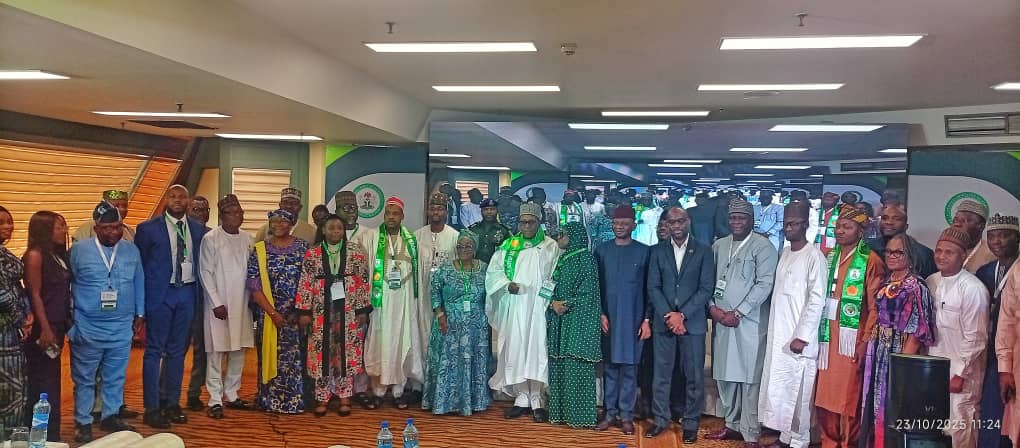
Nigeria’s Coordinating Minister of Health and Social Welfare, Prof. Muhammad Ali Pate, has declared that solving Nigeria’s health crisis is not a matter of technical capacity but political will, calling on state governors, development partners, and the media to take shared responsibility in driving real change.
Speaking at a High-Level Health Media Dialogue held in Abuja with the theme “Advocacy Solutions to Improve PHC Delivery and Health Outcomes in Nigeria”, Pate said Nigeria’s health reform journey must move beyond policy rhetoric to visible political action and transparent governance.
“Fixing health is not a technical problem; it is a political choice,” Pate told participants. “We have competent professionals and evidence-based solutions, but what we often lack is the courage and consistency to make the hard decisions.”
The minister, who addressed media executives, state commissioners, and members of the Nigeria Governors’ Forum, said that improving the country’s health outcomes requires financial commitment and accountability at every level of government.
He noted that under President Bola Ahmed Tinubu’s Renewed Hope Agenda, Nigeria is reforming its public finance structure to raise the tax-to-GDP ratio from 7.5% to 11% within three years, a crucial step to fund essential sectors like health, education, and social welfare.
READ ALSO: Gates Foundation Deepens Health, Poverty Reform in Kano
“No country can achieve good health outcomes without sustainable financing,” Pate said. “If we want better services, we must be ready to fund them, and every naira must be spent with measurable results.”
He challenged the media to play a stronger oversight role by exposing inefficiencies, highlighting success stories, and holding public officials accountable for every health naira spent.
“The media is part of governance,” he said. “When journalists track budgets, monitor service delivery, and tell the human stories behind statistics, you drive reform faster than policies alone.”
The dialogue featured reports from Kaduna, Lagos, and Kano States, showcasing varying levels of progress and innovation in primary health care (PHC) delivery.
Kaduna: Model of Political Commitment
Governor Uba Sani of Kaduna State presented a detailed account of reforms that have repositioned Kaduna as one of Nigeria’s PHC success stories.
According to him, the state has revitalised 255 PHCs, recruited over 1,800 health workers, and introduced a 48-hour free emergency care policy for women, children under five, and the elderly.
Kaduna has also established a ₦1 billion free healthcare fund, launched the Kaduna Centre for Disease Control, and introduced a digital data dashboard to monitor performance and spending.
“Health is a right, not a privilege,” the governor said. “Our people should not fall into poverty because they seek healthcare.”
Lagos: Building Systems That Last
Representing Governor Babajide Sanwo-Olu, Dr Mustapha Akinwunmi Ibrahim, Permanent Secretary of the Lagos State Primary Health Care Board, said Lagos is expanding access through massive infrastructure and technology investments.
He revealed that Lagos currently allocates 12% of its annual budget to health, with plans to increase it to 14% by 2026, moving toward the Abuja Declaration target.
“We are not just building hospitals; we are building systems that last,” Dr Ibrahim said. “Our priority is quality, access, and sustainability.”
Ongoing projects include the 1,200-bed Massey Street Children’s Hospital, 12 new maternal and child centres, and the expansion of health insurance coverage for low-income households.
Kano: Restoring Governance and Access
Kano State’s Commissioner for Health, Dr Abubakar Labaran Yusuf, who represented Governor Abba Kabir Yusuf, said the state is rebuilding its PHC system through better coordination, transparency, and accountability.
“We are making health facilities functional, transparent, and closer to our people,” Dr Yusuf said.
“Our partnership with development agencies has helped improve immunisation coverage and maternal health outcomes.”
READ ALSO: Ampiclox as Contraceptive Threatens Fertility, Health System in Nigeria
Executive Director of the International Society of Media in Public Health (ISMPH), Moji Makanjuola, called on journalists to be proactive advocates for public health by holding government accountable and making data accessible to citizens.
“Every journalist must become a health advocate,” Makanjuola said. “Health reporting is no longer about press statements — it’s about following the money and amplifying the people’s voice.”
She thanked the InGender Health Consortium and other partners for supporting the dialogue, emphasising that stronger collaboration between the media and policymakers is key to ensuring Nigeria meets its Universal Health Coverage (UHC) goals.
The Gates Foundation reaffirmed its long-standing commitment to Nigeria’s health transformation, pledging deeper collaboration to strengthen data transparency, state accountability, and media capacity.
Uche Amaonwu, Country Director of the Gates Foundation in Nigeria, said the next phase of the Foundation’s partnership focuses on empowering journalists, improving access to health data, and supporting states to design measurable, community-driven solutions.
“We believe good data drives good governance,” Amaonwu said. “When the media uses data to tell human stories and track health investments, policymakers listen, and that’s how lives are changed.”
He revealed that the Foundation is working closely with states like Kano, Kaduna, and Lagos to scale successful interventions in maternal and child health, vaccine delivery, and PHC infrastructure.
“Our goal is simple,” she said. “To ensure that policies move from paper to people where they truly make an impact.”
READ ALSO: FG to Strengthen Health System, Disease Surveillance
At the close of the dialogue, a unified message emerged that Nigeria’s health transformation will only succeed if political leaders fund it, the media monitors it, and partners support it with transparency and evidence.
Prof. Pate summed it up powerfully: “We are not reforming health to tick boxes. We are reforming health to save lives.
Health is everyone’s business, and this time, we must get it right.”

Esther Ososanya is an investigative journalist with Pinnacle Daily, reporting across health, business, environment, metro, Fct and crime. Known for her bold, empathetic storytelling, she uncovers hidden truths, challenges broken systems, and gives voice to overlooked Nigerians. Her work drives national conversations and demands accountability one powerful story at a time.