

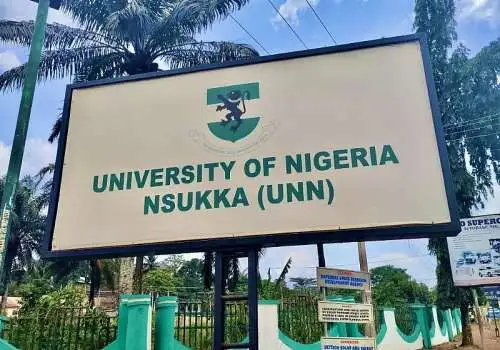
Civil society organisation, Speak Out Africa Initiative (SOAI) has faulted the University of Nigeria, Nsukka (UNN) and its Enugu Campus (UNEC) over the imposition of a compulsory ₦30,000 developmental fee on students, describing the policy as “daylight extortion” and a violation of the right to education.
In a statement released on Thursday, SOAI condemned the reported decision of the university to bar students from writing their examinations for failing to pay the fee, calling it an “academic injustice and breach of contract.”
READ ALSO: Nnaji’s Certificate ‘Fraud’, Separating Fact from Allegation
“Education is not merely a service; it is a fundamental human right,” the organisation said. “No student should be denied the opportunity to write exams because of an arbitrary financial demand.”
SOAI faults decision process, Calls it Unfair and Undemocratic
According to SOAI, the committee that approved the levy on 22 September 2025 comprised 14 members, with only one student representative. The group said this ratio failed to ensure transparency, fairness, and adequate representation of student interests.
It criticised the rapid implementation of the fee within weeks of approval, arguing that the university’s approach was “insensitive and disconnected from students’ lived realities” amid Nigeria’s economic hardship.
READ ALSO: 98% of Nigerian Workers to be exempted from PAYE under new Tax Law — Oyedele
“For many families, ₦30,000 could mean the difference between continuing education and meeting basic survival needs,” the statement added.
Denial of Exam Access Breaches Students’ Rights, Says SOAI
The group particularly condemned reports that students from the Faculties of Medical Sciences, Basic Medical Sciences, Health Sciences, and Dentistry were stopped from writing their examinations.
SOAI said this practice undermines students’ contractual and legal rights, stressing that once a student pays all statutory tuition fees, the university is obligated to provide full academic access.
“Barring students from exams after collecting official fees is punitive and unjust. It breaches both trust and academic fairness,” the organization stated.
Group Lists Demands to UNN Authorities and Government
SOAI outlined several immediate actions and policy reforms it expects from the university and government agencies:
Immediate reversal and refund of the ₦30,000 developmental fee.
Reinstatement of all affected students without academic penalty.
Public apology from the Vice-Chancellor, Prof. Simon Uchenna Ortuanya, and full disclosure of how the fee was conceived and approved.
Creation of an inclusive dialogue platform involving students, faculty, parents, and civil society to review future fee structures.
Intervention by the Federal Ministry of Education and investigation by the National Human Rights Commission (NHRC) into possible rights violations.
READ ALSO:Labour Unions Must Not Emasculate Dangote to Serve Selfish Interest – Expert
The organization further urged UNN management to publish budgetary justifications for all future levies and to establish a student welfare or waiver scheme to assist those unable to meet financial obligations.
‘Education Must not Become a Privilege,’ SOAI Warns
SOAI said the situation at UNN/UNEC reflects a broader crisis in Nigeria’s higher education system, where students increasingly face opaque and unaffordable fees.
“Universities must remember that their purpose is the advancement of knowledge, not revenue extraction from vulnerable youth,” the statement concluded. “Education must never become a privilege for the few but remain a right for all.”
Background
UNN, one of Nigeria’s oldest and most respected federal universities, has faced growing criticism from students and advocacy groups over rising charges and what they describe as “anti-student financial policies.” The ₦30,000 developmental fee controversy has sparked renewed debate on the affordability and governance of public education in the country.
