

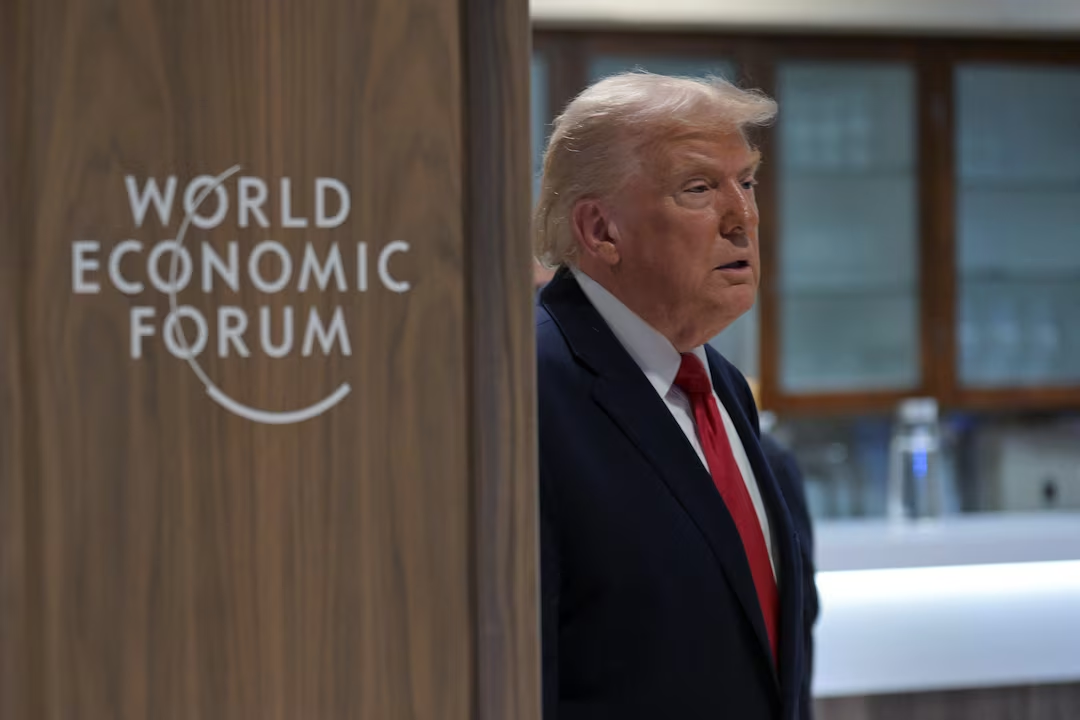
World leaders and business executives at the World Economic Forum explore new trade alliances as U.S. tariffs reshape global commerce.
President Donald Trump’s aggressive use of tariffs, most recently threatening European allies over Greenland before striking a NATO framework deal, has renewed efforts to expand global trade outside the U.S. sphere. At the World Economic Forum in Davos, frustration was evident among Washington’s key trading partners.
“It’s the speed, scale, and scope of change that is really rattling the world,” said Canadian Finance Minister François-Philippe Champagne during a panel discussion on tariffs.
Since Trump last year raised U.S. tariffs to nearly a century-high level, countries have accelerated moves to diversify trade, seeking stability amid rising uncertainty.
CEOs are prioritizing stability, predictability, and the rule of law qualities seen as in short supply, Champagne noted. Recent agreements illustrate this trend: Canada and China cut tariffs on electric vehicles and canola, while the EU signed its largest-ever trade deal with South America’s Mercosur bloc after 25 years of negotiations.
READ ALSO:
-
Blord Trademarks Ratel, Orders VeryDarkMan to Stop Using Name
-
IMF Lifts 2026 Global Growth Forecast as AI Investment Counters Trade Pressures
-
Trump steps back from Greenland tariffs, signals framework for Arctic deal
-
Global Markets Reel as Trump’s Threat, Push to Control Greenland Sparks Tension
WTO Director-General Ngozi Okonjo-Iweala supports such diversification, highlighting its role in spreading jobs and economic growth worldwide.
According to Boston Consulting Group (BCG), the U.S. share of global goods trade could fall from 12% to 9% by 2034, giving way to more domestic production. German exporters report declining trade with the U.S.—a 9% drop in 2025—while tariffs on raw materials like steel and aluminium are driving up costs for companies.
“The world has become more expensive, and structurally it will get even more expensive,” said Volker Treier of the German Chambers of Industry and Commerce.
Reconfiguring Global Commerce
BCG identifies four major trade nodes: the U.S., China, BRICS+ (excluding China), and plurilateral alliances comprising Europe, Canada, Mexico, Japan, Australia, and select Asia-Pacific economies. Trade among plurilateralists and China’s engagement with the Global South are expected to drive global commerce in the coming decade.
Ports are already feeling the shift. Noel Hacegaba of Long Beach reported that China’s share of port cargo fell from 70% in 2019 to 60% last year, with more trade now coming from Southeast Asia. Rotterdam’s CEO Boudewijn Siemons emphasized the urgency: “We’ve relied on cheap production in China, cheap energy from Russia, and cheap defense from the U.S.—all three are falling away. We have to reconfigure ourselves very fast.”

Esther Ososanya is an investigative journalist with Pinnacle Daily, reporting across health, business, environment, metro, Fct and crime. Known for her bold, empathetic storytelling, she uncovers hidden truths, challenges broken systems, and gives voice to overlooked Nigerians. Her work drives national conversations and demands accountability one powerful story at a time.