

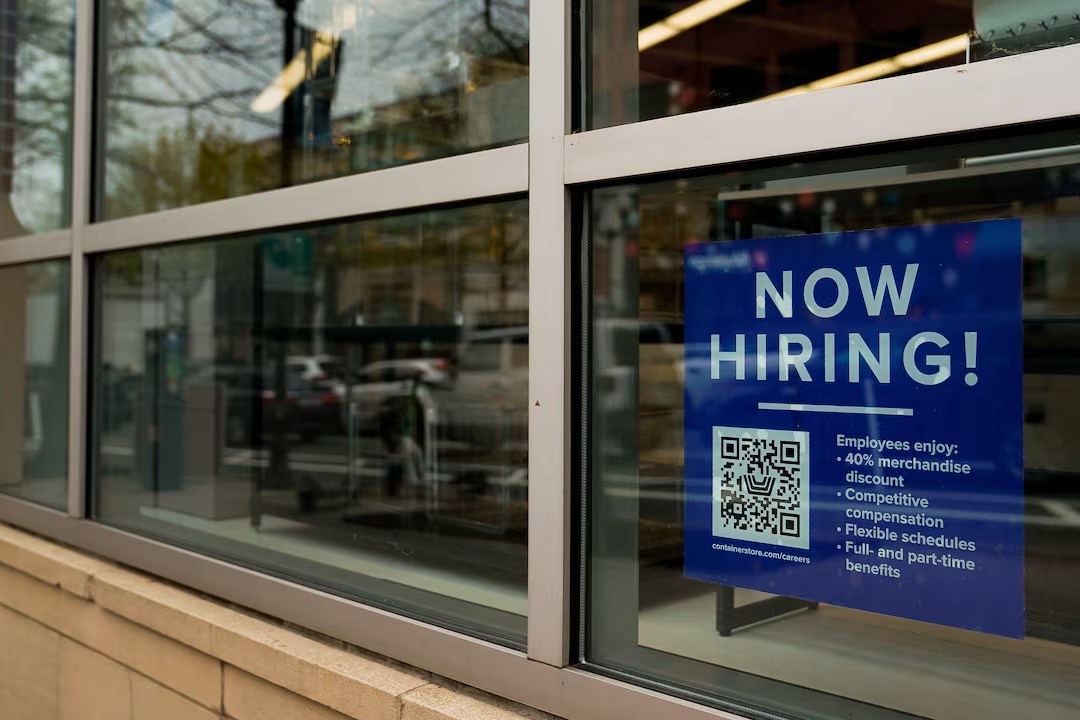
U.S. job growth likely improved slightly in January, helped by fewer post-holiday layoffs, but economists say the labor market remains fragile amid trade tensions and tighter immigration policies.
The Labor Department’s employment report, released Wednesday after a delay caused by a federal government shutdown, is expected to show nonfarm payrolls increased by about 70,000 jobs last month. That would mark an improvement from December’s 50,000 gain, according to a Reuters survey of economists.
Despite the pickup, hiring remains subdued by historical standards.
Economists expect the unemployment rate to hold at 4.4% in January, while annual wage growth is likely to slow.
Analysts say trade uncertainty and stricter immigration enforcement under President Donald Trump have dampened hiring, even as broader economic growth remains solid. At the same time, tax cuts could provide some support to job creation later this year.
“The underlying stress in the labor market is greater than the overall unemployment suggests,” said Diane Swonk, chief economist at KPMG. “Wages are cooling, and it’s harder to get a job if you lose one or if you’re a new graduate. It still feels like a frozen labor market.”
Seasonal Factors Mask Weakness
Retailers and delivery firms hired fewer holiday workers last year. As a result, January, typically the peak month for post-holiday layoffs, likely saw fewer job cuts. That dynamic may have temporarily boosted payroll numbers.
Estimates for January’s payrolls range widely, from a loss of 10,000 jobs to a gain of 135,000. Some private-sector surveys even pointed to possible job losses.
The Bureau of Labor Statistics (BLS) will introduce methodological updates starting with the January report. The agency will revise its “birth-and-death” model, which estimates job gains and losses from business openings and closures.
Critics have blamed the model for overstating payroll growth in recent months.
Goldman Sachs economists estimate the update could reduce monthly job counts by 30,000 to 50,000 compared with previous calculations. The BLS will also publish its annual benchmark revision. Last year, it estimated the economy created 911,000 fewer jobs in the 12 months through March 2025 than previously reported. Economists expect a downward revision in the range of 750,000 to 900,000 jobs.
READ ALSO:
- U.S. Condemns Horrific Kwara Killings, Backs Tinubu’s Security Measures
- African Energy Bank Will Boost Energy Security, Inclusive Growth – Lokpobiri
- FG Disburses ₦152bn to Verified Local Contractors, Pledges More
- FG Eyes Stronger Non-Oil Collections to Achieve ₦40.7trn Revenue Target for 2026
Slower labor force growth has also constrained hiring. Economists say the U.S. now needs to create only 10,000 to 50,000 jobs per month to keep pace with working-age population growth.
White House economic adviser Kevin Hassett warned that job gains could slow further due to weaker labor force expansion. The Census Bureau recently reported that the U.S. population grew by just 0.5% or 1.8 million people in the year ending June 2025.
Stricter immigration enforcement has contributed to slower workforce growth. Some analysts argue that reduced migration has limited labor supply and curbed payroll expansion.
Fed Likely to Stay on Hold
A steady unemployment rate may allow the Federal Reserve to keep interest rates unchanged through the end of Chair Jerome Powell’s term in May. The central bank last month held its benchmark rate in the 3.50%–3.75% range.
Economists say it is too early to attribute labor market weakness to artificial intelligence, though heavy corporate spending on AI may be diverting funds from hiring.
Trade policy remains another source of uncertainty. Trump’s recent tariff threats against European allies and geopolitical moves involving Venezuela have added to business concerns.
“I’ve spoken to a lot of companies, and they say uncertainty is a big factor,” said Ron Hetrick, senior labor economist at Lightcast. “Every time a tariff changes, they have to recalibrate their input costs.”
While January may show modest improvement, economists caution that underlying labor market momentum remains weak.

Esther Ososanya is an investigative journalist with Pinnacle Daily, reporting across health, business, environment, metro, Fct and crime. Known for her bold, empathetic storytelling, she uncovers hidden truths, challenges broken systems, and gives voice to overlooked Nigerians. Her work drives national conversations and demands accountability one powerful story at a time.