

By Rafiyat Sadiq
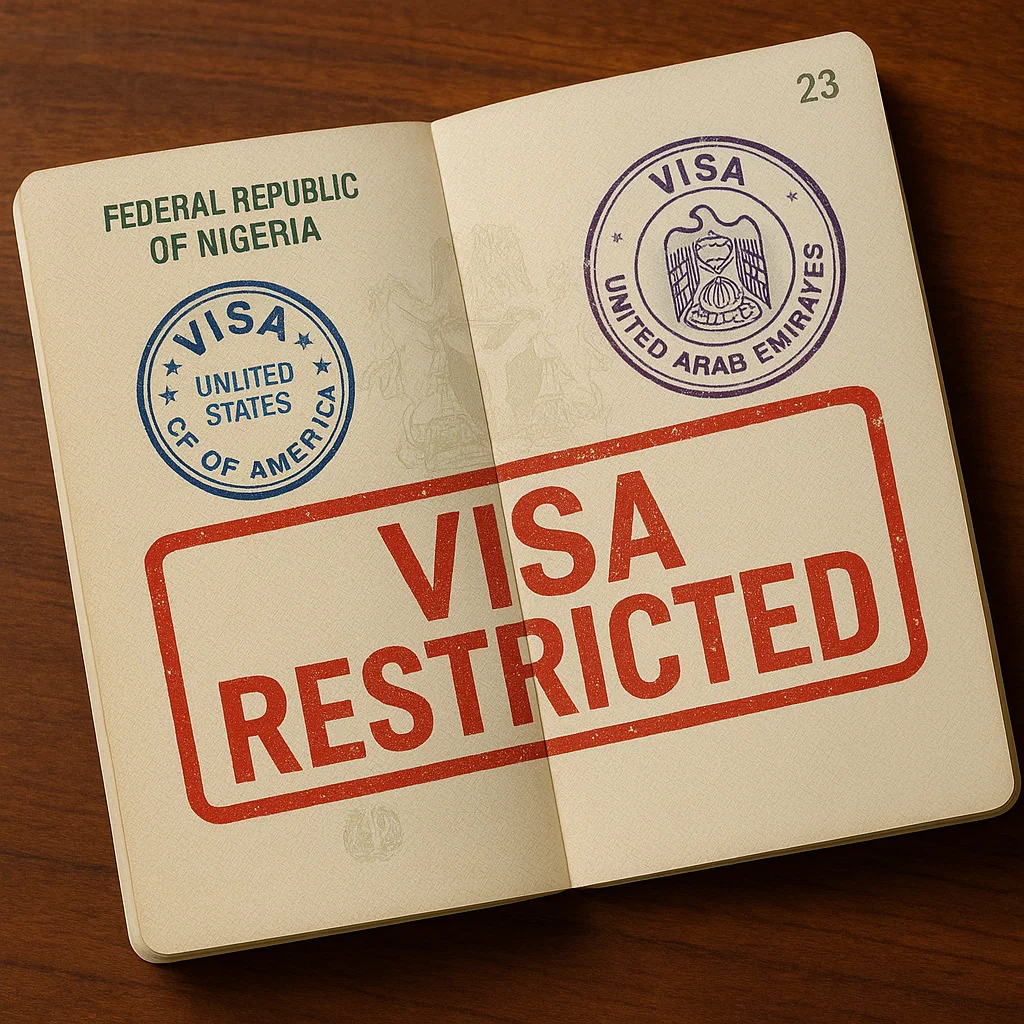
In a sharp diplomatic setback, the United States (US) and the United Arab Emirates (UAE) imposed tough new visa restrictions on Nigerian travellers, sparking outrage and concern among citizens, government officials, business leaders, migration experts, and students abroad.
The coordinated clampdown, announced within hours of each other on July 9, 2025, marks a dramatic shift in how two of Nigeria’s key international partners now treat the country’s citizens raising fears of broader geopolitical isolation.
For many Nigerians, the new policies are more than mere travel inconveniences. Experts warn that they represent a growing pattern of exclusion and could signal the start of a prolonged diplomatic freeze.
Amid rising concerns, seasoned voices in immigration, travel, and international business are sounding the alarm, warning that these restrictions could signal deeper diplomatic hostilities unless the Nigerian government responds swiftly and strategically
In this special report, Pinnacle Daily speaks with an immigration expert, a travel consultant, and a Nigerian businessman, who share their perspectives on the new US and UAE visa restrictions what they mean for Nigeria and the steps the country should take moving forward.
Background
The United States has slashed visa validity for Nigerians from five years to a three-month, single-entry permit, while Dubai has effectively closed its borders to Nigerian transit passengers and solo tourists under the age of 45. These actions reflect growing international concern about Nigeria’s global image.
On June 4, 2025, President Donald Trump signed Proclamation 10949, effective June 9 banning entry from 12 countries, including seven African nations: Chad, Republic of the Congo, Equatorial Guinea, Eritrea, Libya, Somalia, and Sudan, citing security risks.
This update followed broader U.S. measures aimed at tightening visa policies. In June 2025, the Trump administration added Nigeria to a list of 36 countries under review for potential entry suspensions or restrictions, citing concerns about passport security, poor document standards, and high rates of visa overstays.
The U.S. Department of State explained that the move was part of its global visa reciprocity review, a process it described as continuous and subject to change at any time, including adjustments to entry permits and duration.
It emphasized that U.S. visa criteria are designed to protect the integrity of the US immigration system and are based on global technical and security benchmarks.
On July 9, 2025, the U.S. Embassy in Abuja announced that all newly issued non-immigrant visas for Nigerian citizens would now be single-entry and valid for only three months, ending the longstanding five-year multiple-entry visa policy.
The change took immediate effect, though visas issued before July 8 would retain their original terms.
The U.S. Mission in Nigeria stated that the policy is based on the principle of reciprocity and mirrors Nigeria’s current visa terms for American citizens.
On the same day, the United Arab Emirates imposed even stricter measures. Nigerian citizens are now barred from applying for transit visas, effectively removing Dubai as a stopover destination.
Additionally, tourist visa applications for individuals aged 18 to 45 will no longer be processed unless accompanied by a sponsor or in compliance with new requirements.
Applicants aged 45 and above must now provide a six-month personal bank statement showing a minimum monthly balance of $10,000 (or its naira equivalent of ₦15,300,000) to qualify.
The United Arab Emirates officially lifted its visa ban on Nigerian travelers on July 15, 2024, marking the end of a nearly 21-month diplomatic standoff.
This latest round of visa restrictions comes less than a year after both countries restored travel and flight operations, following tensions that had disrupted diplomatic and aviation ties since late 2022.
RELATED STORIES:
1. US Warns Citizens Against Travel to Nigeria over Insecurity, Others
2. Reps Urges US to Reverse Visa Restriction on Nigerians
3. UAE Tightens Visa Rules for Nigerians, Bans Transit Visas
4. U.S. Denies Political Motive Behind Visa Cuts for Nigerians
These developments have sparked concern in diplomatic and immigration circles, with fears that Africa’s most populous nation and largest economy is being systematically side-lined in matters of global mobility and bilateral cooperation. Government officials have expressed dismay, describing the U.S. policy shift as disproportionate and warning that it could impact cultural, educational, and commercial ties between the two nations.
New Visa Rules by US, UAE Spark Concern Across Nigeria
Although both the UAE and the U.S. have imposed visa restrictions on Nigeria, the U.S. decision has gained more attention. This may be due to the growing number of young Nigerians seeking to emigrate in what is locally known as Japa (a Yoruba term meaning “to escape”), with many pursuing business opportunities, academic advancement, and family reunification in the U.S., a top destination of choice for Nigerians
President Bola Ahmed Tinubu strongly condemned the move, describing it as disproportionate and calling for a reconsideration. The Nigerian government pointed out that it still issues five-year visas to Americans, clarifying that only its e-visas are limited to 90 days.
Nigerian Officials have however warned that the new restrictions could damage longstanding cultural, educational, and commercial exchanges, pillars of the U.S.-Nigeria relationship.
The African Union also weighed in, cautioning that such measures could erode decades of diplomatic cooperation.
The U.S. embassy to Nigerians has reiterated that the updated policy is based solely on reciprocity.
However, Bashir Ahmad, an aide to former President Muhammadu Buhari, disputed the U.S. explanation. Posting on X (formerly Twitter), Ahmad claimed that the visa changes reflect Washington’s discomfort with Nigeria’s increasing alignment with BRICS, citing President Tinubu’s recent visit to Brazil for a BRICS gathering.
In response, the U.S. Embassy in Nigeria denied having any political motive behind visa cuts for Nigerians. It clarified that the decision to shorten visa validity was not influenced by Nigeria’s stance on deportees, its growing ties with BRICS, or its e-visa policies stating that visa policies are subject to ongoing review and may change depending on diplomatic, security, and immigration factors.
Meanwhile, Nigeria’s House of Representatives have also condemned the U.S. decision, calling it unfair, damaging to bilateral relations, and harmful to millions of law-abiding Nigerians. In a motion of urgent public importance, Hon. Muhammad Muktar and co-sponsors urged the U.S. government to reverse the policy.
The lawmakers stressed that the July 8 decision would negatively impact business operations, academic pursuits, and family ties, particularly within Nigeria’s vibrant diaspora.
“This new policy will inflict significant consequences across multiple spheres,” Muktar warned, adding that it could also undermine efforts to attract monthly remittances exceeding $1 billion through diaspora bonds.
In a separate development, the U.S. issued a fresh travel advisory against Nigeria, urging its citizens to reconsider traveling to Nigeria due to crime, terrorism, civil unrest, kidnapping, armed gangs, and inconsistent availability of health care services.
The United States government issued the warning on July 15, 2025 adding that some places in Nigeria have an increased risk, stressing: “Overall, all locations carry significant security risks.
The move has further raised concerns about the current state of U.S.-Nigeria relations.
Immigration Official Warns of Long-Term Impacts
A senior Nigerian immigration officer Mr Lawal Onimisi with over a decade of experience processing U.S. and UAE visa applications described the American policy shift as a major diplomatic blow with lasting consequences.
Mr Onimisi warned that the restrictions will disrupt travel plans, especially for students, entrepreneurs, and families who depend on multi-entry access for education, business, or family reunification.
He explained that people will now have to apply more often, which means spending more money and facing more uncertainty
“Business leaders face disrupted schedules, as short-term, single-entry visas do not align with the needs of global trade and investment,” he said.
Mr Onimisi also cautioned that students studying in the U.S. may struggle to return home for holidays or emergencies, while participants in cultural exchange programs could miss long-term opportunities. Tourists and families now face higher travel costs and logistical challenges.
While acknowledging U.S. concerns over visa overstays, the expert emphasized that reciprocity must be rooted in mutual respect and diplomacy, not isolation.
“No developing country can afford to isolate the U.S. in matters of migration, investment, or partnership,” Mr Onimisi said.
With the U.S. economy valued at over $25 trillion and commanding unmatched global influence, he advised that, Nigeria must pursue diplomatic engagement, not confrontation
Students and Tourists Bear the Brunt of Restrictions
Nigeria was the seventh-largest source of international students in the U.S. and the top African contributor, according to the 2024 Open Doors report on international education exchanges.
The report published by the US department of state, bureau of educational and cultural affairs showed a 13.5% increase from 2023.
A travel and study-abroad expert Mr Victor Uchechukwu with more than a decade of experience warned that the visa clampdown by the U.S. and UAE is severely affecting Nigerian students, tourists, and professionals.
“The fear is not just about entering the U.S. but about what happens after graduation,” he said. “Students want to gain work experience before returning or relocating, but the current policies create great uncertainty.”
Mr Uchechukwu cited increased visa denials, stricter screening, and shorter durations as disruptions to academic plans and international fellowships. In the UAE, financial disputes have led to legal restrictions preventing some Nigerians from leaving the country.
Mr Uchechukwu stressed that economic hurdles now compound the problem. “Paying for international tuition and living costs is already a sacrifice. Now, the barriers are both economic and diplomatic,” he said.
Without urgent diplomatic efforts and financial support, he warned, more Nigerians may be forced to abandon plans to study or travel to the U.S. and UAE.
“The long-term effect will be a dangerous brain drain that we cannot afford,” he said.
Restrictions A Major Setback for Nigerian Businesses
A Nigerian entrepreneur and a former ADP governorship candidate for Anambra State, Hon. Nonso Okeke, with 15 years of international business experience, said the U.S. and UAE visa policies are already disrupting commerce, investment, and professional exchanges.
“The U.S. move to limit visas to three months and the UAE’s outright ban create bottlenecks for businesspeople,” he said. “It’s financially and logistically unsustainable.”
Drawing from operations across Spain, UAE, and Africa, Mr Okeke warned that restricted travel discourages foreign direct investment. “Investors need mobility. These policies make it hard to plan or execute cross-border ventures,” he said.
He linked the UAE ban to Nigeria’s failure to settle long-standing aviation-related debts, which, he explained, damaged trust and triggered sanctions.
Mr Okeke also highlighted how the green passport’s reputation has been affected by a few bad actors, noting that Nigerian professionals abroad, particularly in health and consultancy now face mounting travel obstacles.
Commenting on Nigeria’s diplomatic image, He acknowledged that the new policies are also a response to growing international concerns about Nigeria’s reputation. Incidents of fraud involving some Nigerians, along with ongoing insecurity in the country, have damaged the nation’s public image. “Unfortunately, the actions of a few continue to impact the many,” he said.
He called on the Nigerian government to fulfill international obligations and repair strained relations. “Until we restore diplomatic credibility, these restrictions will continue to limit our businesses.”
A Call for Diplomatic Reset and National Responsibility
Experts are urging the Nigerian government to take immediate steps to mend strained international relations, especially in areas like aviation and diplomacy.
According to the experts interviewed, restoring international confidence is not optional but essential.
They stress that Nigeria must not only engage consistently with global partners but also confront its internal challenges, particularly insecurity and widespread fraud, which continue to undermine trust.
They said Addressing these root issues and demonstrating a real commitment to transparency and accountability are critical steps forward urging Nigerians to stay compliant, alert, and flexible as the government works to address the situation.
They warn that the future of international mobility, will depend not just on diplomacy, but on mutual respect and the credibility Nigeria is able to rebuild at home and abroad.

Rafiyat Sadiq is a political, justice, and human rights reporter with Pinnacle Daily, known for fearless reporting and impactful storytelling. At Pinnacle Daily, she brings clarity and depth to issues shaping governance, democracy, and the protection of citizens’ rights.