
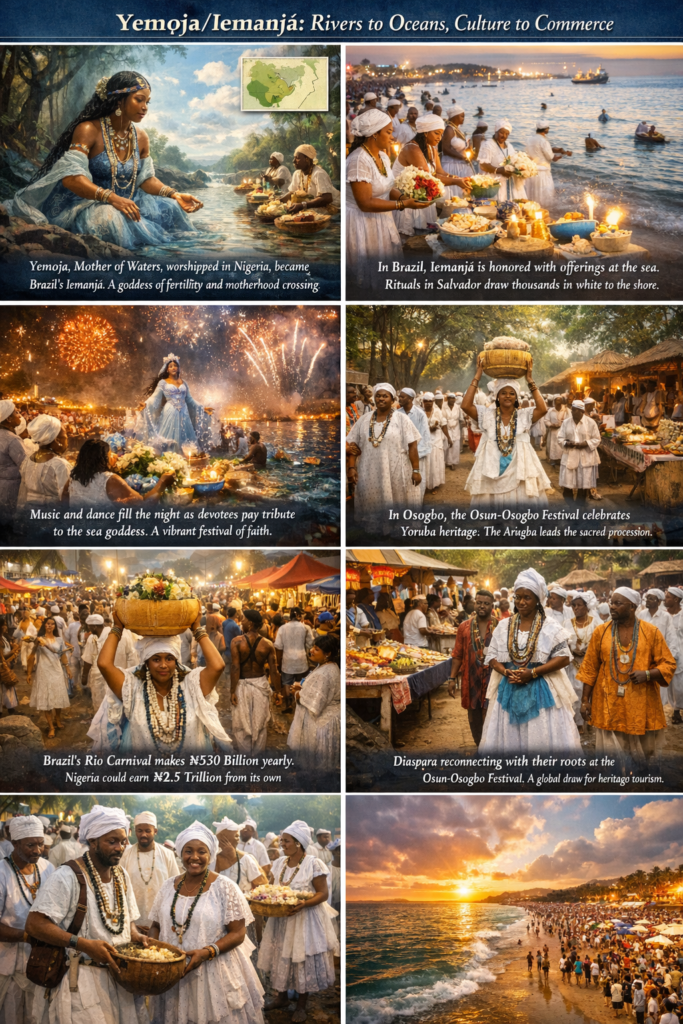
From sacred rivers in Osogboland to the Atlantic waves of Salvador, Brazil, the goddess Yemọja/Iemanjá unites faith, culture, and economic potential. Nigeria’s ancestral festivals could generate billions in revenue while connecting the diaspora to their roots.
Long before colonial borders, the Yoruba people of southwestern Nigeria worshipped Yemọja, the divine mother of waters. Known as Yèyé omo eja “Mother whose children are fish,” she governs fertility, motherhood, protection, and abundance. Rivers were her initial domain, with coastal communities invoking her blessings for safe passage, abundant fish, and family wellbeing.
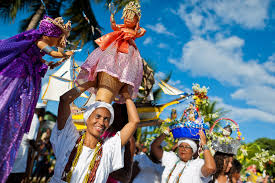
With the transatlantic slave trade, millions of West Africans were taken to Brazil, the Caribbean, and other parts of America. Yemọja’s worship survived, evolving across continents. In Brazil, she became Iemanjá, the ocean goddess at the heart of Candomblé, a syncretic religion blending Yoruba orixás with Catholicism. Iemanjá embodies protection, womanhood, family, fertility, and the life-giving power of water.
Even in Nigeria, Yemọja remains central in riverine and coastal Yoruba communities, though the festivals are less commercialised than Brazil’s.
The Iemanjá Festival in Brazil: Culture, Ritual, and Celebration
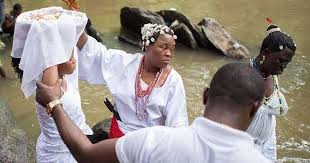
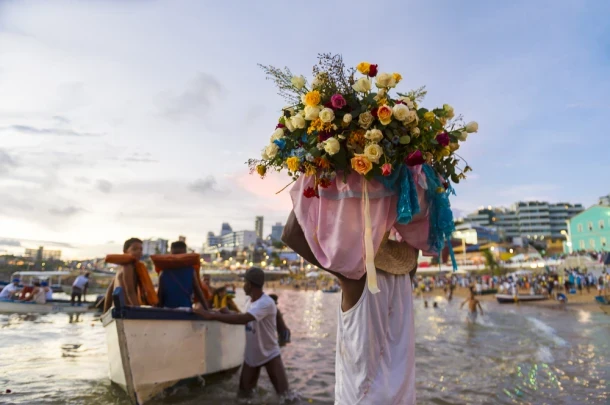
The Iemanjá Festival takes place across multiple Brazilian cities, with the largest celebration held in Salvador’s Rio Vermelho neighbourhood on February 2. During the festival, devotees present offerings such as flowers, perfumes, lipstick, mirrors, jewellery, miniature boats, and white foods like sweet rice and coconut pudding, sending them out to sea where the gifts are either accepted if they float or rejected if washed ashore. Participants dress in white, dance, sing, and celebrate through the night. In Rio de Janeiro, the festival is celebrated on January 1, coinciding with New Year’s Eve, when revellers jump seven waves and throw flowers into the sea. Salvador’s celebrations gained significant momentum in 1925, when 25 fishermen made offerings seeking calm seas and abundant fish.
Iemanjá is the goddess of the sea and serves as the protector of sailors, fishermen, women, children, and families. She is often depicted as a mermaid, dressed in white or blue, and holds a central place in Afro-Brazilian culture and religion.
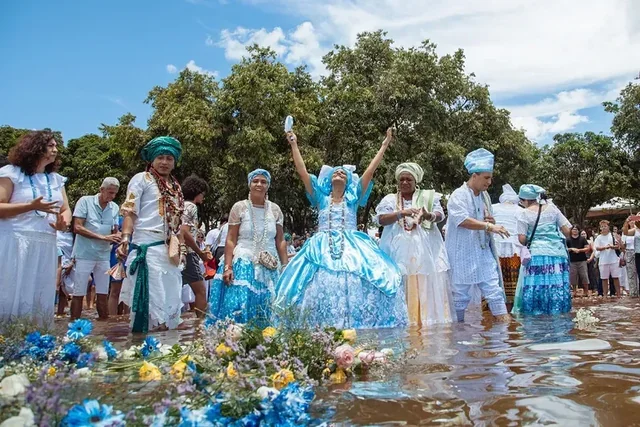
The festival is closely tied to Candomblé, a religion that emerged when African slaves in Brazil were forced to adopt Catholicism, Yoruba orixás were syncretised with Catholic saints, allowing Africans to preserve their faith under colonial rule. Candomblé is still widely practiced today, especially in Salvador and Bahia.
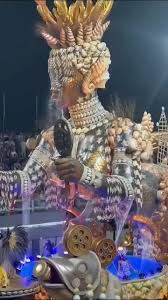
The economic impact of these cultural celebrations is substantial. Brazil’s Rio Carnival and Iemanjá Festival demonstrate the commercial power of spiritual and cultural devotion. Rio Carnival alone generates approximately €1.06 billion (about ₦530 billion) annually, attracting right million visitors, including two million international tourists, with hotels operating at 98% occupancy. Local vendors, performers, transport services, and the hospitality industry all benefit significantly, while diaspora engagement further boosts revenue and global visibility.
Osun-Osogbo Festival: Nigeria’s Cultural Treasure
The Osun-Osogbo Festival, held annually in August at the Osun Sacred Grove, is a two-week Yoruba cultural festival drawing tens of thousands of local and international visitors.
The Osun-Osogbo Festival features several key elements that make it both culturally significant and economically impactful. The grand finale is marked by the Arugba procession, led by a votive calabash carrier, which pays homage to the goddess of fertility.
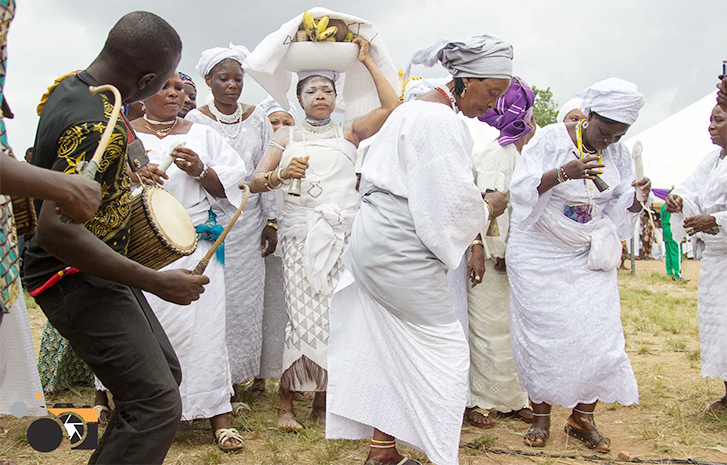
Traditional rites include Iwopopo (cleansing the town), Ina Olojumerindinlogun (lighting the 500-year-old lamp), and Iboriade (assembly of past rulers’ crowns). The festival attracts local, national, and diaspora visitors, forming the backbone of cultural tourism in Osun State.
READ ALSO:
- Kebbi Govt Revives Argungu Fishing Festival after Losing ₦10bn in 6 Years
- Lagos to Host Maiden Food, Culture Festival in December – Musawa
- How Global Aircraft Parts Shortage is Disrupting African Aviation
- Drums, Dance, Naira: The Power of Nigerian Festivals
It also generates over 800 temporary jobs during the event, including positions for tour guides, vendors, security personnel, and entertainers. Osun State projects festival revenue between ₦500 million and ₦2.5 trillion (approximately $1–5 billion) annually, depending on the scale of participation and engagement from the diaspora. As a living cultural monument, the festival blends devotion, history, and community engagement while presenting a vast untapped economic potential for Nigeria.
Business and Economic Angle: Lessons from Brazil
Nigeria has a similar opportunity to harness its cultural festivals for economic growth.
Expanding the Osun-Osogbo Festival and other riverine celebrations could generate between ₦250 billion and ₦500 billion annually from 500,000 to 1 million visitors. By engaging the diaspora through initiatives like the World Orisa Congress, Nigeria could potentially attract ₦2.5–₦3 trillion (approximately $5–6 billion) in revenue. Ancillary sectors such as hospitality, transportation, artisan crafts, and local food vendors would also experience sustained economic benefits, creating a ripple effect across the economy.
Diaspora and Cultural Reconnection
The diaspora represents a powerful revenue source. Africans displaced by the slave trade over 500 years ago are increasingly interested in return tourism, ancestral worship, and cultural heritage.
Potential Revenue Projection: Nigeria vs. Brazil
| Festival | Visitors | Revenue | Notes |
|---|---|---|---|
| Rio Carnival | 8 million | €1.06B (~₦530B) | 98% hotel occupancy, 2 million international tourists |
| Iemanjá Festival | 100,000+ | Substantial local revenue | Ritual offerings, souvenirs, food, lodging |
| Osun-Osogbo Festival | 500,000–1M | ₦250–₦500B | Direct spending on food, transport, and accommodation |
| World Orisa Congress | 1M+ | ₦2.5–₦3T (~$5–6B) | Global diaspora, large-scale tourism and investments |
Even conservative estimates suggest that Nigeria could generate billions of Naira annually, positioning cultural heritage as a national economic engine.
Closing Reflection: A River of Opportunity
From Yoruba rivers to Brazil’s Atlantic shores, Yemọja/Iemanjá has endured, adapted, and thrived.
Nigeria stands at a crossroads, and ancestral devotion can become economic power, driving tourism, jobs, cultural diplomacy, and diaspora engagement.
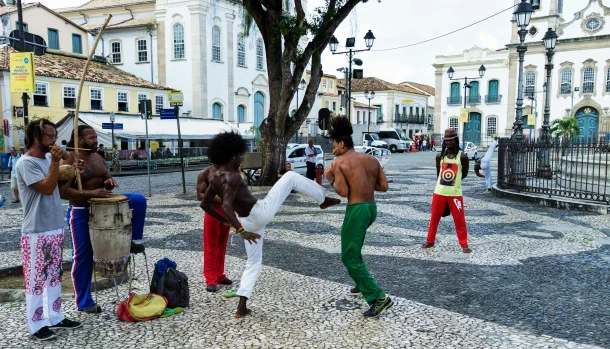
By embracing festivals like Osun-Osogbo, scaling infrastructure, and strategically marketing cultural heritage, Nigeria can turn sacred waters into rivers of revenue, blending faith, culture, and commerce into a sustainable national enterprise.

Esther Ososanya is an investigative journalist with Pinnacle Daily, reporting across health, business, environment, metro, Fct and crime. Known for her bold, empathetic storytelling, she uncovers hidden truths, challenges broken systems, and gives voice to overlooked Nigerians. Her work drives national conversations and demands accountability one powerful story at a time.