
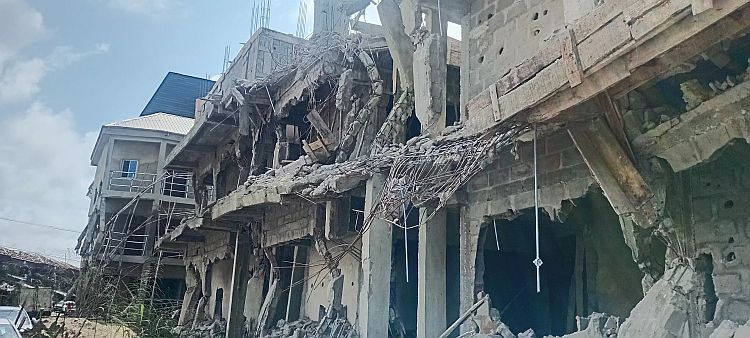
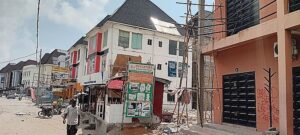
The bustling Lagos International Trade Fair Complex, spanning 300 hectares along the Lagos-Badagry expressway and home to numerous traders, remains a wrecked site after a demolition by the Lagos State Government in September 2025. The sections of the market, including the New Mandela and ASPAMDA, are left with ruinous foundations, beams, walls, and roofs. A visit by The ICIR reveals that amid significant financial losses, traders are still living in fear and uncertainty.
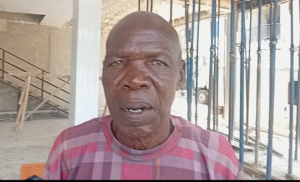
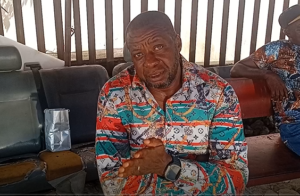
“It was a surprise visit to our compound,” Sunday Ipadeola, an over-70-year-old man, recalled. He watched as five blocks of buildings owned by Magnum Group were sternly torn down.
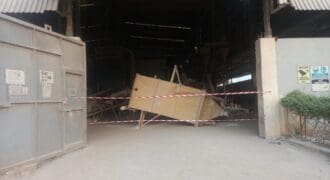
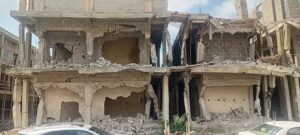
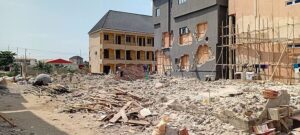
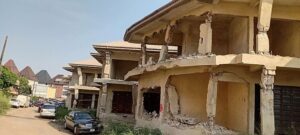
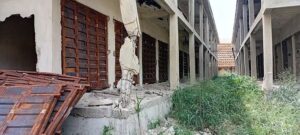
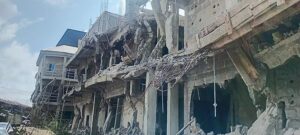
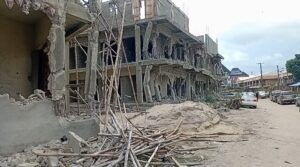
The demolition began on Thursday, September 25, and was carried out without prior warning to the property owners, according to traders. At the New Mandela Plaza, not less than 19 buildings’ foundations, beams, walls and roofs were severely damaged. Three buildings were completely pulled down, leaving behind debris. Traders say they are still dumbfounded over the incident.
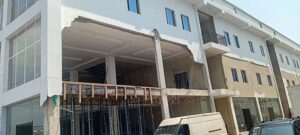
At the Auto Spare Parts and Machinery Dealers Association (ASPAMDA) section of the market, about 18 plazas under construction had their foundations, beams, walls and roofs damaged and dangling in the air.
A leading trade and industry hub
The International Trade Fair Complex is situated along the Lagos-Badagry Expressway in the Ijo LGA of the State. Covering over 300 hectares, the complex attracts about two million visitors daily and hosts more than 30,000 businesses, according to official records, making it a vibrant centre of economic activity.
It has consistently contributed to Nigeria’s economic development by enabling business interactions, drawing investments, and providing opportunities for both local and international companies. Its extensive infrastructure and prime location make it the top choice for businesses wanting a strong presence in the West African region.
As a leading trade and industry hub, it continues to play a crucial role in shaping Nigeria’s commercial landscape. Historically, the first Lagos International Trade Fair took place from Sunday, November 27 to Sunday, December 11, 1977, under the then Head of State and former President, Olusegun Obasanjo.
Demolition leaves traders devastated and fearful
“As early as 8:00 am, on that fateful day, officials from Lagos State entered our compound after removing the perimeter fence with their caterpillar, and started breaking the building’s walls,” Ipadeola says, explaining how he hurriedly informed his boss.
His complexion still wears a shocking look as he expresses how he felt that day. “I felt bad, even from my tone, on that day, it was not easy for me to take it.”
The demolition has left me devastated, says Magnus Ike, the chief executive officer (CEO) of Magnum Group. “When something happens to you, you get flabbergasted, you lose it,” he utters indistinctly.
“It is devastating,” Ike puts it succinctly, adding that there is no way he can fully explain how he has been coping with the damage done to his buildings.
“That day, I was with three of my foreign partners. We were discussing business when the demolition started,” he recollects, wondering whether the partners would ever come back, having witnessed the manner in which his buildings were destroyed.
“The man you met downstairs is over 70 years old; he witnessed the incident. In fact, I had to send a team to carry him out of the place that day, hence he would have lost his life,” he recalled.
Millions of naira drenched
For Ike, the worth of the damage to his buildings is massive. He explains, “As you can see, it’s a very big complex; inside and outside were knocked down. The glasses we used here are 15 millimetres, and each one is about N85,000.”
He stated that the compound floor marbles were destroyed, the perimeter fence was pulled down, the imported security doors were damaged, and all the industrial lights were destroyed.
The Magnum Group boss, whose company deals in anything battery-generated and clean energy, including solar, lithium, and EV motorcycles, also disclosed the cost of an industrial lighting unit at N1.3 million.
READ ALSO:
- Nigeria’s IPO Costs Outstrip South Africa, Egypt Despite Fee Cap
- ‘US Tariffs, Domestic Risks to Shape Nigeria’s 2026 Economy’
- Heavy Debt Burden Clouds TotalEnergies Marketing Nigeria’s Earnings Outlook
- Why New Tax Law Won’t Push Your Rent Up
- Nigeria Fails to Meet 2.06m bpd 2025 Budget Target
Benjamin Michael, who deals in kitchen equipment, witnessed how three of the plazas beside the building housing his shop were completely pulled down, describing it as a great loss.
“Not less than three plazas were flattened beside my shop,” he said, adding: “Many other structures were badly damaged, including our building, as you can see.”
When the caterpillar was punching the buildings, goods were falling off, adding that the goods destroyed ran into millions of naira.
“Many of the products were lubricants. The destruction was massive,” he said, adding that the three plazas that were levelled to the ground were warehouses with goods inside them.
Recalling a similar incident in September 2023, Michael said: “They (Lagos state government) came, broke some walls, cut off some protectors, but the demolition wasn’t as bad and inhuman as this one .”

Trade Fair Board comes under fire
Traders who spoke with The ICIR believe that the Lagos International Trade Fair Complex Management Board (LITFCMB) share in the blame for the demolition.
After the incident, Ike says, he went to the Lagos authorities to enquire why his properties built about five years ago, and having all the necessary building approvals granted by the Federal Ministry of Works and Housing and the Trade and Industry Ministry, were bulldozed.
According to him, all he got was “we’re sorry,” as the state authorities claimed they issued notice to the Trade Fair management.
“Having demolished my buildings, now they are asking me to come for approval, Ike says, lamenting, “That’s what I got out of it. I came back and started borrowing money again to rebuild”.
“We have actually rebuilt to like 90 per cent. What is left now are those areas that need to wait for about 28 days before we can continue reconstruction,” said Ike.
He presumes that even if one wants to press charges, the person will further be frustrated, decrying that Nigeria’s judicial system has failed the masses.
“All we’re focused on now is putting our buildings back in order, even though there is annoyance when we look at the destruction,” Ike added.
LITFCMB fails to respond to inquiries
On December 10, the reporter sent an enquiry via email to the Lagos International Trade Fair Complex Management Board (LITFCMB) but received no acknowledgement. Several calls on the phone numbers provided on its official website were not connecting to networks.
On December 12, the reporter visited the office of the trade fair management board and met with the general secretary, Ayinde, who acknowledged receipt of his enquiry addressed to the LITFCMB Executive Director/CEO, Vera Safiya Ndanusa.
In a follow-up with her on Tuesday, December 16, Ayinde replied, “Once your feedback is ready, we will get back to your organisation.”
A subsequent follow-up with her on Thursday, December 18, was not responded to, and the trade fair management has yet to reach out as of the time of filing the report.
ASPAMDA executives declined to comment
Frantic efforts were also made to have the ASPAMDA executives comment on the issue, but to no avail.
On December 2, the reporter visited its secretariat and met with its public relations officer, Emeka Anoruka, who promised to inform his president and respond accordingly.
Three days later, the reporter shared his enquiry via a WhatsApp message to confirm the number of plazas and shops that were affected, and other related enquiries, including what the association was doing to resolve the issue at hand.
“My brother, please wait till next week. The president is very busy now; his first son is getting married tomorrow, so everything will be after that,” he responds.
On December 9, when a follow-up was made to him, he retorted: “Oga, we don’t have time for all these things now, the president is too busy. He can’t find time for that. You people came late.
“We are rounding off for the year. We’re compiling yearly expenditure for general meetings. We’re rounding many things now.”
When the reporter persisted, Anoruka unwittingly confirmed the association had started repairs of the plazas affected by the demolition and said nothing further.
Losses go beyond money as traders recount emotional damage
Besides the financial losses, traders say they have been left with emotional damage. Michael, the kitchen equipment seller, shared his worries. “Since this period, I have been apprehensive. The day of the demolition, my BP (blood pressure) shot up because I was terrified when I saw the damage they did to the one nearby.
“Weeks have passed, but things have not been normal again because every day I keep entertaining that fear – what could be, when next.”
To him, the emotional torture is not something that can be easily forgotten. His fear has been heightened by the threat that the Lagos State government is not backing down on its enforcement of physical planning regulations at the Trade Fair.
Calls for state powers to be clearly defined
Following the September 2025 incident, traders now want the powers of the state government to be clearly spelt out.
Michael recalls his line of business officially moved into the trade fair in 2000, and that the spare parts traders moved in since 1995, approximately.
“If the Trade Fair Management are conceding that it’s now within the powers of the Lagos state government to regularise the construction of buildings here, then let then inform the stakeholders that henceforth it’s the Lagos state government that is in charge of regularising the structures so that after having done with what you need to do with the management board, you now go to the government to finalise whatever that is therein for them to approve,” he urged.
Uncertainty still grips traders three months after
Uncertainties now pervade the minds of the traders as they say the shocking demolition has struck a blow on them and left them to trade daily in fear.
“It’s uncertain as we’re still confused to this moment. We don’t know where we are,” Paschal Okechukwu Udeh, the chief executive officer of Trade Fair City Parks Nigeria Limited, expressed concern, saying: “We’re just looking at the President to come to our aid to help us.”
He recalls that on the day of the incident, one of his staff members alarmed him about the state government being at the complex with their caterpillars and bulldozers, smashing the buildings.
“I hurriedly came out of my home, and saw them,” he said, stressing that he’s still in shock, like other traders, over the incident. “No one has been able to define it up to the moment.”
His understanding is that since the complex is under the Federal Ministry of Trade and Commerce, traders have nothing to do with the Lagos state or its agencies.
“It’s the federal government that gave us this place,” he notes, wondering why the state physical planning agency woke up that morning to demolish buildings without prior notice whatsoever.
“But I don’t think that is the argument. This is a kind of intimidation,” Udeh thinks otherwise. His reason is that the Lagos state officials have the Trade Fair management to whom they’re supposed to communicate, or the Federal Ministry of Trade and Commerce.
“They’re supposed to parley with them so that they can discuss and find out a way forward because we pay ground rent here every year to the federal government,” he said.
His viewpoint is also anchored on the fact that since the traders pay enormous ground rent to the federal government, any demand by the state is tantamount to a double taxation on the traders.
Traders resort to makeshift repairs amid fears
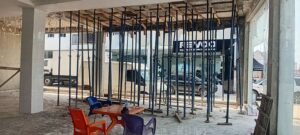
The reporter observed that traders have started to repair broken walls and refix the dangling pillars, besides other reconstruction works. He further gathered that what was being done was for the traders to find a place to secure their goods, not necessarily because a concrete understanding had been reached with the state government over the matter.
Udeh explained that the traders were agitated and afraid, and had to approach the Lagos physical planning authority to ask questions because most of the buildings were warehouses with goods inside.
“When they came wrecking the buildings, we spoke with them, and they said they were actually sorry that we should go and safeguard our goods.
“So, safeguarding them doesn’t mean that we have to leave them outside for rain or sun to beat, he said, adding, “We’re still patching those places they broke to amend them so that we can contain our goods till they come out with the whitepaper that will serve everybody. We’re still waiting!”
According to Udeh, the complex has not less than 15 workers in a warehouse and over 30,000 employees, and up to 500,000 workers serve in the about 50,000 to 150,000 plazas and shops at the trade fair, which the reporter couldn’t confirm.
“So, if these people move out on the streets because there is no place for them to trade, there will be another catastrophe in Nigeria,” he worried.
He urged the federal government to look into the matter critically, as the traders are helping the nation in promoting business activities.
Lagos government vows to enforce compliance
In an 8-point resolution sent to the reporter by Mukaila Sanusi, director of public affairs at the Lagos State Ministry of Physical Planning and Urban Development, the state government vowed zero tolerance for illegal and unapproved developments within the Trade Fair Complex.
It states that, although the complex is on federal land, it doesn’t exempt developers from obtaining necessary planning permits in line with the state’s physical planning laws.
According to the state authorities, the Supreme Court Judgment of 2003 (Attorney-General of Lagos State v. Attorney-General of the Federation), and the Lagos State Urban and Regional Planning and Development Law 2019, as amended, empowers Lagos State to regulate and enforce physical planning laws.
It maintains that these legal instruments empower the state to regulate physical development within its territories, including federal lands, except for areas under exclusive federal use, such as military formations.
The commissioner for physical planning, Oluyinka Olumide, reiterates that the enforcement focuses solely on the approval status of physical developments.
‘It is not negotiable for all structures within the confines of Lagos State as stipulated by the Lagos State Urban and Regional Planning and Development Law 2019 as amended,” Olumide insists.
‘Law vesting trade fair in the federal government remains in force’
Martin Okpaleke, a Lagos-based legal practitioner, conversant with the origin and development of the complex, explained that the law vesting the Trade Fair Complex in the federal government is still in force.
He specifically noted that the Lagos International Trade Fair Complex Management Act vested the complex in the LITFCMB, recognising it as a body corporate. He submits, “So, the land remains under the federal government.”
According to him, the fact that the land is still vested under the federal government doesn’t mean that the Lagos state government can’t enforce physical planning compliance.” There’s a distinction between the vesting of title in the federal government in the complex through acquisition and the exercise of planning powers,” he clarified.
“Urban planning authority is vested in a state. That is the essence of the Supreme Court judgment of 2003,” Okpaleke clarified, meaning that technically, the state government can exercise planning powers.
He believes the proper approach should have been intergovernmental which both powers need to strengthen for all necessary approvals and for the betterment of the nation.
Apart from the vesting of title, Okpaleke notes that the Trade Fair is also an enterprise under the Public Property Privatisation and Commercialisation Act.
“It’s an enterprise, a business, being run by the federal government,” he emphasises. “So, it doesn’t make sense for Lagos state to jump up unilaterally.
The barrister noted that while similar laws exist in other jurisdictions, one hardly hears of demolitions because they tend to be very proactive in handling issues that arise.
“Have you noticed that you really hear reports of demolitions in those jurisdictions. They tend to be proactive. Then, there are opportunities for correction, but if the developers want to have their way, there are penalties.
“Only in Nigeria that the government will wait for people to exhaust their resources, put up something, and the next thing is to go on a demolition spree,” Okpaleke said.
This report was first published by the ICIR.

Alex is a business journalist cum data enthusiast with the Pinnacle Daily. He can be reached via ealex@thepinnacleng.com, @ehime_alex on X