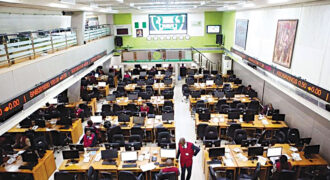

The Nigerian stock market started the week on a bearish note as the All-Share Index (ASI) declined by 0.25 per cent to close at 153,739.65 amid concerns about United States President Donald Trump’s threat of military action on Nigeria over alleged Christian genocide.
Pinnacle Daily reported that Trump had asked the country’s Defence Department to prepare for possible “fast” military action in Nigeria if President Bola Tinubu’s government fails to crack down on the killing of Christians.
He had further threatened to immediately stop all aid and assistance to Nigeria.
He made the threats in a post he shared on his Truth Social handle on Saturday, November 1.
“If the Nigerian government continues to allow the killing of Christians, the U.S.A. will immediately stop all aid and assistance to Nigeria and may very well go into that now disgraced country, ‘guns-a-blazing’, to completely wipe out the Islamic terrorists who are committing these horrible atrocities,” Trump declared.
His threat of attack has sparked agitation that it could lead to possible negative sentiment on the Nigerian stock market.
Equities market performance
At the close of Monday’s trading session, the ASI fell to 153,739.65 basis points from the 154,123.62 basis points it closed on Friday, declining by 0.25 per cent.
Similarly, the market capitalisation fell by 0.25 per cent to close at N97.58 trillion from N97.83 trillion on Friday, leaving investors to suffer a N250 billion loss.
READ ALSO: DMO Opens November FGN Savings Bond at Lower Rates
A cursory look at market data from the Nigerian Exchange Limited (NGX) shows that the share prices of 37 stocks declined as against 19 stocks that gained.
Arising from the negative sentiment, trading activity was mixed, as the total volume and value of shares traded closed in the red, while total deals closed in the green.
At the close of the day’s trading, 627.5 million shares exchanged hands at a value of N25 billion in 36,425 deals, compared to 5.201 billion shares that exchanged hands at N45.16 billion in 30,598 deals on Friday.
Honeywell Flour Mill led the losers’ table with a 10 per cent decline in its share price to N18.00. This was followed by the Northern Nigeria Flour Mills shedding 9.98 per cent to close at N84.30.
Aradel’s share price trailed the market, declining by 9.21 per cent to close at N710.00
While Japaul Gold and Ventures’ share price fell by 7.95 per cent to N2.20, Ikeja Hotel dropped by 7.71 per cent to close at N17.35.
On the gainers’ table, Union Dicon Salt led the pack as its share price rose by 9.93 per cent to close at N7.75.
Omatek Ventures followed with a 9.92 per cent appreciation to N1.33. The Nigerian Aviation Handling Company gained 7.62 per cent to close at N113.00
International Breweries rose by 6.35 per cent to N13.40, and Champion Breweries by 6.33 per cent to close at N15.95.
Anticipated impact of Trump’s threat on the market
A financial analyst, Matthew Ogagavworia, told Pinnacle Daily that before U.S. President Trump’s threat of action on Nigeria, the stock market had been reacting to the belief that the dollar would crash in response to plans by Dangote Refinery to ramp up and increase its production to 1.4 million barrels per day.
READ ALSO: Presidency Debunks Reports of Tinubu’s Planned U.S. Visit
What that means is that if foreign portfolio investors perceive that the naira will be stronger, they will want to quickly exit with their dollars today, rather than wait for the dollar to lose value.
He also added that the Nigerian market has faced the threat of invasion by Trump to defend Christians.
“All that combined has not made Nigeria an investment destination for now. So foreign portfolio investors are jumping out before any crisis erupts. I think that’s what I can say, and I can account for what has happened,” Ogagavworia said.
He stressed that even before Trump’s threat, Nigeria had been relatively unsafe for its citizens and had been hampering the investment environment.
“There are some states you will not want to go and walk today even if you are offered a job there,” he said, expressing concern over the uncertainty that has beclouded the investment environment.
“If you are a foreign investor and you are hearing the kind of frightening news coming out of here, will you put in your investment? You should be scared.
“So, for the foreign investors who are getting any negative sign, they would rather want to cut back on their investment or even do so, because they are not coming to invest to stay; they are just trading on a differential. That’s why they are foreign portfolio investors. They are not the FDI that we need,” Ogagavworia added.
Speaking with Pinnacle Daily, a stock market broker, David Adonri, believes certain fundamentals drove the bearish sentiment in the market rather than the insinuation of Trump’s threat to Nigeria.
“I don’t agree with the insinuations that the bearish trend we have been witnessing in the past two or three days in the equities market is linked to what action the US President is proposing to take in Nigeria.
READ ALSO: How 10 Most Capitalised Stocks Control over 60% of NGX Market Cap
“In the sense that such an action ought to positively impact the market, but that people are reading negative insinuations into it beats my imagination, because what the American government is requesting is that the Nigerian government should wipe out the terrorists in Nigeria,” Adonri said.
He thinks the Nigerian government is either refusing or incapable of wiping out the terrorists and bandits who have held the economy to ransom and continue to unleash a reign of terror on the country.
If the Americans had come in to kill those terrorists, the Nigerian economy would have soared, he said.
He believes that if Nigeria had dealt with insecurity, inflation rates would have been reduced to lower single digits.
He said if the Nigerian government had succeeded in killing all the terrorists and bandits, inflation would have tempered significantly downward to a single digit.
He stressed that food inflation, which is the main cause of the inflationary pressure, is coming from farming insecurity, as terrorists and bandits have captured the farmlands and driven away all the farmers into IDP camps.
He is of the view that since the Nigerian government has refused or demonstrated to be incapable of killing all the terrorists, and the US now wants to come in to kill all the terrorists, that was supposed to be good news that should propel the market.
“So that insinuation is not correct at all,” Adonri maintained. “I think what is happening in the market should be a reaction to some of the fundamentals of the market itself.”
He noted that the third-quarter results of some of the companies listed on the stock market have not been impressive or inspiring.
He noted that the third quarter of Nigerian Breweries and Cadbury, which are companies that have propelled the bull run in the market recently, did not report impressive third-quarter financial results.
“Also for some other companies, they were not really very impressive. Even the banks did not come up with inspiring third-quarter results.
“Those were actually the factors that elicited the negative reaction of investors, which sent the market into a fatigue in the past two or three days,” Adonri added.

Alex is a business journalist cum data enthusiast with the Pinnacle Daily. He can be reached via ealex@thepinnacleng.com, @ehime_alex on X