The Nigerian Midstream and Downstream Petroleum Regulatory Authority (NMDPRA) and the Nigeria National Petroleum Company Limited (NNPCL) have pledged to continue taking practical steps towards overhauling downstream infrastructure to boost energy sector growth.
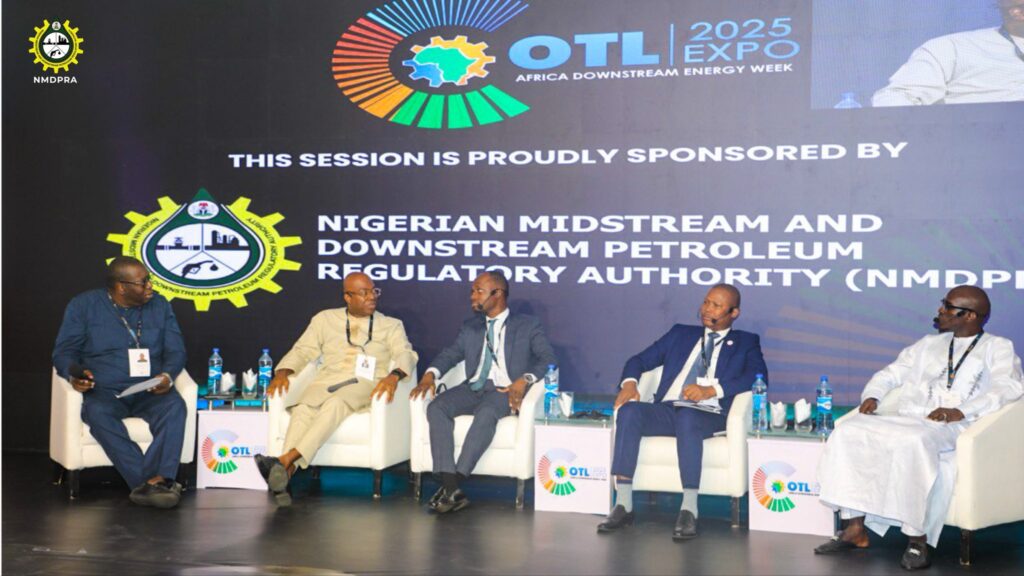
The agencies made the pledge at the ongoing 2025 Oil Trading and Logistics (OTL) Africa Downstream Energy Week in Lagos.
Delivering his keynote address at the event, NMDPRA Chief Executive, Engr. Farouk Ahmed said the agency is progressively enabling the growth of energy infrastructure and supply through its licensing activities, and other initiatives such as the Midstream and Downstream Gas Infrastructure Fund (MDGIF), the Decade of Gas, and the Presidential initiative on Compressed Natural Gas (PiCNG), among others.
Ahmed, who was represented by Mr. Ogbugo Ukoha, said the agency is also ensuring that Nigeria’s petroleum industry is made sustainable by the deployment of creative carbon management strategies that are targeted at achieving the Net-zero target.
He said that through the Authority, Nigeria, alongside other countries, has succeeded in establishing the African Energy Bank, crucial for guaranteeing the availability of funding for energy projects on the continent.
Speaking on the agency’s efforts towards adoption of clean energy, Ahmed said: “We are also making progress in establishing a framework for hydrogen technology in the industry. When nurtured, hydrogen technology would serve as the ultimate carbon capture mechanism, relying on complementary CSU technologies to deliver clean energy.”
He further stated that the growth of the industry is not limited to Nigerian borders, but also includes the establishment of systems and infrastructure for transport and trading of energy commodities from Nigeria to all West Africa and some North African countries through the Africa Atlantic Gas Pipeline project and the Trans-Saharan Gas Pipeline.
READ ALSO: Sale Of Oil, Gas Assets Will Weaken NNPCL, Threaten Economy, NUPENG, PENGASSAN Warn
“These infrastructure projects among partners are intended to foster collaboration instead of competition,” he stated, adding that they are also envisaged to encourage integration of the African economies.
He disclosed that NMDPRA will, in the coming weeks, launch the Gas Commodity Exchange, which would be the first of its kind in Africa, “serving as a major spot for reference market for natural gas and its derivatives.”
“The NMDPRA is committed to fostering growth, allowing multiple players to operate within a healthy competition and also fostering sustainable energy provision across the artificial borders of the African continent.”
He noted that insights from past OTL conferences have helped to shape policies and industry direction.
On his part, GCEO of NNPCL, Bayo Ojulari, said the national oil company will deploy additional infrastructure across the oil and gas value chain while revamping the existing downstream infrastructure nationwide.
Ojulari, who was represented by executive vice president, NNPC Downstream, Mumuni Dagazau, stressed that investing in robust infrastructure is key to meeting demand and unlocking new opportunities.
“We are deploying new infrastructure and revamping existing assets to support strategic alliances,” he stated.
“Our co-investments across upstream, midstream, and downstream operations reflect our belief that shared growth is sustainable growth.
“These assets will be accessible to partners seeking to store and transport products, supporting strategic alliances and collaboration in the downstream sector.”
He noted that recent policy reforms, such as deregulation and foreign exchange harmonisation, among others, had created new economic prospects by fostering integration, innovation, and better collaborations across the energy value chain.
“We are witnessing strategic measures, supply partnerships, and joint investments that signal a shift from siloed operations to integrated ecosystems,” he stated.
Ojulari argued that frameworks such as the Petroleum Industry Act (PIA) and fiscal incentives for renewable and gas projects are fostering a stable environment for long-term investment.
He pointed out that the growth has led to the demand for new skill sets and investments in LPG, CNG, and mini-LNG plants.
He charged industry leaders to work together to reshape sustainable energy systems, form alliances, and explore ideas that advance decarbonisation and economic growth.
Chairman of OTL Advisory Board, Otunba Adetunji Oyebanji, also underscored the need for investment in infrastructure such as pipelines, depots, data systems, and digital tools.
He said the theme of this year’s event –‘Energy Sustainability: Growth Beyond Boundaries and Competition’ – reflects the modern realities in the continent.
While noting that there are immense opportunities in the sector, Oyebanji stated that Africa must define its own path to energy sustainability, adding that it requires courage, clarity, and cooperation.
“We must invest in infrastructure, pipelines, depots, data systems, and digital tools. We must build capacity through research, training, and innovation. And we must hold ourselves accountable to the highest standards of transparency and environmental responsibility.
“The downstream sector remains at the heart of Africa’s energy value chain. Its growth and transformation will determine how successfully we navigate this new era of sustainability and competition. Let us therefore seize this moment with purpose and foresight, working together to ensure that our industry not only survives change, but leads it.”
Chief Executive Officer, OTL Downstream Development in Africa, Joyce Akabogu, said the conference is a gathering of industry leaders and policymakers in the energy sector to share insights on how Africa can leverage its natural resources for sustainability.
Akabogu explained that the downstream is where the people get access to energy, stressing that when it works well, citizens feel it.
“When the downstream works well, citizens feel it. When it doesn’t, the nation feels it too. That is why this sector must continue to stay at the centre of Africa’s growth strategy.”
She said the continent is rich in natural resources and if strategically harnessed, they would be able to play a leading role in the world’s energy market.
OTL Africa Downstream Energy Week is Africa’s premier gathering of downstream and midstream energy stakeholders, including policymakers, operators, and industry service providers.

Victor Ezeja is a passionate journalist, scholar and analyst of socioeconomic issues in Nigeria and Africa. He is skilled in energy reporting, business and economy, and holds a master's degree in mass communication.