
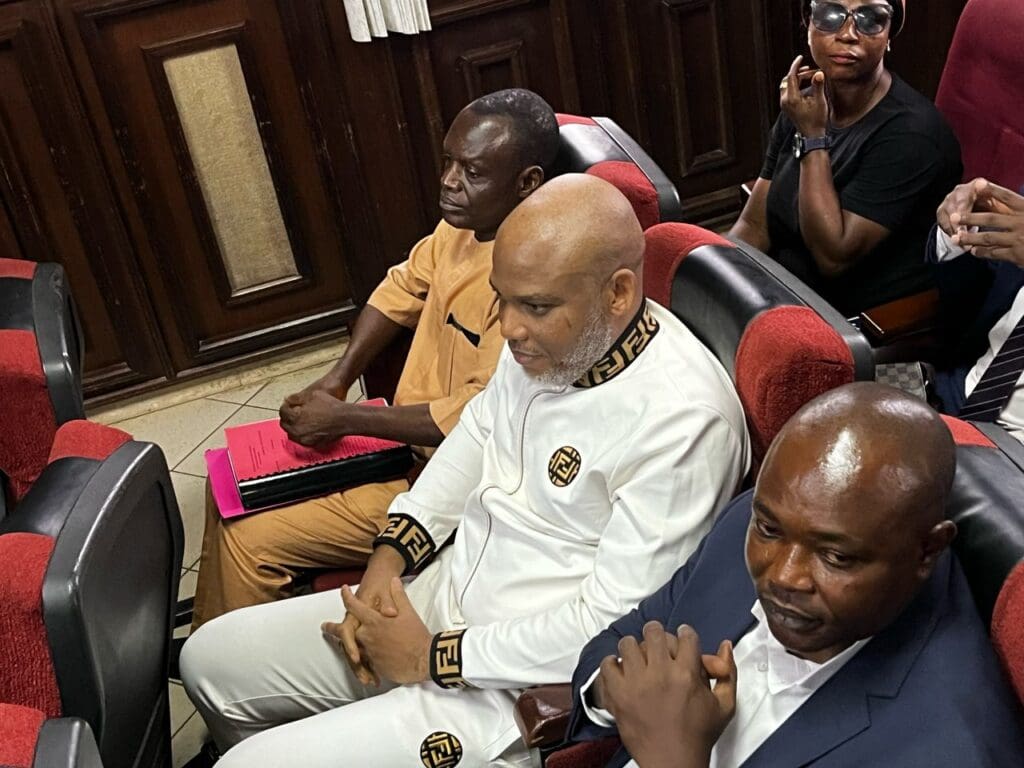
In a dramatic turn on Friday, the trial of the detained Indigenous People of Biafra (IPOB) leader, Nnamdi Kanu, was delayed yet again when he failed to open his defense in the Federal High Court, Abuja. The hearing was adjourned to Monday, 27 October, after Kanu told the court that he had yet to gain access to the case file, preventing adequate preparation.
The development came barely 24 hours after Kanu disengaged his team of lawyers led by former Attorney-General of the Federation, Chief Kanu Agabi (SAN), opting instead to represent himself in the terrorism trial.
Why the Case Was Adjourned
When proceedings resumed, the prosecuting counsel, Adegboyega Awomolo (SAN), informed the court that the matter was fixed for Kanu to begin his defense. However, when called upon, Kanu told Justice James Omotosho that he was unable to proceed because he had not been given the case file to review and prepare his defense adequately.
According to him, officials of the Department of State Services (DSS), where he is being detained, had yet to deliver the file to him despite arrangements to do so.
READ ALSO: Nnamdi Kanu’s Legal Team Collapses, as Lawyers, SANs Withdraw from Case
Kanu requested an adjournment until Monday, 27 October, to enable him to familiarize himself with the case file. He also prayed the court to direct the DSS to allow him to receive visitors, including witnesses expected from the United Kingdom, the United States, Kenya, and Ethiopia, over the weekend to aid his preparation.
The prosecution did not object to the application, prompting Justice Omotosho to grant the request and order the DSS to permit Kanu to meet his visitors on Saturday and Sunday. The judge, however, warned that the six days earlier allotted to the defendant to conduct his defense, starting from 23 October, would not be extended.
Legal and Procedural Quagmires
Kanu’s inability to open his defense raises several legal and procedural challenges. Reacting to this, Barrister Christopher Chidera, a constitutional lawyer based in Enugu, said the situation highlights persistent procedural issues in Nigeria’s criminal justice system. He explained that the right to a fair hearing normally encompasses timely access to court documents. A defendant must be able to study the case file, examine evidence, and cross-check charges to mount a coherent defense.
“The right to a fair hearing is hollow if an accused person is denied timely access to court documents. Whether or not Kanu represents himself, the state must ensure procedural fairness,” Chidera told journalists.
The legal expert, however, noted that Kanu’s claim that he has not been handed the file is placing a fundamental procedural defect at the heart of his defense strategy.
He added that representing oneself in a terrorism trial “is a risky but symbolic move” that might expose the defendant to technical pitfalls.
READ ALSO: Nnamdi Kanu Set to Open Defense, Names Wike, Sanwo-Olu, Buratai as Witnesses
“Representing oneself—known as pro se defense—is permitted under Nigerian law, though rarely advisable in high-stakes criminal trials. Abandoning counsel mid-trial may show a lapse in strategy or desperation rather than confidence.”
One senior defense lawyer, when asked about the gambit, remarked (off the record) that a defendant “who refuses legal assistance at a terrorism trial risks damaging his own interests.” Conversely, it may also be a calculated move to highlight alleged state obstruction.
Also weighing in, Barrister Jude Njoku, a UK-based human rights lawyer, said Kanu’s self-representation appears both a protest and a legal strategy.
“His decision to dismiss counsel underscores distrust in the process. But it could also be a deliberate political statement aimed at drawing international attention to what he views as persecution,” Njoku noted in a recent interview.
Similarly, public policy analyst Dr. Chidi Onuoha, of the Centre for Democratic Development Studies, Abuja, told Pinnacle Daily that the repeated adjournments “reflect the broader political tension surrounding the trial rather than mere courtroom logistics.”
“Every delay feeds into competing narratives — one about state overreach, and the other about judicial independence. The optics are as important as the verdict,” Onuoha observed.
Context and Implications
This is the fourth time since 2021 that Kanu’s defense opening has been delayed, and analysts believe it exposes the trial’s deep political undertones. The Supreme Court had earlier reinstated terrorism charges against him after a lower court dismissed them, ruling that his controversial rendition from Kenya did not absolve him from trial.
Kanu has submitted a list of 23 witnesses, including former and serving public officials such as Abubakar Malami, Nyesom Wike, Babajide Sanwo-Olu, and Tukur Buratai, who he claims can provide testimony relevant to his case.
Observers say how Justice Omotosho handles the upcoming session could determine whether the trial progresses smoothly or sinks deeper into another cycle of adjournments and political rhetoric.
What To Expect Next
1. Monday’s hearing: Kanu must formally open his defense. If he again fails, the court might compel him to proceed or risk being declared non-compliant.
2. Visitor access enforcement: Whether the DSS complies with the court’s directive to permit weekend access could become a fresh battleground.
3. Quality of defense: Representing himself, Kanu must strategically deploy his witness list or risk forfeiting key parts of his argument.
4. Judicial reactions: The court has warned that the six-day defense window will not be extended. Any further delays may test the judge’s patience and raise questions of judicial consistency.
READ ALSO: Nnamdi Kanu Insists Nigerian Court Lacks Jurisdiction as Govt Defends Trial
In sum, Friday’s setback was not simply a hiccup; it exposed embedded tensions in the trial. One of procedural rights, personal agency, and the heavy atmosphere of politics within which this case unfolds.
Kanu’s supporters have framed the trial as a symbol of political repression, while their critics argue that the government must uphold national security and the rule of law. In recent days, protests in Abuja demanding Kanu’s release were met with tear gas and arrests, even though those arrested have been granted bail by the court.