
If Abuja’s roads are modern but its homes unsafe, if its bridges are grand but its residents are killed in their bedrooms, then progress remains hollow. The Federal Capital Territory (FCT) today boasts a new network of roads, flyovers, and modern infrastructure, the handiwork of an administration determined to stamp its mark on the nation’s …
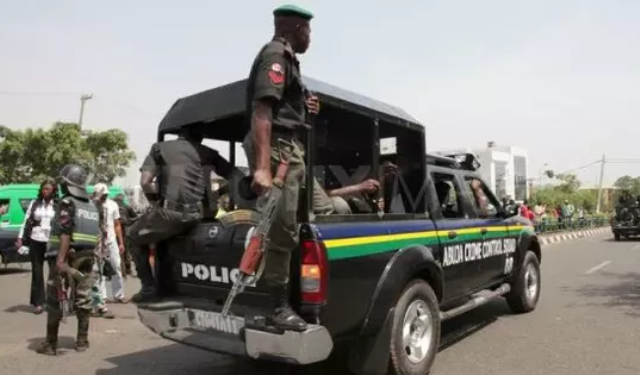
If Abuja’s roads are modern but its homes unsafe, if its bridges are grand but its residents are killed in their bedrooms, then progress remains hollow.
The Federal Capital Territory (FCT) today boasts a new network of roads, flyovers, and modern infrastructure, the handiwork of an administration determined to stamp its mark on the nation’s capital. Yet beneath this glow of progress lies an unsettling reality: violent crime is spreading inwards, eroding safety, and casting a shadow over Abuja’s development gains.
Residents across the FCT are reporting a level of criminality that increasingly undermines the sense of safety the capital is meant to represent.
Recent weeks alone have seen high-profile murders, abductions, rescue operations and the arrest of organiSed gangs, events that show both progress by security forces and the urgent need for a rebalanced, security-first strategy alongside development.
READ ALSO: FCT Police Arrest Five Bandits, Recover Arms in Nasarawa
Monday’s attack and eventual murder of an Arise TV presenter, Somtochukwu Maduagwu, by 15 armed criminals in her Katampe residence has again reminded residents that the city’s biggest crisis may not be potholes or drainage, but insecurity.
“The killing was cruel and senseless,” police declared, promising an investigation. But residents are left with questions: if a professional in a gated home can be targeted, who is truly safe?

Recent Cases Paint a Dark Picture
The presenter’s death is not an isolated tragedy. It joins a disturbing roll call of violent incidents across the capital in September alone:
8–10 September (Gwarinpa): Kasham Thomas, an accountant, was found dead in her vehicle along 35 Road. Stab wounds suggested a brutal assault.
7–8 September (National Assembly Complex): A decomposing body was discovered inside a car parked for days at the annex gate. The deceased, a site labourer, went unnoticed in the heart of Nigeria’s most secure legislative grounds.
14–15 September (Takushara/Kabusa): Vincent Bala, an Uber driver, was killed during a midnight raid. Hoodlums stabbed him while searching for a local official.
29 September (Katampe): The Arise TV journalist was killed in her home during a violent robbery, underscoring how professional classes are now firmly within criminals’ sights.
READ ALSO: Nigeria May Lose N14.7bn Daily From Dangote PENGASSAN Row
These incidents follow ongoing patterns of kidnappings in Guzape, Katampe, Mpape, and Kubwa corridors, crimes that have become disturbingly routine.
Quick snapshot: what the numbers and operations tell us
Kidnapping load: Official FCT scorecards and command statements put kidnapping among the most reported violent crimes. A review of command releases and reporting shows that FCT recorded 104 kidnapping incidents in 2024 (with several hundred suspects arrested and dozens of victims rescued and ransoms or cash recovered), a figure that signals persistent, organised abductive activity across the territory.
Recent enforcement: However, in focused, intelligence-led operations in September 2025, the FCT police and tactical units reported arrests of multiple bandit/kidnap leaders and large cache recoveries following manhunts across Nasarawa and adjoining corridors, pointing to the fact that many perpetrators operate from outside Abuja but strike within its environs.
Tactical successes: Police “May–June” operations in 2025 recorded dozens of cases and the arrest of 82 suspects in that campaign, showing measurable operational response when resources and intelligence are concentrated.
(These figures are drawn from public police statements, command scorecards and investigative reporting. They show both the scale of incidents and the reactive successes of law enforcement — but they also highlight a continuing flow of violent incidents).
Concrete Short-term Actions for the FCT Minister, Nyesom Wike
FCT Minister Nyesom Wike has been widely credited for bold infrastructural works across Abuja. The city’s physical transformation offers an opportunity to integrate security as a twin priority. The following are immediate, publishable tasks the Minister can implement within 30–90 days to show security is being treated with the same seriousness as roads and drainage:
1. Declare a 90-day “Security Retrofit” for high-risk districts (Katampe, Guzape, Mpape, Gwarinpa corridors): coordinated installation of high-mast lights, CCTV nodes, and increased night and day patrols in those estates.
2. Convene an FCT-Nasarawa/Kogi security summit to formalize corridor policing and extradition/operation protocols for cross-border gangs.
3. Publish a monthly FCT security scorecard mirroring the infrastructure scorecard: arrests, recoveries, hotspots, response times, to create public accountability and allow residents to make informed safety choices.
4. Finance and fast-track community protection grants (equipment, radios, training) to vetted community policing teams, administered through FCT Security Services Department with police oversight.
5. Community policing plus formalized vigilante oversight, train, arm (non-lethally) and supervise local vigilante units with police vetting, payment and accountability to reduce abuses while leveraging local intelligence.
READ ALSO: Workers Locked Out at NUPRC Headquarters Amid PENGASSAN–Dangote Dispute
Development Must be Matched with Security
Abuja’s infrastructure renaissance is visible from satellite to street level. Yet for development to be meaningful, the city’s residents must feel secure within the new roads, estates and civic spaces that the FCT Administration is constructing. Arrests and rescues show the police are capable and responsive, but they are repeatedly forced into a reactive posture against organised, mobile criminals who exploit jurisdictional gaps and infrastructure blind spots. The FCT Minister, Barr. Nyesom Wike, already lauded for infrastructure delivery, can cement a legacy by equally prioritizing a security retrofit that ties physical development to protective systems. The capital cannot be complete until its citizens can walk their streets, drive its expressways, and sleep in their homes without fear.