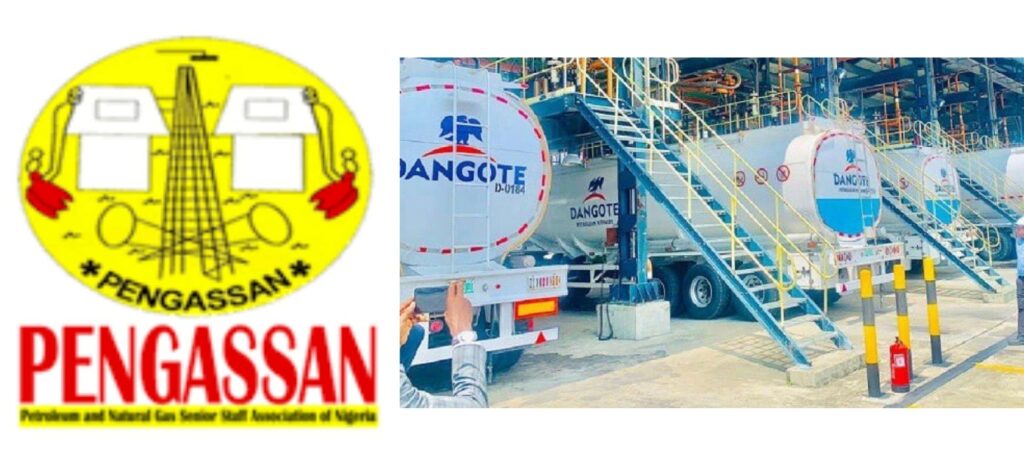
There are concerns that the controversy between the Petroleum and Natural Gas Senior Staff Association of Nigeria (PENGASSAN) and Dangote Petroleum Refinery may lead to Nigeria incurring a daily loss of about ₦14.7 billion.
Development economist Professor Ken Ife said Nigeria can’t afford to be losing such an amount daily due to the PENGASSAN strike, describing it as an economic haemorrhage.
PENGASSAN had, over the weekend, directed its members to down tools over the alleged sacking of 800 Nigerian workers by Dangote Refinery. The labour union claimed that the sack was because of the workers’ decision to unionise. PENGASSAN General Secretary Lumumba Okugbawa, in a statement, called for the reinstatement of the affected workers, arguing that the refinery violated Nigerian labour laws, the constitution and the International Labour Organisation (ILO) conventions.
However, Dangote Refinery responded, explaining that there is ongoing reorganisation in the company in response to repeated acts of sabotage and that only a “small number of Nigerians” were affected. The $20 billion refinery countered claims by PENGASSAN that it is recruiting about 2,000 Indians to replace sacked Nigerian workers. It also affirmed that not less than 3,000 Nigerians are currently working in the company and there are ongoing recruitment programmes for new intakes.
In a statement on Sunday, Dangote accused PENGASSAN of resorting to illegality and deploying bullying tactics against not just the refinery but Nigerians generally. It said the organised labour’s action is criminal and amounts to economic sabotage, warning that shutting crude oil and gas supplies to the refinery could plunge Nigerians into fresh rounds of fuel scarcity while causing huge revenue losses to the government.
READ ALSO: Dangote Refinery: PENGASSAN, NUPENG Actions Threaten National Security – Expert
It highlighted PENGASSAN’s past activities and the negative impact on investments in the oil and gas industry, such as acting in collaboration with the Nigeria Union of Petroleum and Natural Gas Workers (NUPENG), to block the sale of Port Harcourt and Kaduna refineries to Blue Star Consortium, led by the Dangote Group, for $750 million in 2007.
“It is now obvious to everyone that the FGN’s decision at the time was the right one and that PENGASSAN and NUPENG ignominiously wrote their names on the wrong pages of history,” the Dangote Group stated.
It also criticised PENGASSAN for affirming that petrol production had commenced at the Port Harcourt Refinery after the NNPCL announced it had resumed operations late last year but later turned out to be false as the plant went moribund again.
PENGASSAN shut down the Dangote Refinery and fertiliser plants on Sunday, while its members embarked on a nationwide strike on Monday morning. They barricaded the premises of the Nigerian National Petroleum Company Limited (NNPCL), the Nigerian Midstream and Downstream Petroleum Regulatory Authority (NMDPRA), and the Nigerian Upstream Petroleum Regulatory Commission (NUPRC) in Abuja on Monday, singing solidarity songs.
Professor Ife, who appeared on Channels Television’s Morning Brief on Monday, said the association cannot because 800 workers hold over 230 million Nigerians to ransom by denying them access to basic needs by disrupting the supply of crude oil and gas.
“You don’t bring the whole country to their knees; you don’t equate 800 workers to 230 million Nigerians; you don’t equate 800 workers to 42 million employers or allow the country to bleed N14.5 billion every day,” Ife stated.
He urged the unions to go and buy the government-owned refineries and manage them.
READ ALSO: Dangote Refinery: PENGASSAN, NUPENG Actions Threaten National Security – Expert
Nigeria recorded 1.63 million barrels per day of crude oil production in August. Data contained in a report submitted by the Nigerian Midstream and Downstream Petroleum Regulatory Authority (NMDPRA) to the Federal Account Allocation Committee (FAAC) in July showed that an estimated average of 17 million litres of fuel was supplied into the Nigerian market from Dangote Refinery. This amounts to N14.7 billion when multiplied by an average price of N865 per litre of petrol.
Energy expert Professor Wumi Iledare affirmed that the PENGASSAN strike could have a significant disruption of the economy.
Iledare, an emeritus professor of energy studies at Louisiana State University, said the union is holding the entire nation to ransom, by grounding activities in the oil and gas sector.
He pointed out that there are issues with the implementation of the Petroleum Industry Act (PIA) that PENGASSAN has, over the years, failed to fight. According to him, one of the contentious issues that needs to be addressed in the PIA is the lack of a board of directors in the upstream and downstream regulators. He said it is the board that is supposed to address any issue arising from actions that Dangote is taking that could have an impact on the petroleum downstream sector.
“They should be contesting the governance of the sector that is inefficient, ineffective, unethical and inequitable instead of crucifying the Dangote Refinery complex,” Iledare stated.
He dismissed claims that the Dangote Refinery is becoming a monopoly, stressing that it’s a strategic national asset that is contributing to boosting energy security in the country.
“The strike they are causing will create a big shock to the economy that will take a long time to recover from. It is even PENGASSSAN and NUPENG that are bringing Nigerians to their knees with respect to the downstream petroleum sector. They will not allow the sector to be reformed over many years. Dangote is now there to create a new era.”
While noting that it is the right of the labour unions to demand and protect the rights of workers who are their members, Iledare warned that they should exercise caution in doing so to avoid plunging the entire country into economic crisis.
He called for the use of dialogue in addressing the contentious issues.
Also, Dr Taofiq Raimi, President/CEO of Rotavalue Consultants, called on the government to do a holistic review of all the issues at stake and bring the warring parties to a meeting to resolve the matter.
Raimi said the country cannot afford to have a reverse in the gains already made through the declining inflation rate in the past five months by another rise in the cost of food and transportation, among other things, as a result of fuel scarcity that will be created by the PENGASSAN strike.
Also, commenting on the dispute, a financial analyst, Kalu Aja, queried the rationale behind a labour union shutting down crude oil and gas supply to a big refinery that makes a significant contribution to a country’s economy.
He called on the Nigerian government to intervene and stop the economic carnage, warning that it poses a huge threat to the quest of achieving a $1 trillion GDP by 2030.
“We play in this nation. A union will shut off crude oil valves? Think about that for a moment. What powers give a union the right to shut off crude oil pipes? For whatever reason? The government that wants to achieve a $1 trillion GDP should act now,” he stated via his X handle.
“Go abroad to any functional democracy or non-democratic nation and tell the government you will shut off the largest functional refinery in the country for any reason. This is precisely why I said these unions have held Nigerians to ransom,” he added.
READ ALSO: Dangote Refinery Aborts Plans, Resumes Fuel Sale in Naira to Marketers
The development has elicited mixed reactions across the country. While some accused the labour unions of taking the matter too far, others criticised the Dangote Group of high-handedness against its workers.
The development has set the internet on fire. A former lawmaker, Senator Shehu Sani, said, “Dangote took his risk and built his refinery. He wants it to operate without disruptions. He wants to have total control. He doesn’t want unionism. He doesn’t want what happened to the government-owned refineries to happen to his own. The workers want to unionise to protect themselves from what they fear would be ‘slavery’. That’s the clash.”
“Nigeria’s state-owned refineries collapsed partly due to union power struggles, corruption, and inefficiency. Dangote doesn’t want that repeated. Fear of Strikes vs Fear of Exploitation”, a public commentator, Ahmadu Yahuza, stated.
However, another X user, Maxwell Timi, believes that government-owned refineries were not wrecked by union activities but by corruption.
“There’s nothing wrong in privately or publicly owned businesses having unions. Even banks that are privately owned allow staff to belong to various unions. Unions are to protect workers’ interests only. Government-owned refineries were not destroyed by unions but by corruption!”
“The truth is, once employees are allowed to unionise, the PEGANSSAN hierarchy automatically becomes co-owner of the company. They then indirectly control the owners with regular demands to avoid union revolt. This is how unions have been wrecking every corporation in the country,” another X user identified as Schrodinger wrote.
“This is a classic case of conflicting interests, but absolute control without room for workers’ voices can backfire. While Dangote’s fears about inefficiency are valid, shutting out unions entirely risks creating an exploitative environment. The solution should be balanced to allow fair union representation while ensuring operations stay efficient and free from sabotage,” Paul Udeozor stated.

Victor Ezeja is a passionate journalist, scholar and analyst of socioeconomic issues in Nigeria and Africa. He is skilled in energy reporting, business and economy, and holds a master's degree in mass communication.