
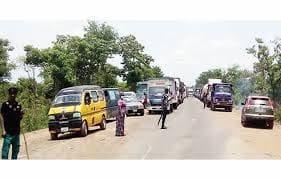
Traders and motorists commuting along the Aba–Ikot Ekpene highway have raised serious concerns over what they describe as widespread extortion by security agencies and local toll collectors operating numerous checkpoints along the route.
A once-smooth interstate drive between Akwa Ibom and Abia states has reportedly become a nightmare for drivers and passengers, especially traders who depend on the corridor for daily business activities.
According to findings, no fewer than 20 checkpoints are currently mounted along the short stretch from Ikot Ekpene, Essien Udim Local Government Area (LGA), to Opobo Junction, which borders Aba North LGA in Abia State.
At each of these stops, security personnel—including armed soldiers, policemen, and operatives of the National Drug Law Enforcement Agency (NDLEA)—alongside local toll collectors, allegedly extort money from drivers.
READ ALSO: Nigerians Quit Jobs Over Soaring Transport, Inflation
A 45-minute journey now takes hours
Emmanuel Etim, a trader specialising in secondhand clothes at Ibom Plaza, Uyo, lamented the economic impact of the extortion.
“Ordinarily, the trip from Uyo to Aba should take just about 45 minutes. But because of the constant stoppages at these checkpoints, we now spend several hours on the road. The bribes and tolls collected are passed on to us as passengers,” said Etim, who hails from Nsit Atai LGA.
He added that a significant portion of his profit margin is swallowed by these illegal fees, as drivers increase fares to cover their costs at the checkpoints.

Drivers Pay between ₦3,000 and ₦5,000 Per Trip
Commercial drivers operating on the route say the extortion has become institutionalised.
“We pay between ₦200 and ₦500 at each checkpoint, and there are at least 20 of them. If you’re driving a truck or carrying goods, they charge as high as ₦1,000 or more depending on your cargo,” said Agumba, a commercial bus operator.
“On average, we spend ₦3,000 to ₦5,000 just to get from Ikot Ekpene to Aba. If not for these checkpoints, the drive is barely 20 minutes.”
According to Agumba, most drivers are already familiar with the routine. At each stop, officers extend their hands, and drivers respond by slipping in the ‘usual’ fee. Speed bumps have been strategically installed at some locations to prevent motorists from avoiding the extortion points.
READ ALSO: Nigerians Quit Jobs Over Soaring Transport, Inflation
Illegal Levies Inflating Cost of Goods
Traders say the illicit tolls are also contributing to rising prices of goods, particularly items transported from major commercial hubs like Lagos, Onitsha and Aba. The impact is more noticeable on livestock and meat products entering Akwa Ibom from the North.
At Itam International Market in Itu LGA, traders confirmed that while prices of food staples such as garri, rice, beans, potatoes, and onions have dropped in recent weeks, the cost of beef, goat meat, pork, and dog meat remains significantly high.
Livestock Traders Cry Out
Adamu Illiasu, a cattle dealer at the Nasarawa Livestock Market in Itam, said the illegal checkpoints are the biggest barrier to stable meat prices in Akwa Ibom.
“We pay too many tolls transporting animals from the North to the South. The most painful part is the illegal levies between Aba and Ikot Ekpene. It’s hurting our business badly,” Illiasu explained.
Another livestock dealer, Abubakar Isa, based at the Hausa/Fulani settlement along Eka Street in Uyo, shared similar sentiments.
“We’ve lost most of our private customers, except for politicians, because we now have to pass the cost of these multiple taxes to buyers just to stay afloat.”
READ ALSO: Tinubu Govt Taxing Citizens Who Cannot Breathe Anymore – Peter Obi
Calls for Government Intervention
A senior member of the Hausa/Fulani community in Uyo, who spoke on condition of anonymity, criticised what he described as government inaction.
“We were hopeful when the Nigerian Governors’ Forum (NGF) announced that checkpoints on state highways would be dismantled to allow free movement of essential goods. But nothing has changed, especially in the South. Uniformed officers are still extorting drivers daily.”
He called on both state and federal governments to act swiftly, stressing that the socio-economic pressure on low-income Nigerians is becoming unbearable.
Background
Earlier in the year, the NGF, in a bid to stabilise food prices and ease inflation, directed member states to eliminate illegal checkpoints and multiple taxation that hinder movement of goods across Nigeria. Despite these directives, enforcement remains a challenge.
Economic analysts have repeatedly warned that the persistence of these roadblocks, particularly in key commercial corridors, will continue to drive up the cost of living, erode trader profits, and hamper Nigeria’s efforts to recover from current economic shocks.