Nigeria’s push into digital finance is under scrutiny as doubts grow about the credibility of the country’s flagship stablecoin, the cNGN.
Promoted as Africa’s gateway to global crypto adoption, the project now faces tough questions about reserves, adoption, and sovereignty.
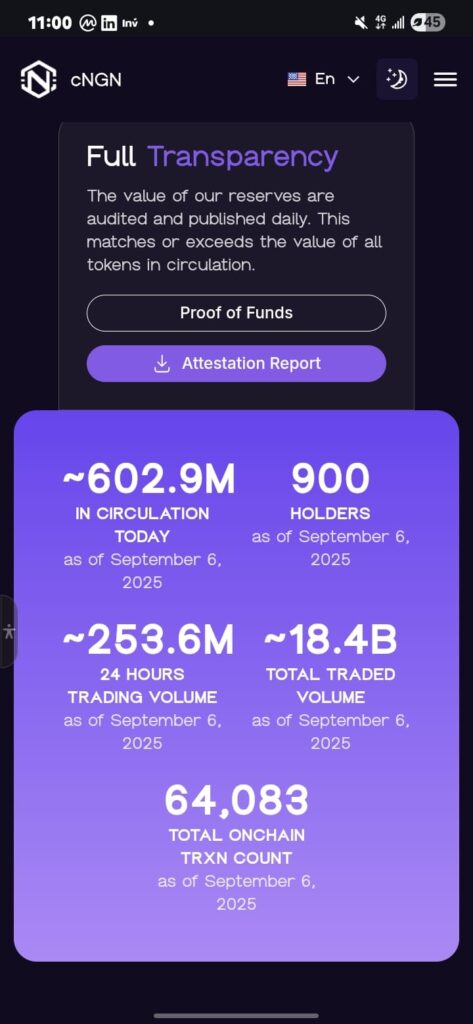
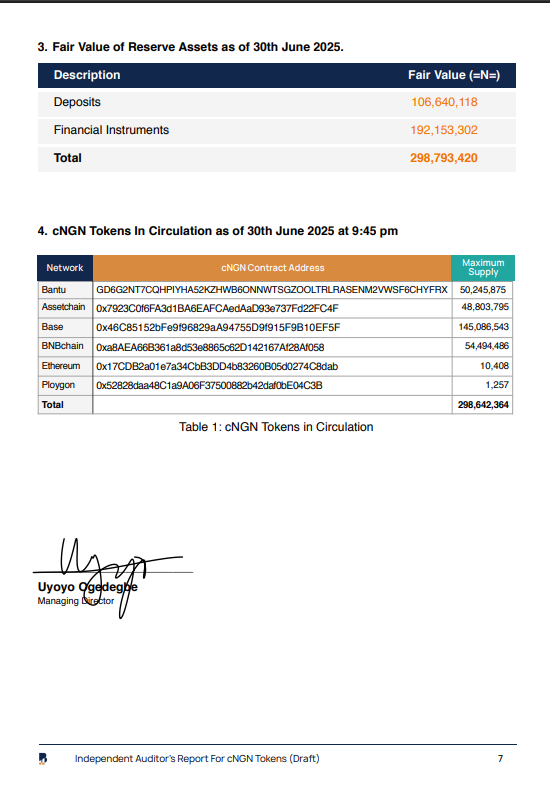
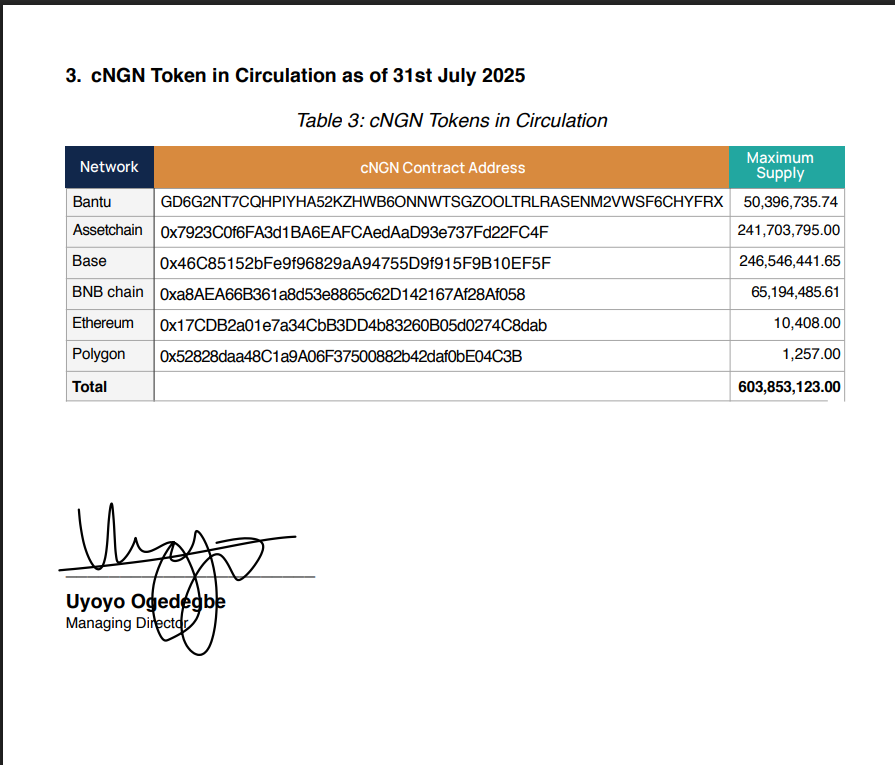
cNGN’s last attested report showed about 298 million tokens in circulation as of June. By August, supply had jumped to 603 million, yet no fresh verification confirmed those reserves. Analysts say such gaps weaken trust in the project.
“Without continuous and independently verified attestations, the public cannot know if these tokens are truly backed by naira reserves,” a Lagos-based fintech analyst, Bola Tunji, told Pinnacle Daily. “This kind of opacity has collapsed other global projects.”
Pinnacle Daily found that questions over transparency remain unresolved. Transparency in stablecoin design is not just about publishing numbers; it requires timely, consistent, and verifiable reporting.
Looking at recent cNGN attestations, June 2025 showed ₦298M in reserves. By July 2025 this had jumped to ₦603M, almost ₦300M in new inflows within a single month.
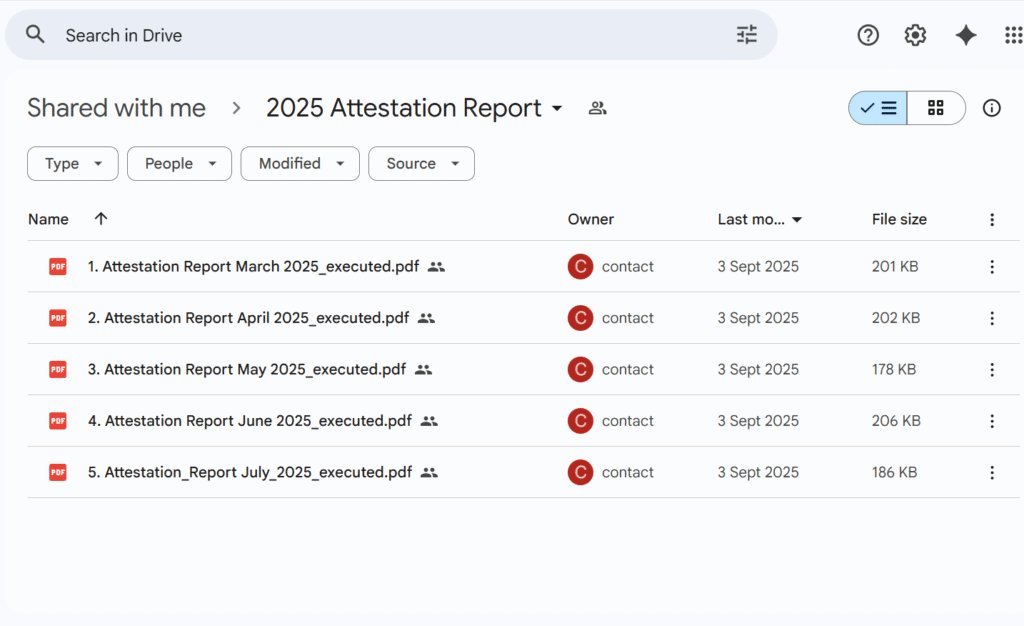
However, the July report was uploaded only on September 3rd, 2025, the same day their website updated to reflect the ₦603M figure. Through August, balances stayed flat and even showed a margin shortfall despite the supposed July inflow surge.
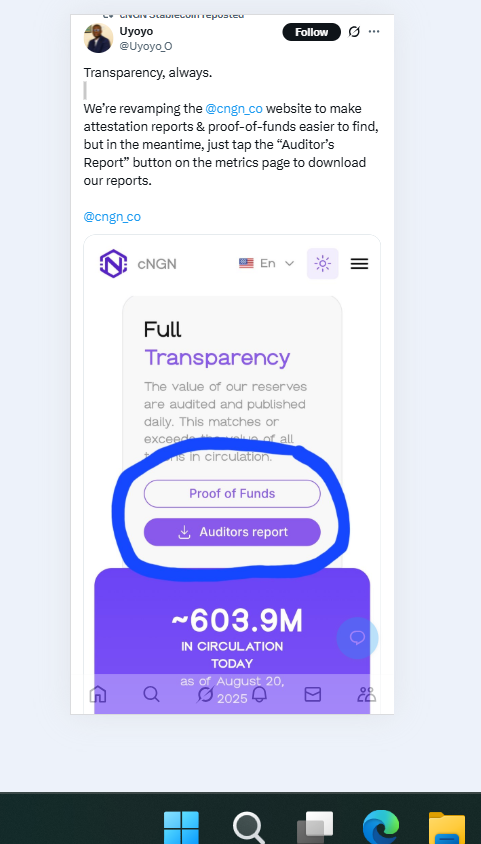
The fundamental question raised by Nigerians is this: are we seeing real progression, regression, or simply numbers being synchronised after the fact?
Nigerians argue that for stablecoins, delayed uploads and sudden jumps erode confidence. Attestations should be living proofs of reserve health, not retroactive add-ons. If the claim is transparency, then reporting must be both timely and independently verifiable. Because in this space, the real risk is not volatility; it is opacity.
Promoters highlight Nigeria’s high global ranking in crypto adoption, citing Chainalysis and CoinGecko data. But experts warn that rankings do not equal real market share in the $160 billion stablecoin sector, where USDT (Tether) and USDC (Circle) dominate.
“Most of Nigeria’s crypto activity is retail-driven small, peer-to-peer transactions for hedging inflation or sending money home,” said a blockchain researcher at the University of Ibadan. “On that front, cNGN has not proved its relevance.”
Speaking exclusively to Pinnacle Daily, Olayimika Oyebanji, a DeFi researcher and blockchain lawyer, said cNGN suffers from reserve opacity.
“One critical loophole is the lack of reserve transparency. Stablecoin markets run on trust. Gaps in attestation reports cast doubt on credibility.”
He recalled that in April 2025, two African-focused exchanges, YellowCard and Roku, refused to list cNGN, citing weak capital backing and unclear reserves. He also questioned cNGN’s “store-of-value” promise, pointing to inflation, currency volatility, and the naira’s steady decline.
READ ALSO: Solana Surges to $237, Tops BNB for Fifth Crypto Spot
For Oye Shobowale-Benson, a public servant and sovereign blockchain architect, the risk goes beyond finance.
“The cNGN is not just another fintech project; it is a test of Nigeria’s sovereignty in digital finance. Running it on Ethereum, a foreign blockchain, sets a dangerous precedent.”
He criticised oversight lapses. The SEC promotes cNGN as if it were a security, while the CBN, which controls monetary policy, has been sidelined.
Shobowale-Benson also warned that every naira shifted into cNGN drains liquidity from banks, weakens lending, and undermines policy.
“On all five IMF fundamentals of payment safety, efficiency, resilience, accessibility, and trust, cNGN falls short,” he said.
Tinubu’s Directive and the Regulatory Shift
President Bola Tinubu, speaking through Finance Minister Wale Edun at the 18th Annual Banking and Finance Conference in Abuja, directed regulators to monitor the rise of stablecoins and digital currencies. He warned that the shift away from traditional banking brings new risks.
Meanwhile, the Senate’s Capital Market Committee is working with the Stakeholders in Blockchain Association of Nigeria (SiBAN) on a legal framework for cryptocurrency exchanges. The Investment and Securities Act 2025 also classifies digital assets as securities, giving the SEC power to license and supervise exchanges and custodians.
Shobowale-Benson welcomed Tinubu’s move as “a drip better than a drought” but insisted Nigeria must build sovereign digital rails, not just track transactions.
Others remain sceptical. Oluwafemi O., a fintech entrepreneur, dismissed government claims that the CBN could track every crypto transaction.
“Even the U.S. cannot track all crypto flows. Cryptocurrencies are everywhere and hard to trace. With this traditional mindset, the government will run into a brick wall.”
ALSO READ: Tinubu urges CBN to track all cryptocurrency transactions.
Unlike the Central Bank’s eNaira, cNGN is privately managed but regulated. It promises cheaper blockchain transactions, faster remittances, and integration across blockchains such as Ethereum, Bantu, Binance, Polygon, and TRON. Unlike the state-issued eNaira, it is privately managed.
Yet analysts warn that without verified reserves, stronger transparency, and clear sovereignty safeguards, cNGN risks becoming a hyped experiment with little global impact.
In pursuit of balance, Pinnacle Daily contacted cNGN for two weeks for comment on reserve transparency, governance, and adoption concerns. The company did not respond.
As Shobowale-Benson summed up: “Silence is not transparency. Blocking critics is not governance. If Nigeria wants to lead Africa in digital finance, cNGN must show reserves, define liability, and align with national interests.”

Esther Ososanya is an investigative journalist with Pinnacle Daily, reporting across health, business, environment, metro, Fct and crime. Known for her bold, empathetic storytelling, she uncovers hidden truths, challenges broken systems, and gives voice to overlooked Nigerians. Her work drives national conversations and demands accountability one powerful story at a time.